Qvidian vs Inventive AI (2026): Content Library vs AI Agents

Last reviewed: July 2026. The facts below are drawn from Upland's and Inventive AI's own product materials, verified G2 and Capterra reviews, third-party pricing analyses, and named customer case studies. Ratings, prices and feature packaging move quickly in this category — treat every figure here as a starting point and confirm the current specifics with each vendor before you sign.
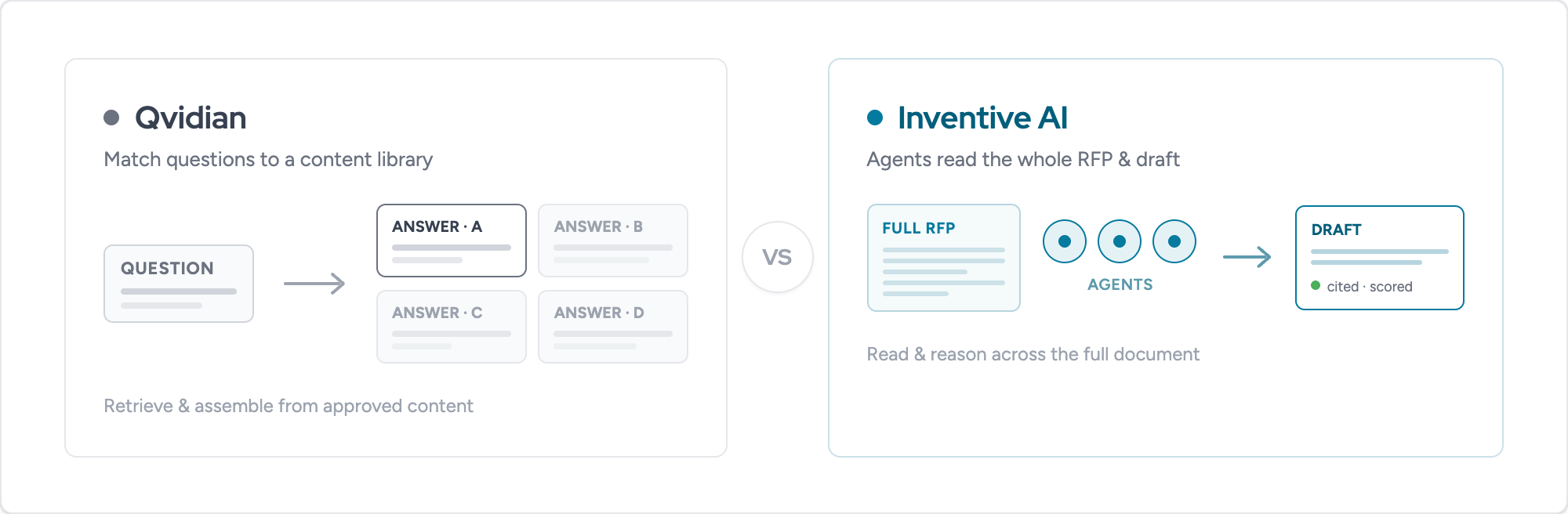
Qvidian vs Inventive AI comparison — content-library matching versus AI agents reading a full RFP
TL;DR — Qvidian (now Upland Qvidian) fits enterprise and regulated teams that want a governed content library, Microsoft Office–native authoring, and predictable, template-driven reuse. Inventive AI fits teams that want AI agents to read the whole RFP, draft from knowledge they already store elsewhere, and flag conflicts automatically. The honest verdict depends on one question: do you want a library you maintain and search, or an agent that drafts and self-checks? If you lean toward the latter, Inventive AI is built AI-native for exactly that workflow.
You typed "Qvidian vs Inventive AI" because you want a straight comparison, not a pitch. This guide breaks both platforms down the way a buyer actually evaluates them — architecture, response quality, content governance, integrations, security and price — using verified reviews and real vendor materials. Where a claim can't be verified, it's flagged as such.
One thing to set up front, because it shapes everything else: these two tools were built on different assumptions. Qvidian is a mature, content-library platform with AI layered on; Inventive AI is an agent-native platform designed around finishing the response, not maintaining a library. Neither assumption is "wrong" — they suit different teams. We'll keep Qvidian's genuine strengths in view throughout, and we'll say plainly where each one is the better fit.
What Is the Real Difference Between Qvidian and Inventive AI?
Qvidian answers RFPs by matching incoming questions to pre-approved content in a centralized library and assembling it with its AutoFill feature and structured templates. Inventive AI runs a set of AI agents that read the full RFP and its attachments, draft responses from connected knowledge sources, validate them, and flag what needs a human decision.
That is the whole comparison in one sentence: retrieve-and-assemble versus read-and-reason. Qvidian's model rewards clean, well-governed content and gives compliance-minded teams tight control over approved language. Inventive AI's model reduces the library-maintenance burden and aims to catch cross-document problems automatically, at the cost of being a newer entrant with a shorter public track record. The rest of this page is about which trade-off fits your team.
For a structured way to score the whole category rather than just these two, see the RFP software comparison guide.
Qvidian vs Inventive AI at a Glance

| Dimension | Qvidian (Upland Qvidian) | Inventive AI |
|---|---|---|
| Best for | Enterprise & regulated teams wanting a governed content library and Office-native authoring | Mid-market & enterprise teams wanting AI-native, agent-driven RFP/DDQ/security-questionnaire responses |
| Core architecture | Content library + AutoFill template matching; AI as an add-on | Multi-agent, AI-native reasoning across the full RFP + connected sources |
| AI drafting | Qvidian AI Assist (rewrites/personalizes library content; paid add-on) | Autonomous agents draft with source citations and a confidence score |
| Conflict detection | Typically manual review across sections | Content Governance Agent flags conflicts, duplicates and outdated content automatically |
| Content model | Maintained content library; SME licenses to update | Knowledge Hub connects existing systems and live-syncs; no separate repository to maintain |
| Integrations | Salesforce, Microsoft Office 365 (Word/Excel/PPT/SharePoint/Teams) | SharePoint, Google Drive, Salesforce, Confluence, Notion, Zendesk, Okta, HubSpot (Gong coming) |
| Security | Enterprise controls; strong install base in financial services & insurance | SOC 2 Type II; customer data never used to train public models |
| G2 rating | 4.3 / 5 (~150 reviews) | Newer entrant — confirm the current listing |
| Pricing | Quote-only; third-party estimates ~$15K–$25K base, $25K–$80K+ all-in | Starting at $830 per month, billed annually; no per-seat cost. |
| Implementation | Reported 3–6 months; steep learning curve | Guided setup measured in days per vendor |
Figures are reported at time of writing from vendor materials, verified reviews and third-party analyses; confirm current specifics with each vendor.
Qvidian vs Inventive AI: Feature-by-Feature Comparison
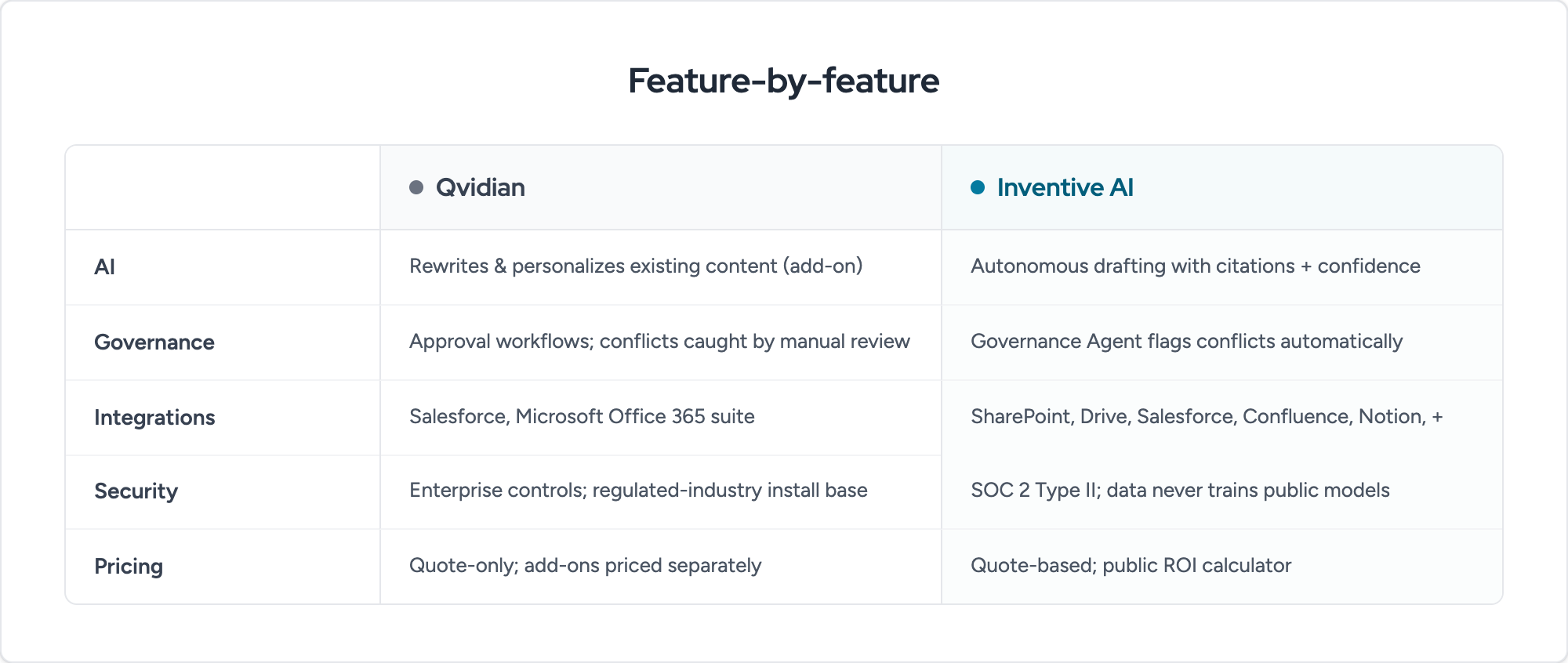
| Evaluation dimension | Qvidian (Upland Qvidian) | Inventive AI |
|---|---|---|
| Response approach | Matches questions to stored answers via AutoFill; assembles from templates | Agents read the full document and draft contextual responses, then validate them |
| AI capabilities | AI Assist adjusts tone/length/voice of existing content; flags AI-generated text | Autonomous drafting, Context Engine personalization, Competitive Intelligence and Go/No-Go agents |
| Response quality | Consistent when the library is clean; cross-section contradictions caught by manual review | RAD AI reports 2× more client-ready answers than the next-best tool tested; vendor cites ~66% of responses needing no edits |
| Content governance | Approval workflows + SME-maintained library | Content Governance Agent surfaces conflicts, duplicates and stale content without manual sweeps |
| Hallucination control | AI Assist flags generated content for review | Every answer ships with citations and a confidence score; flags "information unavailable" rather than guessing |
| Knowledge management | Centralized repository you build and maintain | Connects to knowledge already in SharePoint, Drive, Salesforce, Confluence, Notion, etc.; live-syncs on source change |
| Format flexibility | Word, Excel, PowerPoint via Office integration | Excel grids and narrative-prose proposals |
| Collaboration & workflow | Multi-step reviewer workflows; project tracking | Question/section assignments, reviewer workflows; approved answers feed back to the Knowledge Hub |
| Integrations | Salesforce, Microsoft Office 365 suite | SharePoint, Google Drive, Salesforce, Confluence, Notion, Zendesk, Okta, HubSpot |
| Security & compliance | Enterprise-grade; used in regulated industries | SOC 2 Type II; data never trains public models |
| Pricing transparency | Quote-only; AI and services priced separately | Quote-based; public ROI calculator |
| Best-fit buyer | Teams prioritizing library control and Office-native authoring | Teams prioritizing AI-native drafting with governance built in |
Cells reflect vendor materials and verified reviews at time of writing. Test each capability against your own edge-case questions in a demo before deciding.
Qvidian (Best for governed content libraries and Office-native teams)
Qvidian rebranded Upland Qvidian after Upland Software acquired it — is a long-established proposal and RFP automation platform. Reviewers position it as a dependable, enterprise-grade content-library system, with a particularly strong install base in financial services, insurance and other regulated industries where approved language and audit trails matter. If your team already runs a structured question-and-answer process and wants to author inside Word and Excel, Qvidian is squarely in its lane.
Qvidian best features
• Powerful content search and AutoFill — reviewers repeatedly praise how quickly the library surfaces reusable answers; one Capterra reviewer says "if you can use google, you can use Qvidian."
• Governed content library — approval workflows and structured templates keep approved language consistent across submissions.
• Microsoft Office 365 depth — work on Qvidian projects directly in Word, Excel, PowerPoint, SharePoint and Teams.
• Salesforce integration — create and update Qvidian "Projects" from within the CRM to keep deal data synced.
• AI Assist — a generative-AI add-on (launched 2024) that rewrites and personalizes existing library content for tone, length and voice, and flags AI-generated text.
• Multi-step reviewer workflows and analytics — automate approvals and track content performance.
See how an agent-native workflow differs from library matching — Insider moved its win rate from 30% to 50% and cut response time 90% after switching to Inventive AI.
Qvidian limitations
• Dated user interface. G2 and Capterra reviewers describe the UI as less modern than newer tools, which can slow onboarding. Teams weighing this often review the field of Qvidian competitors and alternatives before committing.
• Steep learning curve and long implementation. Third-party analyses report a 3–6 month rollout and meaningful admin overhead.
• Ongoing library maintenance. Reviewers cite time spent on content upkeep and duplicate resolution; a mid-market proposal writer notes problems with "library maintenance and how slow the software is" (per G2, via third-party summary).
• Retrieval, not full-document reasoning. AutoFill matches questions to stored content rather than reasoning across the entire RFP, so complex or novel questions still need manual drafting.
• AI is a paid add-on. AI Assist and advanced automation sit outside the base tier, which raises effective cost.
• Support concerns post-acquisition. Several reviews report that support responsiveness declined after the Upland acquisition (confirm against current reviews).
• Quote-only pricing. No public pricing; procurement teams report longer evaluation cycles as a result.
Qvidian pricing
Qvidian does not publish pricing — it's quote-only, sold through Upland Software. Third-party analyses estimate a base license around $15,000–$25,000 per year, with broader enterprise contracts reaching $25,000–$80,000+ once you add users, AI Assist, integrations and professional services; content administration can add a further 0.5–1 FTE of internal cost. Treat these as external estimates, not vendor-confirmed figures — see the detailed Qvidian pricing, features and reviews breakdown and confirm your own quote with Upland and via Vendr.
Qvidian ratings and reviews
• G2: 4.3 / 5 across roughly 150 reviews — confirm on the live G2 listing.
• Capterra: 4.4 / 5 across roughly 41 reviews — confirm on Capterra.
• TrustRadius and Gartner Peer Insights: both carry Qvidian listings; check the current scores directly on TrustRadius and Gartner before quoting them.
What are real users saying about Qvidian?
"The search feature is very intuitive. If you can use google, you can use Qvidian to find anything." — verified reviewer, Capterra
Mixed: reviewers report that the interface feels dated and that keeping the content library clean is time-consuming, especially at scale — per G2 and Capterra reviews.
Inventive AI (Best for AI-native drafting with governance built in)
Inventive AI is an autonomous, AI-agentic platform for RFPs, RFIs, DDQs and security questionnaires, with humans kept in the loop for approvals. Rather than asking a team to maintain a content library and search it, Inventive triggers a set of agents that understand the request, pull from knowledge the company already stores, draft the response, and flag only what needs human judgment. It's aimed at proposal, presales, sales-engineering, revenue and InfoSec teams in the mid-market and enterprise.
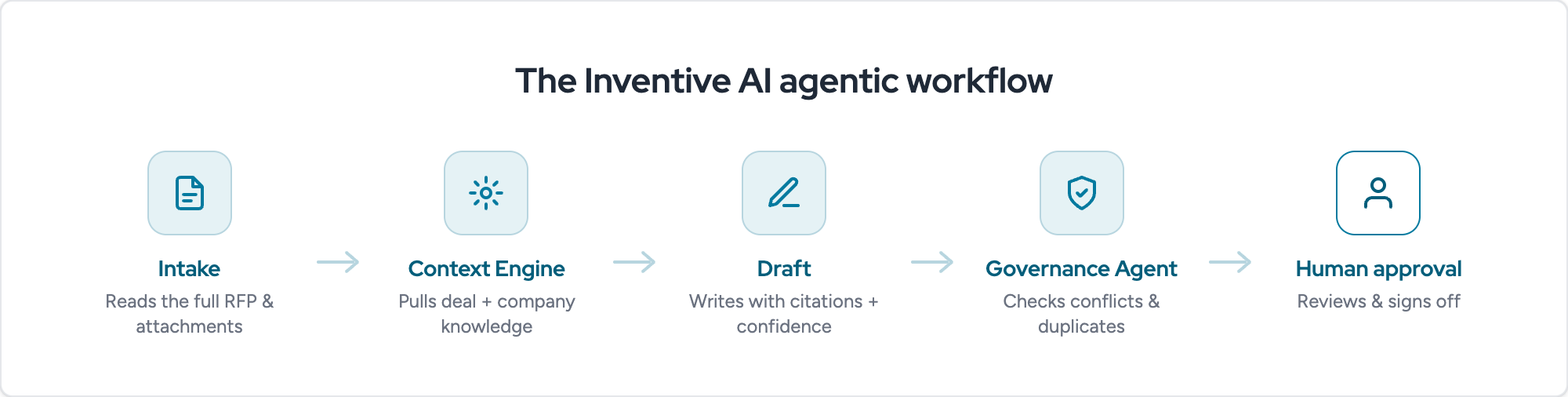
Key capabilities of Inventive AI:
• Autonomous agents run the whole process — not just drafting: understanding the RFP, finding the right information, drafting, flagging gaps and validating.
• Context Engine — combines company knowledge with the specific customer, deal and sales context so answers are tailored per opportunity rather than reused verbatim.
• Content Governance Agent — automatically detects conflicting answers, flags outdated content and surfaces duplicates, replacing manual library sweeps.
• Hallucination control — every response ships with source citations and a confidence score, and the system flags "information unavailable" instead of guessing.
• Knowledge Hub, not another repository — connects SharePoint, Google Drive, Salesforce, Confluence, Notion, Zendesk, Okta and HubSpot, and live-syncs when a source document changes.
• Full Response Analyzer, Go/No-Go and Competitive Intelligence agents — check the whole document for compliance and contradictions, qualify opportunities early, and sharpen positioning against named competitors.
• Format flexibility — handles Excel-grid questionnaires and narrative-prose proposals.
• On response quality, a customer benchmark from RAD AI reports 2× more client-ready answers than the next-best tool tested.
Best for: teams that would rather trigger and approve work than build and babysit a content library — and that want conflict detection and citations in the workflow, not as a later manual check.
Inventive AI pricing
Inventive AI uses volume-based pricing based on RFPs and security questionnaires, with unlimited users and no per-seat fees. Plans start at $830/month, billed annually. Buyers can use the Inventive ROI calculator to estimate potential savings. AssetWorks, for example, reported a 422% ROI from RFP automation with Inventive AI in its case study.
Weighing Qvidian's quote against an AI-native platform? MaxVal reports answering 80 RFP questions in 3 hours — work that used to take nearly a week. Book a demo to test it on your own questions.
Feature Deep Dives: How the Two Compare
AI Capabilities and Response Quality
The core split is retrieval versus reasoning. Qvidian's AI Assist improves existing library content — adjusting tone, length and voice — which is genuinely useful when your answers are already written and approved. Inventive AI's agents generate responses by reasoning across the full RFP and connected sources, then attach citations and a confidence score.
• Qvidian: dependable, consistent output when the library is well-maintained; novel or multi-part questions still lean on manual drafting.
• Inventive AI: built for first drafts on questions you haven't answered before; RAD AI, a named customer, reports 2× more accurate responses than other RFP AI tools. > Note: Both approaches depend on your source content being trustworthy. Whichever you pick, validate output against your hardest, most technical questions in a trial — averages hide the edge cases that lose deals.
Content Governance and Conflict Detection
This is where the architectures diverge most. Qvidian relies on approval workflows plus periodic human review to keep the library current and catch contradictions between sections. Inventive AI assigns that job to its Content Governance Agent.
• Qvidian: strong, auditable approval controls — a real advantage for compliance-heavy teams — but contradiction-catching is largely manual.
• Inventive AI: the governance agent flags conflicts, duplicates and outdated content automatically, and a Full Response Analyzer checks the whole document before submission. > Note: As MaxVal's Susan Krelitz put it, "even with AI, the old tools (Loopio, Responsive, Qvidian) still felt like Q&A pairs." If cross-document consistency is your pain point, weigh how Inventive approaches automated content governance directly.
Integrations
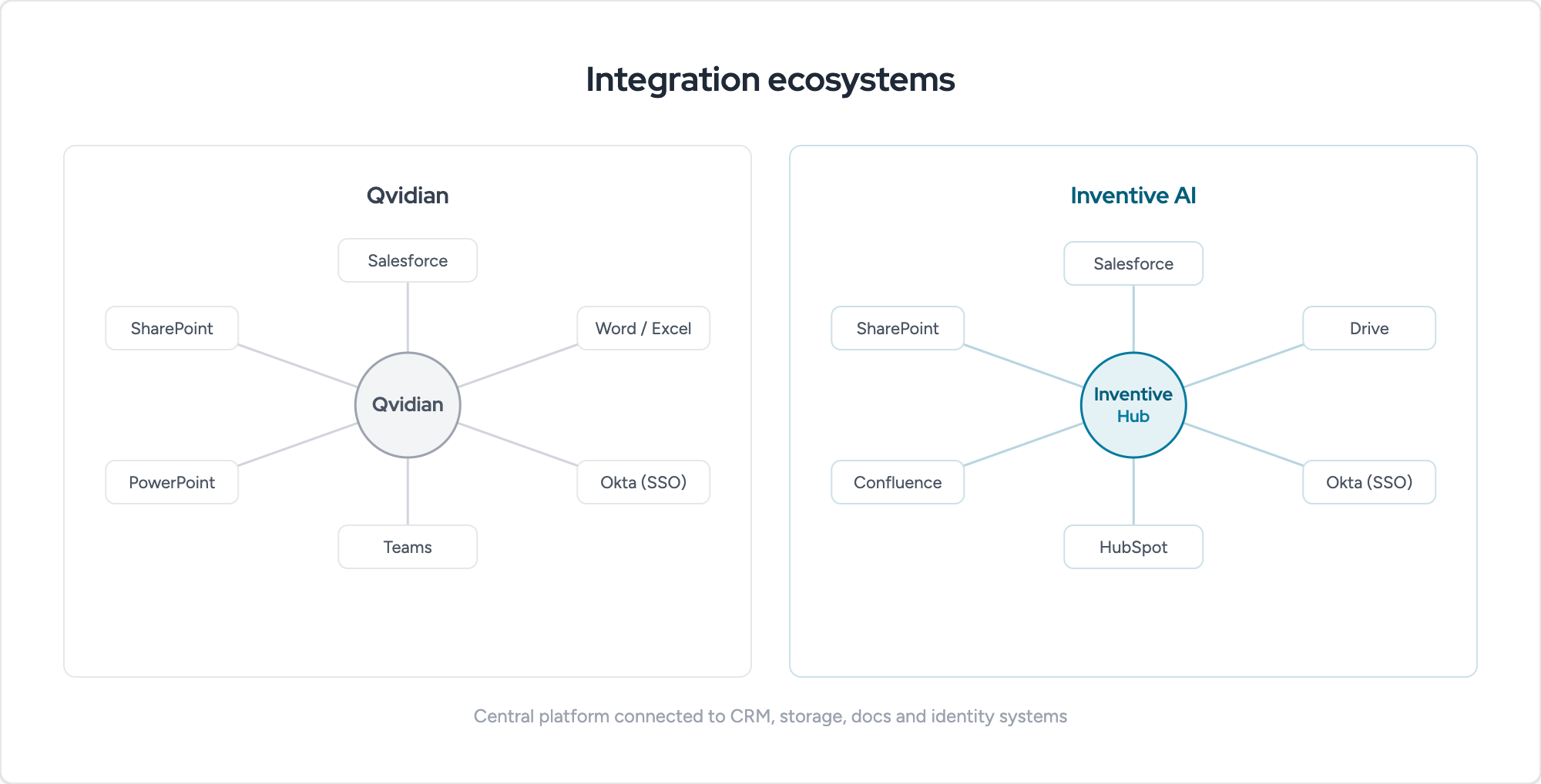
| Integration | Qvidian | Inventive AI |
|---|---|---|
| Salesforce | Yes | Yes |
| Microsoft SharePoint | Yes | Yes |
| Microsoft Office / Word / Excel | Yes (native authoring) | Export + Excel grids |
| Google Drive / Workspace | Limited | Yes |
| Confluence / Notion | Limited | Yes |
| Okta (SSO) | Enterprise SSO | Yes |
| HubSpot | Via workarounds | Yes |
Security and Compliance
Both target enterprise buyers. Qvidian carries the enterprise controls expected in financial services and insurance deployments. Inventive AI is SOC 2 Type II compliant and states that customer data is never used to train public models — see the Inventive security overview for specifics.
Note: For security-questionnaire workloads specifically, evaluate how each handles evidence citations and answer traceability — Inventive's security-questionnaire automation is built around cited, confidence-scored answers.
What Should You Consider When Choosing Between Qvidian and Inventive AI?
Weigh these against how your team actually responds today, not against a feature checklist:
• Architecture fit — do you want to maintain and search a library (Qvidian), or trigger agents that draft and self-check (Inventive AI)?
• Response quality on hard questions — test both on your most technical, non-boilerplate questions.
• Content governance — is contradiction-catching automated, or does it depend on manual review?
• Hallucination control — are answers cited and confidence-scored, or flagged only as "AI-generated"?
• Knowledge sources — will you build a new repository, or connect the systems you already use?
• Integrations — CRM, storage, docs and SSO your team actually runs.
• Security & compliance — SOC 2, SSO, data-handling and audit needs for your industry.
• Format needs — Excel-grid questionnaires, narrative proposals, or both.
• Total cost of ownership — license plus AI add-ons, implementation, and the headcount to administer content.
• Time to value — weeks or months until the team is productive.
• Track record vs. innovation pace — a long-established platform versus a fast-moving AI-native entrant.
For a weighted scoring framework across the whole market, use the enterprise RFP software comparison, and cross-check the shortlist against the best RFP software roundup.
Still deciding? HiBob's proposals lead has praised the pace of Inventive's platform improvements, and RAD AI calls the team "incredibly responsive." See the platform in a demo and judge it on your own RFPs.
Frequently Asked Questions
What is Qvidian used for?
Qvidian (Upland Qvidian) is used to automate RFP, RFI and proposal responses from a centralized, governed content library, with AutoFill matching questions to approved answers and native authoring inside Microsoft Office. It's most common in enterprise and regulated industries.
How much does Qvidian cost?
Qvidian is quote-only. Third-party analyses estimate roughly $15,000–$25,000 per year for a base license and $25,000–$80,000+ for broader enterprise contracts, with AI Assist, integrations and implementation priced separately. Confirm your specific quote with Upland.
Does Qvidian have AI?
Yes — Qvidian AI Assist, launched in 2024, is a generative-AI add-on that rewrites and personalizes existing library content and flags AI-generated text. It augments a content library rather than reasoning across the whole RFP the way an agent-native platform does.
Is Inventive AI a good alternative to Qvidian?
It's a common one for teams frustrated by library maintenance or manual conflict-checking. Inventive AI is positioned as an AI-native, agentic platform, and named customers report strong outcomes — Insider cites a 50% higher win rate and 90% faster responses. Whether it fits depends on your governance and integration needs; trial both.
Which is better for security questionnaires and DDQs?
Both handle them, but the approaches differ: Qvidian relies on library reuse, while Inventive AI drafts cited, confidence-scored answers and flags gaps. If evidence traceability matters, compare them on a real questionnaire — see the best AI agents for security questionnaires.
What are the best Qvidian alternatives?
Common alternatives include Responsive (formerly RFPIO), Loopio, RocketDocs and QorusDocs among library-based tools, plus AI-native platforms like Inventive AI. See the full field in Qvidian competitors and alternatives, or the head-to-head Qvidian vs Responsive comparison.
Related comparisons and resources
If you're still mapping the category, these go deeper on the topics this comparison touches:
• Qvidian pricing, features and reviews breakdown
• Qvidian competitors and alternatives
• Best enterprise RFP software comparison
• Loopio vs Inventive AI and Responsive vs Inventive AI
• AI RFP automation software and the RFP software comparison guide

.avif)