Conveyor vs Responsive: In-Depth RFP Tools Breakdown
Conveyor vs Responsive compared on AI, pricing, integrations, and reviews plus where AI-native platforms like Inventive fit for RFP and questionnaire teams.
Last reviewed: January 2026. This comparison draws on each vendor's published product pages, verified G2 and Capterra reviews, Responsive's TrustRadius listing, and independent third-party pricing data from Vendr, Proposify, and AutoRFP. Ratings, review counts, and quotes are accurate as of the review date. Both vendors revise pricing and features often, and most plans are quote-based — confirm the current numbers with Conveyor and Responsive directly before you buy.
TL;DR: Which One Fits Your Team?
Conveyor fits infosec and presales teams whose primary pain is inbound security questionnaires and who want a customer-facing Trust Center to deflect repeat requests. Responsive (formerly RFPIO) fits larger, cross-functional teams that run high volumes of RFPs, RFIs, and questionnaires and want a deep, governed content library with broad integrations. There is no universal winner, it depends on what your team needs: questionnaire deflection and a lean AI agent, or a mature response-management system with a big answer library. If you are weighing both, it is also worth understanding the newer AI-native RFP platforms now entering the same category.
What Should You Consider When Choosing Between Conveyor and Responsive?
The three criteria that most often decide this comparison are your primary use case (inbound security questionnaires vs. full RFP/RFI volume), how much editing the AI drafts need before they ship, and total cost at your real question volume. Score each tool against the checklist below, and turn the items into demo questions.
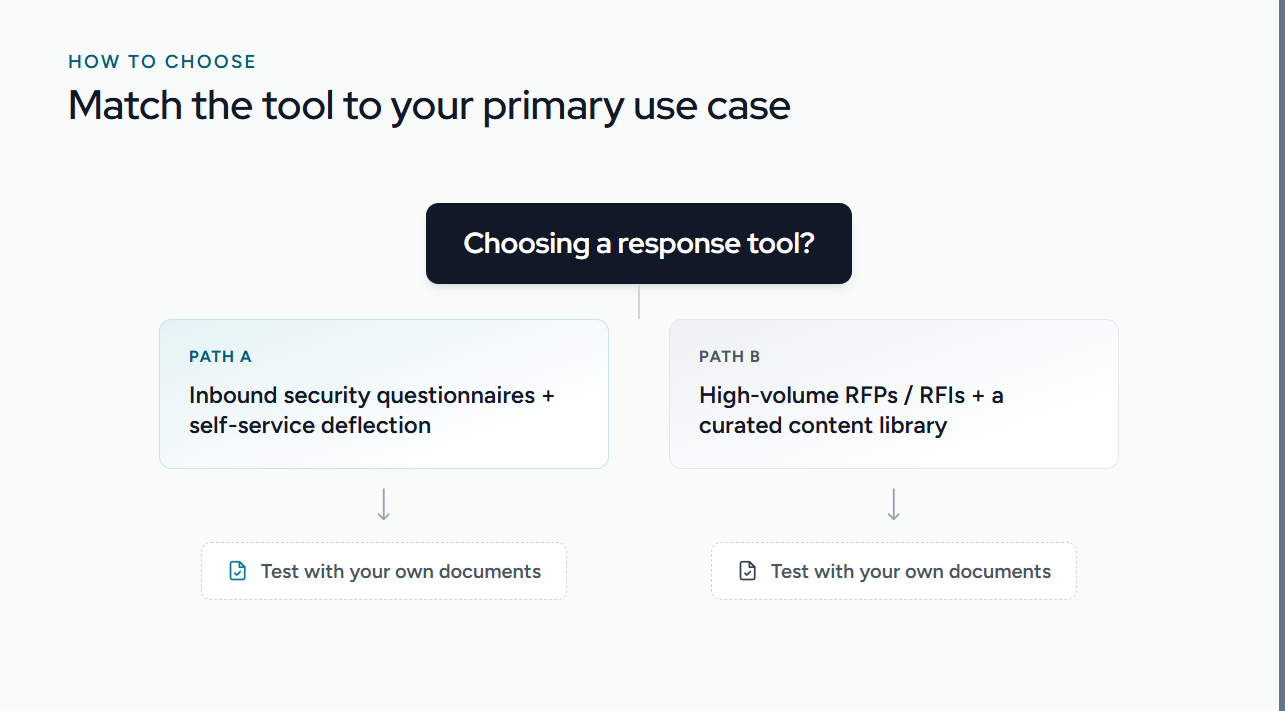
• Primary use case: Are you mostly answering inbound security questionnaires, or running full RFP/RFI proposals? Conveyor leans security; Responsive spans both.
• AI capabilities: How does the AI draft answers, and how much editing do responses need afterward?
• Response quality: Test edge-case questions in a trial. Count how many answers ship without a rewrite.
• Conflict detection: Does the tool flag contradictory or outdated answers, or is that a manual review job?
• Content management and governance: Who curates the library, and how do stale answers get caught?
• Trust Center / self-service: Can customers self-serve security docs to cut inbound volume? This is Conveyor's signature.
• Collaboration: How do SMEs contribute — in-app, or from Slack, Outlook, and Teams?
• Integrations: Confirm your CRM, storage, and SSO connect natively.
• Workflow automation: How much of intake, assignment, and drafting runs without a person babysitting it?
• Security and compliance: SOC 2, SSO, data-handling terms — verify in writing.
• Analytics: Can you see response times, win rates, and content usage?
• Pricing and total cost: Both are largely quote-based. Model the cost at your real volume, including AI add-ons and credit consumption. A roundup of the best RFP software can help you frame the total-cost questions to ask each vendor.
• Ease of implementation: How long until the first real response ships?
• Enterprise scalability: Will pricing and performance hold as your question volume grows?
Conveyor vs Responsive at a Glance
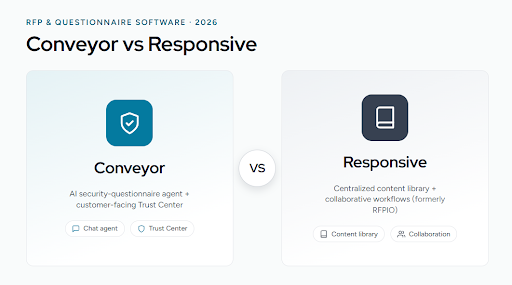
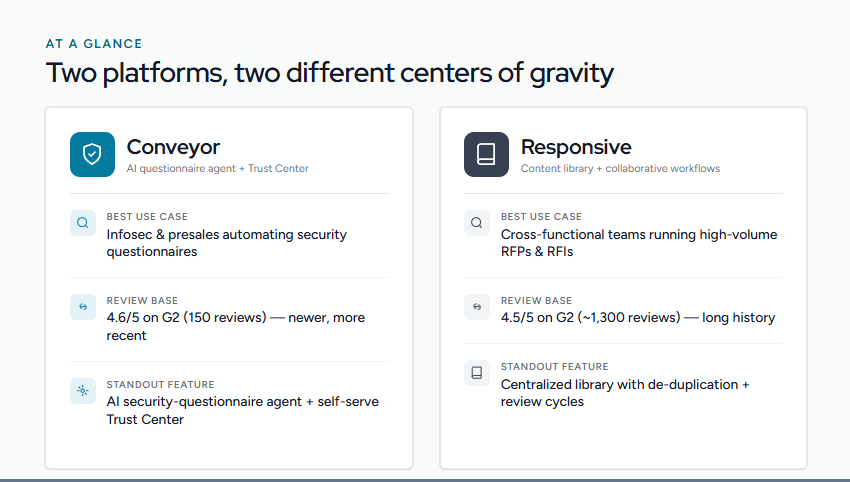
Conveyor is an AI-native platform built around a security-questionnaire agent and a customer-facing Trust Center. Responsive is an established enterprise response-management platform built around a large, curated content library and collaborative workflows.
| — | Conveyor | Responsive (formerly RFPIO) |
|---|---|---|
| Best for | Infosec/presales teams automating security questionnaires + Trust Center deflection | Cross-functional teams running high-volume RFPs, RFIs, and questionnaires |
| G2 rating | 4.6/5 (150 reviews) | 4.5/5 (~1,300 reviews) |
| Capterra rating | Listed, rating not shown at review date | 4.6/5 (159 reviews) |
| Review base | Newer, thinner, more recent | Long history across G2, Capterra, TrustRadius |
| Standout feature | AI security-questionnaire agent + Trust Center | Centralized content library with de-duplication + review cycles |
| Pricing model | Credit-based; Free + Professional tiers | Quote-based platform fee + components |
Figures reported at time of writing; confirm current ratings and pricing with each vendor.
Feature-by-Feature Comparison
This is the detail behind the summary. Values are sourced from vendor pages, G2, Capterra, TrustRadius, and third-party pricing data.
| Dimension | Conveyor | Responsive (formerly RFPIO) |
|---|---|---|
| Core focus | Security questionnaires, AI RFP response, Trust Center | Strategic response management across RFPs, RFIs, security questionnaires |
| AI answering | AI agent for questionnaires; praised as accurate, big time savings (G2) | AI Assistant answering from curated Content Library; "increasingly better with time" per G2 |
| Content library | Knowledge base feeds AI answers | Centralized library with review cycles and de-duplication — cited as core value |
| Trust Center | Customer-facing self-serve security docs; reported to cut inbound volume | Not a core positioning |
| Multi-language | Not emphasized in sourced material | Auto-translation (e.g., English/Spanish) per vendor/reviews |
| Collaboration | In-app review; some portals reported as less clean to answer in (G2) | SMEs contribute from Outlook, Slack, Teams, Microsoft & Google Workspace |
| Integrations | Slack, Salesforce, HubSpot, DocuSign, Jira, Front | Salesforce, HubSpot, Microsoft 365, Teams, Google Workspace, Slack, Seismic, Highspot, Jira, Box, Dropbox, Okta, Azure SSO |
| G2 rating | 4.6/5 (150) | 4.5/5 (~1,300) |
| Capterra rating | Listed (rating not shown) | 4.6/5 (159) |
| Pricing model | Credit-based (1 credit ≈ 100 questions); Free + Professional | Quote-based platform fee + components; unlimited projects |
| Reported starting price | Professional from ~$9,600/yr (G2-listed, confirm) | No public dollar amount — quote only |
| Third-party pricing | ~$20,000–$50,000/yr typical; ~$21K avg (Vendr) | ~$14,000/yr typical; roughly $5K–$29K+ (Vendr via Proposify) |
| Common criticism | Navigation, roadmap clarity, no Google Doc URLs, credit costs at scale | Search reliability, UI complexity, AI add-on cost, template formatting |
Figures reported at time of writing; confirm with each vendor before purchasing.
Worth a side-by-side look: Teams that outgrew library-first tools describe the shift to agent-driven drafting in Inventive's RFP AI accuracy case study — a useful reference point when you demo Conveyor and Responsive.
Conveyor: Deep Dive
Conveyor is an AI-native platform aimed at infosec and presales teams. It combines an AI agent for security questionnaires, AI-assisted RFP responses, and a customer-facing Trust Center where prospects can self-serve security documentation. As a newer entrant, its review base is smaller and more recent than Responsive's.
Best features
• AI questionnaire agent that reviewers describe as accurate, with large reductions in manual effort (G2).
• Trust Center that lets customers self-serve security docs and get instant answers — reported to reduce inbound questionnaire volume.
• Strong ease-of-use and time-savings signals, the most-mentioned praise across G2 reviews.
• Handles both security questionnaires and RFP responses in one platform.
• Native integrations with Slack, Salesforce, HubSpot, DocuSign, Jira, and Front.
• Credit-based model with a Free tier lets smaller teams start before committing to Professional.
Limitations (sourced)
• Some users find the interface and navigation less intuitive, and portals not always clean to answer. If clean answering UX is a priority, weigh Conveyor alternatives during evaluation.
• Reviewers report a lack of clarity in the product roadmap.
• Google Doc URLs are not currently supported; file upload works instead.
• Some G2 users flag that credit-based pricing (Trust Center access, RFP projects) can become costly at scale.
• Thinner, more recent review base means less long-term signal than Responsive.
• Integration footprint is narrower than Responsive's for content-source and SSO options.
Ratings and reviews
• G2: 4.6/5 across 150 reviews (G2).
• Capterra: listed, rating not shown at review date (Capterra).
• TrustRadius: no verified score found at review date.
Positive: "We utilize Conveyor to handle security questionnaires and RFPs, ensuring timely and accurate responses. The platform's automation has significantly reduced manual effort and improved our response times." — G2
Mixed: "The only downside is that google doc URL's are not currently supported. The file upload works just fine, but sometimes my clients send a janky format." — G2
See it in action: If inbound security questionnaires are your bottleneck, compare how AI agents purpose-built for them stack up in this guide to AI agents for security questionnaires, then book a live Inventive demo to test your own edge cases.
Conveyor Pricing: How Much Does Conveyor Cost?
Conveyor is credit-based, and its published starting figure is around $9,600/year on the Professional tier — but most buyers land higher once volume is factored in. Conveyor offers a Free tier plus a paid Professional plan, and it prices on how many organizations download from your Trust Center and how many questionnaires or RFPs you process; our full Conveyor AI pricing and features breakdown covers the tiers and G2 ratings in more detail.
• G2-listed starting price: Professional from ~$9,600/year, with cost driven by download volume and questionnaires/RFPs processed — reported, confirm on the live G2 listing.
• Third-party contract data (Vendr): typical annual contracts of $20,000–$50,000/year, averaging ~$21,000 and reaching ~$66,000 at the top end (Vendr).
• Model: credit-based, where 1 credit ≈ 100 questions, with volume discounts; security-questionnaire automation lives on the Professional plan (Conveyor).
The credit model rewards predictable volume but can climb once Trust Center access and multiple RFP projects stack up — model your real annual question count before signing.
Responsive (formerly RFPIO): Deep Dive
Responsive is an established "strategic response management" platform headquartered in Beaverton, OR. It centers on a large centralized content and answer library, collaborative workflows, and AI-powered answering across RFPs, RFIs, security questionnaires, and buyer questions. Its multi-year presence gives it one of the deepest review histories in the category.
Best features
• Centralized content/answer library with review cycles and de-duplication — repeatedly cited as core value.
• Consistent, standardized responses across teams; users report answering more RFPs in less time.
• AI Assistant that reviewers say improves over time, with multi-language auto-translation and answer reuse.
• Broad integration footprint: Microsoft 365, Google Workspace, Slack, Teams, Seismic, Highspot, and more.
• SMEs contribute from tools they already use (Outlook, Slack, Microsoft, Google).
• Enterprise editions (Lite, Emerging, Growth, Enterprise) support unlimited projects and responses.
Limitations (sourced)
• Search reliability is criticized, reviewers say it misidentifies queries and surfaces unrelated results. If library search speed is central to your workflow, it is worth scanning Responsive (RFPIO) alternatives as you evaluate.
• UI complexity — reviewers cite buried menu options and interface elements that are hard to understand.
• AI features add cost and can reduce ROI for some teams; a few reviewers find AI runs complicated or not flexible enough.
• Formatting issues sometimes occur when downloading templates.
• Pricing is quote-only with no public dollar figure, so budgeting requires a sales conversation.
• The library-first model rewards ongoing curation — answers stay useful only if someone keeps the content current, which is upkeep some smaller teams underestimate.
Ratings and reviews
• G2: 4.5/5 across ~1,300 reviews (listing shows 1,309; a rating-page snapshot cited 1,207) (G2).
• Capterra: 4.6/5 across 159 reviews (Capterra).
• TrustRadius: listing exists, but an exact trScore was not verifiable at review date (TrustRadius).
Positive: "I really appreciate how time saving it is while managing different projects at the same time. I also value how it generates answers using our curated Content Library, its AI Assistant has gotten increasingly better with time." — G2
Mixed: "The search is terrible. It constantly misidentifies what I'm searching for and shows completely unrelated results." — Capterra
Responsive Pricing: How Much Does Responsive Cost?
Responsive is quote-based — no dollar amount is published on its site, and pricing scales with team size, edition, and negotiation. For a plan-by-plan view of what to expect, see our comparison of Responsive's pricing and plans. It sells editions named Lite, Emerging, Growth, and Enterprise, each contacted through sales, with a platform fee plus components that support unlimited projects and responses.
• Editions: Lite / Emerging / Growth / Enterprise, all quote-only with no listed dollar amount.
• Third-party marketplace data (Vendr via Proposify): roughly $14,000/year typical, with core subscriptions ranging about $5,000–$29,000+ depending on team size and negotiation.
• Model and discounts: annual platform fee plus components, supporting unlimited projects/responses, with multi-year or annual-prepay discounts reported around 10–25% (Vendr).
Because AI features can be a paid add-on, confirm whether AI answering is bundled or metered in your quote — several TrustRadius reviewers cite the add-on cost as the difference between good and mediocre ROI.
Also Worth Considering: Inventive AI
If you are weighing Conveyor and Responsive, it is worth knowing that a newer category of AI-native proposal platforms is taking a different architectural approach — and Inventive AI is one example of it. Rather than being organized around a content library you maintain or a single questionnaire agent, these tools run the response workflow with AI agents and keep humans in the loop for approvals.

Inventive AI is positioned as an autonomous, AI-agentic platform for RFPs, RFIs, DDQs, and security questionnaires, aimed at mid-market and enterprise proposal, presales, sales-ops, InfoSec, and SME teams. Once triggered, its agents are described as understanding the document, drafting, and validating — surfacing only what needs human judgment.
Key capabilities of Inventive AI
• AI first drafts the vendor describes as up to 10x faster with ~95% accuracy, generated from connected knowledge rather than manual writing.
• Knowledge Hub connecting SharePoint, Google Drive, Salesforce, Confluence, Notion, Zendesk, Okta, and websites, with live sync when a source doc changes.
• Conflict detection via a Content Governance Agent that flags contradictory, outdated, or duplicate content and prioritizes trusted sources.
• Deal-specific personalization through a Context Engine that folds in customer priorities, CRM data, and sales notes per opportunity.
• Competitive intelligence agents that compare positioning against named competitors inside the response.
• Format flexibility across Excel-style questionnaires and narrative proposals.
• Collaborative review and approval with assignments, ownership, and progress tracking; approved answers feed back into the Knowledge Hub.
• Response quality: in a customer benchmark, RAD AI reported 2x more accurate responses than other RFP AI tools tested, including named legacy tools.
Best for: mid-market and enterprise teams that want agents to run the full RFP, DDQ, and security-questionnaire process — from intake to validated draft — instead of maintaining a library or editing single-agent output.
Why buyers comparing Conveyor and Responsive might look at Inventive as an alternative
The shared pain point across both tools is upkeep: Conveyor's credit model and Responsive's curated library both put ongoing effort on the team to keep answers current and costs predictable. Inventive is positioned to address that by connecting to systems already in use rather than adding another repository, and by using a governance agent to flag stale content automatically. As one attributed data point, Insider reported a win-rate improvement from 30% to 50% and 90% faster RFP responses after adopting it. Whether that fits your team is worth testing directly — book a demo and run your own edge-case questions.
Verdict: Is Conveyor Better Than Responsive?
Neither is universally better, it depends on what your team needs. Conveyor is the tighter fit if inbound security questionnaires are your bottleneck and a self-service Trust Center would deflect repeat requests; its AI agent earns praise for accuracy and time savings, though its review base is thinner and its credit pricing can climb at scale. Responsive is the stronger fit for cross-functional teams running high RFP/RFI volume who want a deep, governed content library and broad integrations; that maturity comes with a steeper interface, search complaints, and AI features that can add cost.
Score both against your primary use case, then run a trial with your own documents and count how many answers ship without a rewrite. If the ongoing upkeep of either model gives you pause, the AI-native alternatives roundup for enterprise RFP software is a reasonable next stop.
Test before you commit: MaxVal reported answering 80 RFP questions in 3 hours — work that used to take nearly a week. See whether an agentic workflow changes your numbers in a hands-on demo.
Frequently Asked Questions
Is Conveyor better than Responsive?
Neither wins outright — it depends on your use case. Conveyor is built around security-questionnaire automation and a customer-facing Trust Center and holds a 4.6/5 G2 rating across 150 reviews; Responsive is a broader response-management platform with a large content library and a 4.5/5 G2 rating across ~1,300 reviews. Choose Conveyor for questionnaire deflection, Responsive for high-volume, cross-functional RFP work.
How much does Conveyor cost?
Conveyor is credit-based, with a G2-listed Professional starting price around $9,600/year, though third-party data from Vendr puts typical annual contracts at $20,000–$50,000/year (averaging ~$21,000). Cost scales with Trust Center download volume and the number of questionnaires or RFPs processed — confirm current pricing on the live G2 listing and with the vendor.
How much does Responsive cost?
Responsive is quote-only, with no public dollar figure; editions run Lite, Emerging, Growth, and Enterprise. Third-party marketplace data (Vendr via Proposify) reports roughly $14,000/year typical, with core subscriptions ranging about $5,000–$29,000+ depending on team size and negotiation. AI features may be a paid add-on, so confirm what is bundled in your quote.
What do reviewers criticize most about each tool?
For Conveyor, G2 reviewers cite navigation that is not always intuitive, unclear roadmap communication, no support for Google Doc URLs, and credit costs that climb at scale. For Responsive, reviewers flag unreliable search, a complex UI with buried menus, AI add-on costs that dent ROI, and occasional formatting issues when downloading templates.
Is there an AI-native alternative to Conveyor and Responsive?
Yes — a newer category of AI-agentic platforms, including Inventive AI, takes a different approach by running the response workflow with agents that connect to existing systems instead of relying on a maintained library or a single questionnaire agent. It is one option to evaluate alongside Conveyor and Responsive; test all three with your own documents before deciding.
Related Comparisons and Resources
If you are still narrowing the field, these guides go deeper on the tools and the category:
• Conveyor alternatives and competitors — options if Conveyor's UX or credit model gives you pause.
• Responsive (RFPIO) competitors and alternatives — options if library search or AI add-on cost is a concern.
• Conveyor vs Inventive AI comparison — a security-questionnaire-focused head-to-head.
• Responsive vs Inventive AI — library-first vs agent-first, compared.
• Best enterprise RFP software comparison — a broader shortlist for larger teams.
• AssetWorks Facilities' 422% ROI on RFP automation — a costed case study for ROI modeling.

.avif)