Tribble vs Arphie (2026): Features, Pricing, and Which to Choose
Tribble vs Arphie compared on cited drafts, Slack and Teams answers, portals, security, support, and pricing, with a clear pick for each team type.
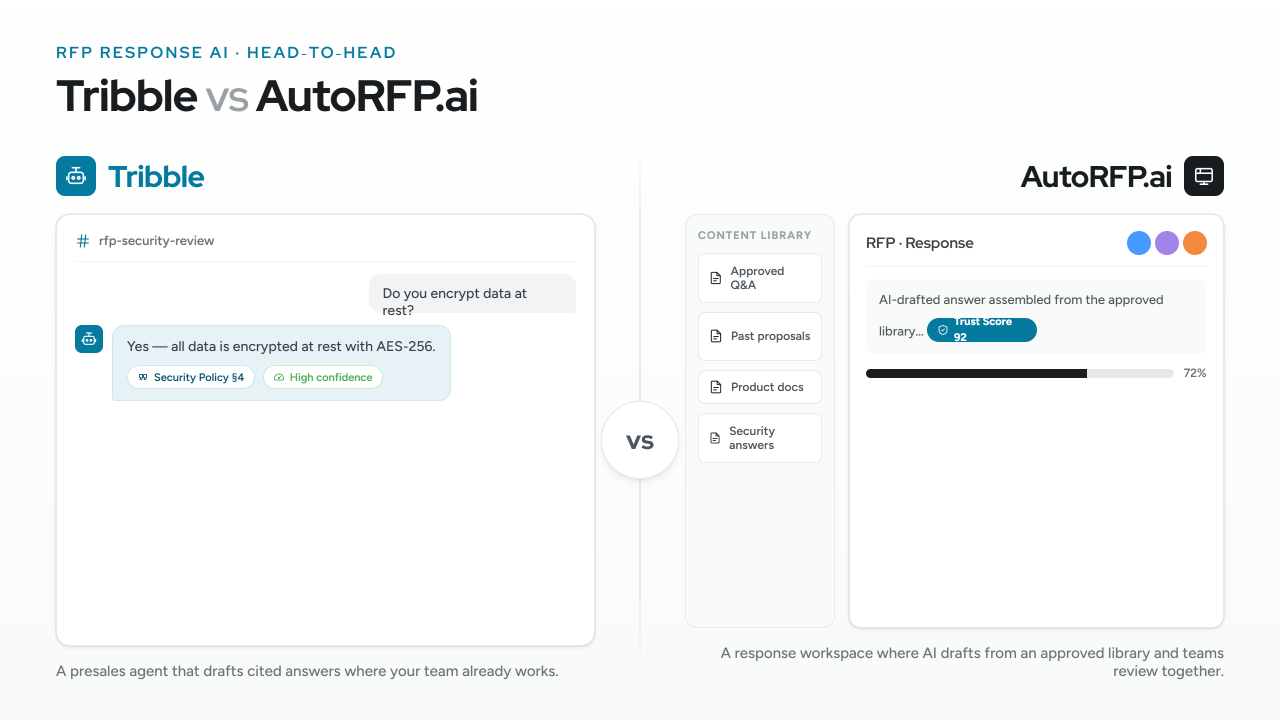
Tribble and Arphie are AI-native platforms that draft cited responses from internal sources for different teams. Tribble combines an RFP tool (Respond) with a sales agent (Engage) for team questions in Slack, Teams, and CRMs. Arphie focuses on RFPs, security questionnaires, and DDQs, providing source citations and confidence scores for each answer.
The choice turns on who's asking the questions: a proposal team working through a questionnaire, or sellers asking mid-deal. This Tribble vs Arphie comparison covers drafting, accuracy signals from reviews, support, security, integrations, pricing, and customer reviews.
TL;DR: Arphie vs Tribble by team type
- Tribble fits companies that want one approved knowledge base serving both RFP responses and sellers' questions in Slack, Teams, and the CRM.
- Arphie fits proposal and security teams focused on RFPs, security questionnaires, and DDQs; it publishes a price range, and G2 reviewers report about 1 month to set up.
- Accuracy is Tribble's most common G2 complaint (16 reviews tag inaccurate responses), while Arphie's complaints center on file import, export, and portal limits.
- Teams that want a bid-fit check and a full-response review before submission can trial Inventive AI, from $830/month, billed annually, with unlimited users.
Tribble vs Arphie at a glance
Tribble covers sellers as well as proposal teams and answers inside vendor portals, while Arphie stays focused on completing RFPs and questionnaires with a short rollout.
Based on vendor websites, G2, and Gartner Peer Insights, retrieved October 29, 2026.
What is Tribble?
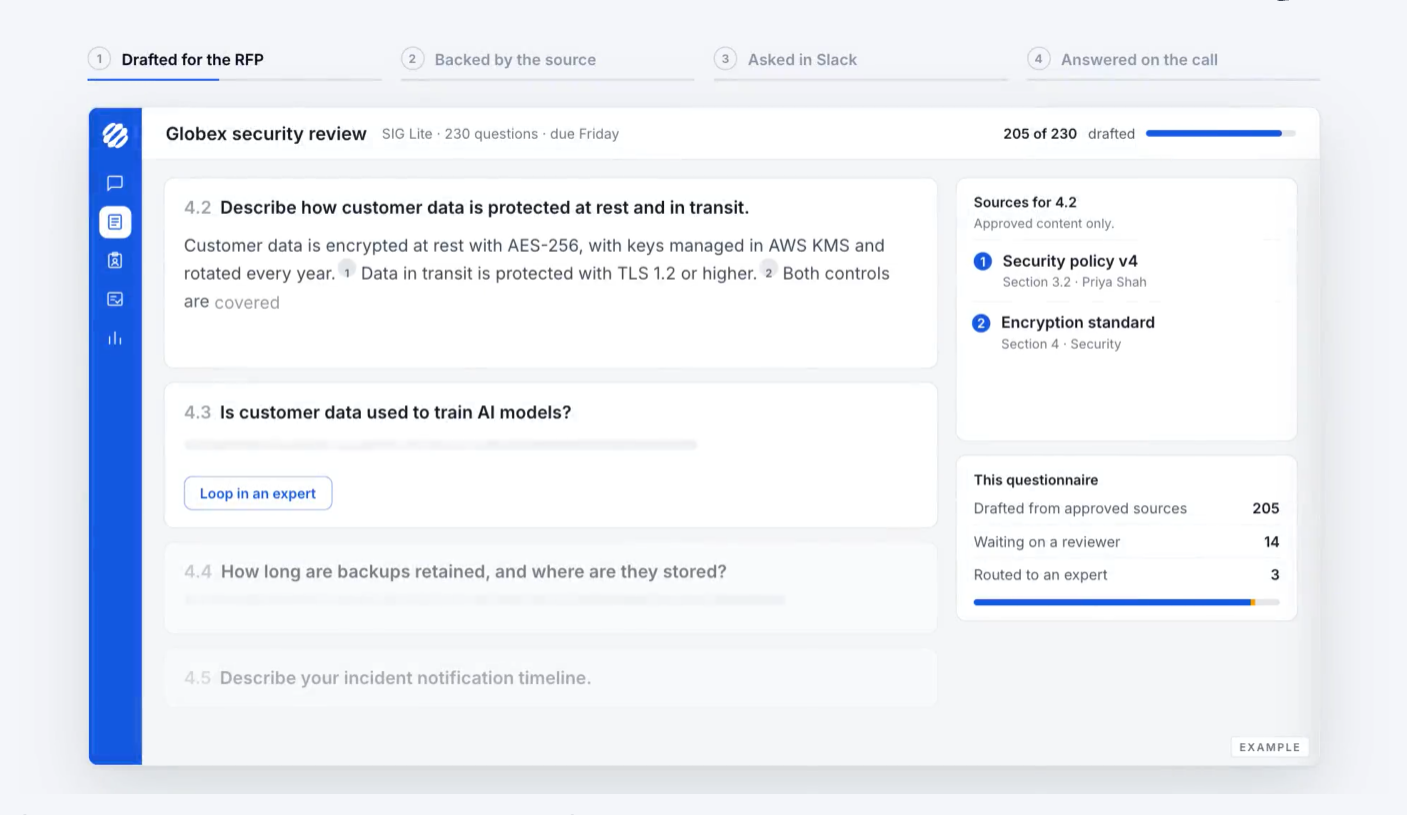
Tribble is an AI platform that answers RFPs, questionnaires, and sales questions from a company's approved knowledge. It has three parts: Respond drafts RFP, DDQ, and security questionnaire responses; Engage supports sellers before, during, and after calls in Slack and Microsoft Teams; and the Brain is the shared knowledge base behind both.
Every draft shows its source and a confidence level, and every stored response in the Brain has a named owner. When the Brain can't support a response, Tribble routes the question to an expert in Slack and stores the approved reply for next time. When two sources disagree, Tribble sends the conflict to the owner to settle.
What is Arphie?
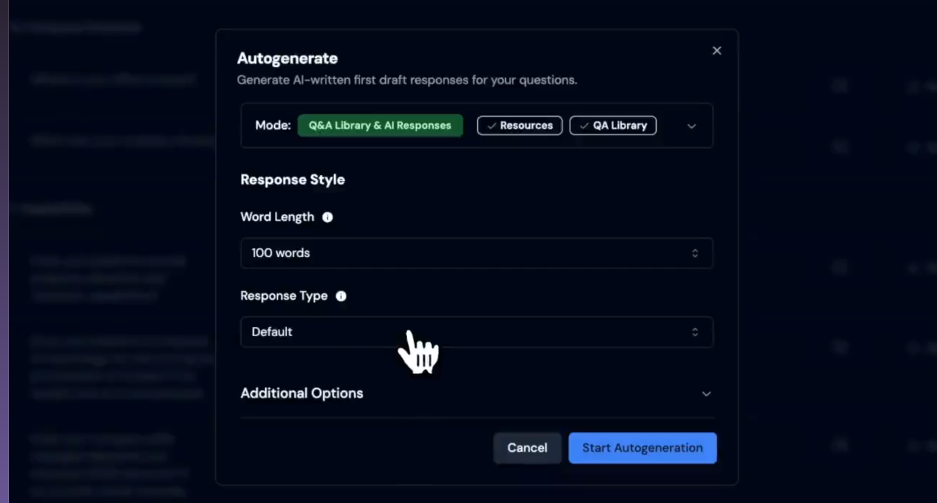
Arphie is an AI-native response platform for RFPs, RFQs, security questionnaires, and DDQs. Its agents draft each question from connected sources and show the documents used, a confidence score, and a step-by-step explanation of how they reached the response.
Arphie's scope is narrower than Tribble's. It centers on completing questionnaires and RFPs, exports finished responses into the buyer's original Excel or Word file, and offers Quick-Ask AI in Slack for questions outside a project. Its product pages don't describe a call assistant for sellers.
Where do Tribble and Arphie get their responses, and who checks them?
Both tools draft only from approved, connected sources and cite them. Tribble adds a named owner for every response and routes low-confidence or unsupported questions to that person, while Arphie puts the confidence score and sources in front of the reviewer inside its web app.
The review load differs in practice. Tribble's G2 reviews tag inaccurate responses 16 times, with reviewers describing different responses to the same question and outdated information from connected drives. Arphie's G2 reviews focus on file handling rather than accuracy, though 26 reviews are a much smaller sample than Tribble's 175.
Accuracy carries more weight now that buyers double-check. In a 2026 Gartner survey of 645 B2B buyers, 69% said they prefer to check AI-generated insights with a sales rep, and 51% said they're more likely to encounter misleading information from generative AI.
Tribble features, limitations, pricing, and reviews
Tribble's strengths are one knowledge base for proposals and sellers, expert routing in Slack and Teams, and answering inside portals and original files. Its weaknesses, based on G2 reviews, are inconsistent accuracy and a learning curve.
Tribble key features as per G2 reviews
- Answers in Slack: Reps and SMEs ask questions in Slack and get cited responses, which reviewers call Tribble's strongest use case.
- Confidence-based review: Each response shows its sources and a confidence score, so proposal managers spend review time only on low-confidence items.
- Fast RFP first drafts: Generates a full first draft of a large RFP in under an hour, per an enterprise proposal manager.
- CRM and call context: Pulls from Salesforce and Gong calls alongside documents in Confluence and Highspot.
- Simple content updates: Adding or updating the content the AI uses is easy, and a RevOps admin can handle the setup.
- Responsive support: Reviewers describe the Tribble team as highly responsive.
Tribble limitations as per G2 reviews
Based on G2 reviews of Tribble (retrieved October 2026):
- Responses can be vague, inaccurate, or inconsistent, and the same question can return different responses.
- Old content resurfaces: drafts pull outdated information from connected drives and context from years ago, sometimes with wrong dates.
- Training Tribble on its sources takes a learning curve, and new integrations can wait on an internal admin.
- Slack routing can leave larger teams unsure who should answer a question.
- Output sometimes needs cleanup for stray characters and merged cells in Excel.
- Processing can lag on some responses.
Tribble pricing
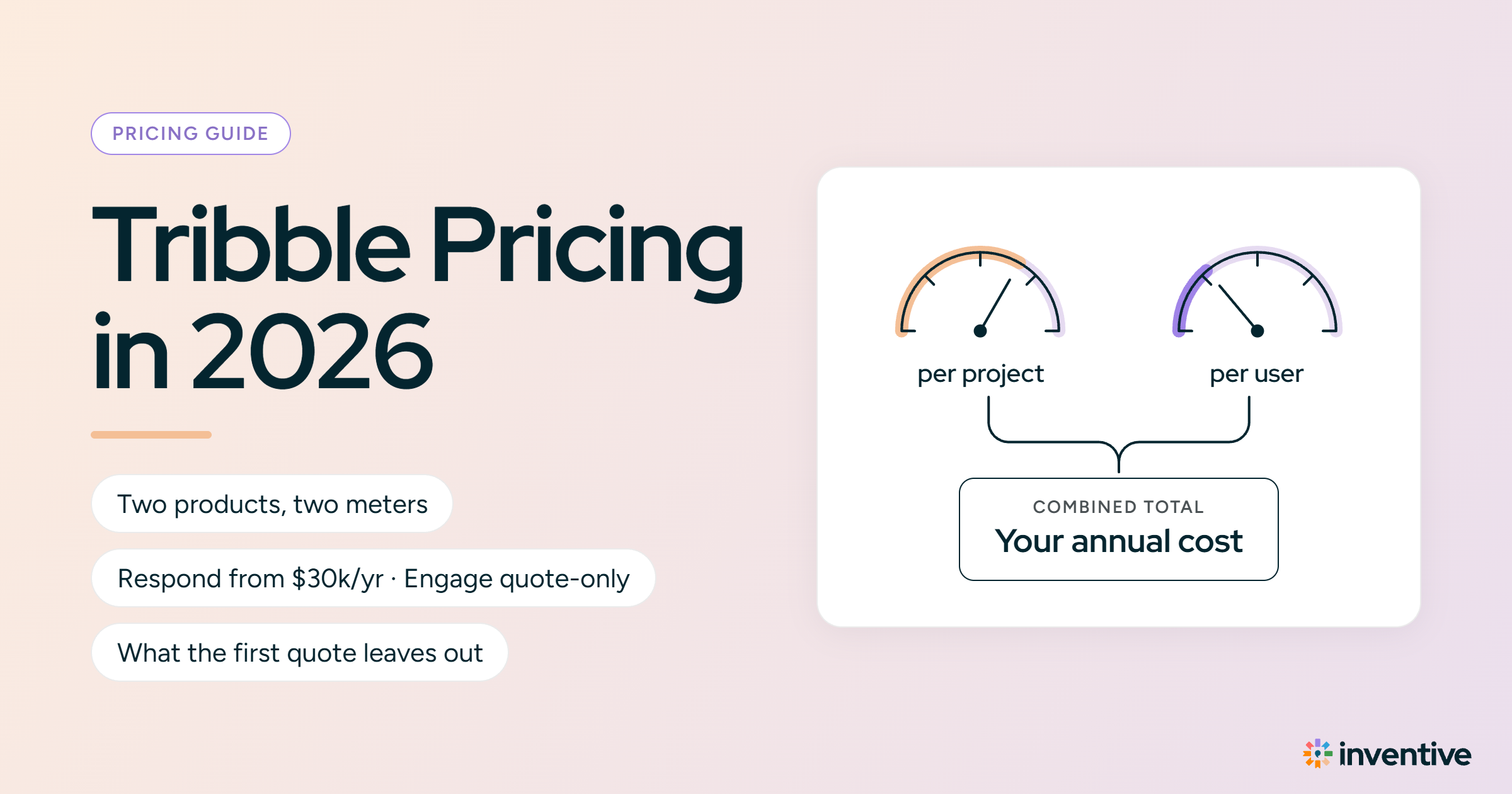
Tribble doesn't publish list prices; its pricing page says the price depends on how many projects a team runs and how many users it has. Respond is priced per project, and everyone who helps on a project is included, so an SME answering a few questions adds no cost. Engage is priced per user per month, and the Brain is included with both.
Tribble ratings and reviews
As of October 29, 2026:
- G2: 4.7/5 from 175 reviews
- Gartner Peer Insights: No rating listed
- What G2 reviewers praise most: ease of use (53 reviews), time savings (51), and the Slack integration (28)
- Time to go live: G2 doesn't publish an average; reviewers describe anything from a simple setup to about a week when IT connects SharePoint and Confluence
One reviewer's take: Caroline J., a Sales Enablement Strategist at an enterprise company, rates Tribble 4.5/5 for pulling answers from Gong, Highspot, Salesforce, and Confluence in one question, but says training it on its sources takes a real learning curve (G2, June 2026)
Arphie features, limitations, pricing, and reviews
Arphie stands out for showing its work on every response, writing back into the buyer's file, and going live quickly. G2 reviewers point to file handling, portals, and reporting as the weak spots.
Arphie key features as per G2 reviews
- Source-backed responses: Cites the exact source and shows a confidence score on every response.
- Content stays where it lives: Connects to Google Drive folders and website documentation and syncs changes, replacing manual uploads.
- Duplicate cleanup: Smart Merge highlights duplicate entries in the knowledge base.
- Ad-hoc Slack questions: Teams ask Arphie questions in Slack without opening a project.
- Quick go-live: Reviewers report running the system within days and getting first drafts about 15 minutes after upload.
- Fast support: Reviewers report replies within minutes, and bugs fixed the same day.
Arphie limitations as per G2 reviews
Based on G2 reviews of Arphie (retrieved October 2026):
- Non-spreadsheet documents are harder to import, and one investor relations reviewer found import limited to Excel.
- AI draft generation can be slow.
- Keeping the knowledge base trained and current takes ongoing work.
- Questionnaires inside procurement portals don't work well.
- Some reporting features haven't shipped yet.
- The Salesforce package is still maturing.
Arphie pricing
Arphie's list prices aren't public either; Arphie prices RFP teams by concurrent projects, with an annual range of $36,000 to $60,000+ in its own comparison table.
Arphie ratings and reviews
As of October 29, 2026:
- Gartner Peer Insights: 5.0/5 from 5 ratings
- G2: 4.9/5 from 26 reviews
- Time to go live: about 1 month, according to G2 reviewers
- Time to return on investment: about 3 months, according to G2 reviewers
One reviewer's take: An enterprise software user rates Arphie 5/5 for ease of use, but says drafts are slow to generate and importing anything other than spreadsheets is restrictive
-Verified User in Computer Software, Enterprise, G2, September 2026
Tribble vs Arphie head-to-head: support, security, integrations, and pricing
Tribble reaches more of the sales team: sellers get answers in Slack, Teams, and the CRM, and questionnaires can be answered inside vendor portals. Arphie shares more detail about its security testing and support.
Support and onboarding
Security
Integrations
Pricing
Is Tribble or Arphie better for sellers answering questions in Slack and Teams?
Tribble is the better fit for sales teams. Engage answers rep questions in Slack, Teams, and the CRM during deals, drafts follow-ups for the rep to approve, and routes gaps to experts. Arphie's Quick-Ask AI answers knowledge base questions in Slack, but Arphie's public pages don't describe Teams support or a call assistant.
- Where reps ask: Tribble works in Slack, Teams, the CRM, and live calls. Arphie works in Slack.
- After the call: Tribble drafts follow-ups and CRM field updates. Arphie doesn't offer this.
- Pricing impact: Engage adds per-user monthly pricing for sellers on top of Respond's per-project pricing.
Sprout Social runs 65 sellers on one Tribble Brain and reports customer-ready proof points in about 5 minutes, according to Tribble's customer story.
Is Tribble or Arphie better for security questionnaires and DDQs?
Tribble covers more formats and intake paths, including portals and named DDQ templates. Arphie gives reviewers a confidence score and source list on every response with less setup, but G2 reviewers report weak portal handling.
- Formats: Tribble names SIG, CAIQ, VSA, ILPA DDQ templates, and custom operational due diligence (ODD) templates. Arphie supports Excel and Word questionnaires and DDQs without naming templates.
- Portals: Tribble answers inside vendor portals. Arphie reviewers report weak portal handling.
- Consistency: Tribble checks each DDQ response against every other response and against what the allocator last received. Arphie merges duplicate library entries.
- Uncovered questions: Tribble marks questions its sources don't cover instead of filling them. Arphie shows a confidence score so reviewers can spot weak responses.
Investment and security teams comparing more options can use this list of the best DDQ software.
How to choose between Tribble and Arphie
Companies that want sellers and proposal teams on one knowledge base lean toward Tribble, and teams focused only on completing RFPs and questionnaires lean toward Arphie. The table below shows which tool fits each Tribble vs Arphie scenario.
Questions to ask Tribble and Arphie before signing
Five questions and an accuracy test expose the differences that demos tend to skip in a Tribble vs Arphie evaluation.
- If a seller asks the same question twice, will they get the same response, and how do you test that?
- Who owns each response in the knowledge base, and how are owners notified when a source changes?
- Does the price change if we add sellers, SMEs, or more concurrent RFPs mid-contract?
- Which buyer portals has the tool completed questionnaires in for customers like us?
- What will our security team receive: the SOC 2 report, a penetration test summary, and SSO documentation?
A three-question accuracy test
Load the same approved sources into both tools, then run three checks:
- Repeat question: Ask the same product question five times across different projects and check whether the responses match.
- Stale document: Leave an outdated policy next to its replacement and check which version each draft cites.
- Uncovered question: Ask something the sources don't cover and check whether the tool routes it to a person or drafts a guess.
Inventive AI: decide which bids to answer and check every response before it ships
Inventive AI drafts RFP, RFI, DDQ, and security questionnaire responses from the tools a company already uses, such as SharePoint, Google Drive, Confluence, Notion, and Zendesk. Every response carries a citation and a confidence score.
- Go/No-Go agent: Maps requirement coverage as fully met, partially met, not met, or unknown, so the team decides whether a bid is worth answering before anyone starts drafting.
- Full Response Analyzer: Reviews the entire response in one pass before submission. It checks for contradictions between sections, compliance gaps, and requirements that haven't been addressed.
- Competitive intelligence: Competitor boards track what competitors are doing, so proposal teams can use that context when positioning against them in a response.
- Unlimited users: Pricing starts from $830/month, billed annually, with unlimited users, so SMEs, sellers, and reviewers can join without extra licenses.
Tribble vs Arphie: which one to shortlist
Tribble is the stronger pick for companies that want proposal teams and sellers working from one approved knowledge base, with responses delivered in Slack, Teams, and the CRM. Arphie is the stronger pick for proposal and security teams that only need RFPs and questionnaires completed, want a confidence score on every response, and prefer a published price range.
Teams still split on Tribble vs Arphie should run the accuracy test above, since accuracy is where Tribble's reviews are weakest and where Arphie's review sample is smallest.