Tribble vs AutoRFP (2026): Which AI-Native RFP Tool Fits Your Team?
Compare Tribble and AutoRFP.ai on AI drafting, pricing, integrations and reviews for RFPs and security questionnaires plus the AI-native alternative.
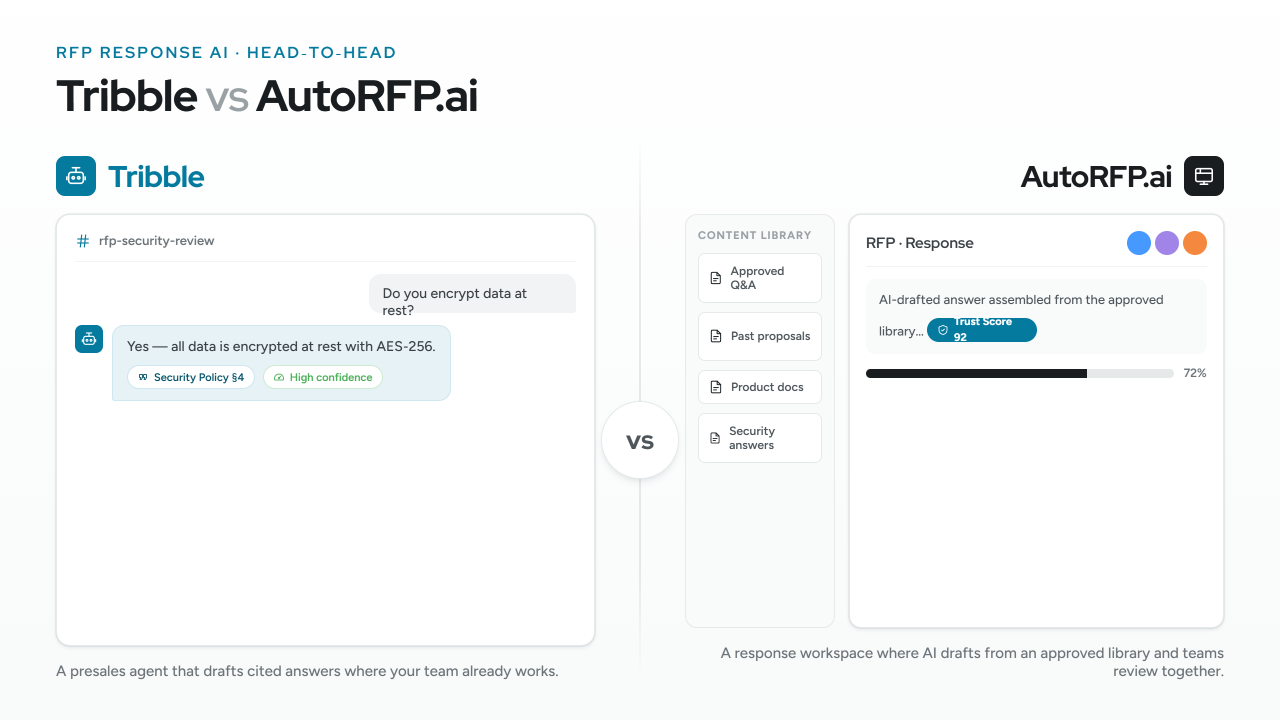
Last reviewed: January 2026. This comparison draws on vendor-published pages, verified G2 and Capterra reviews, and independent third-party write-ups such as SiftHub and Gartner Peer Insights. Both tools are recent AI-native entrants, so review counts are thin and skew recent, and pricing changes often. Treat every figure below as a starting point and confirm current tiers, features, and rating counts directly with each vendor before you commit.
TL;DR: Tribble vs AutoRFP in Three Sentences
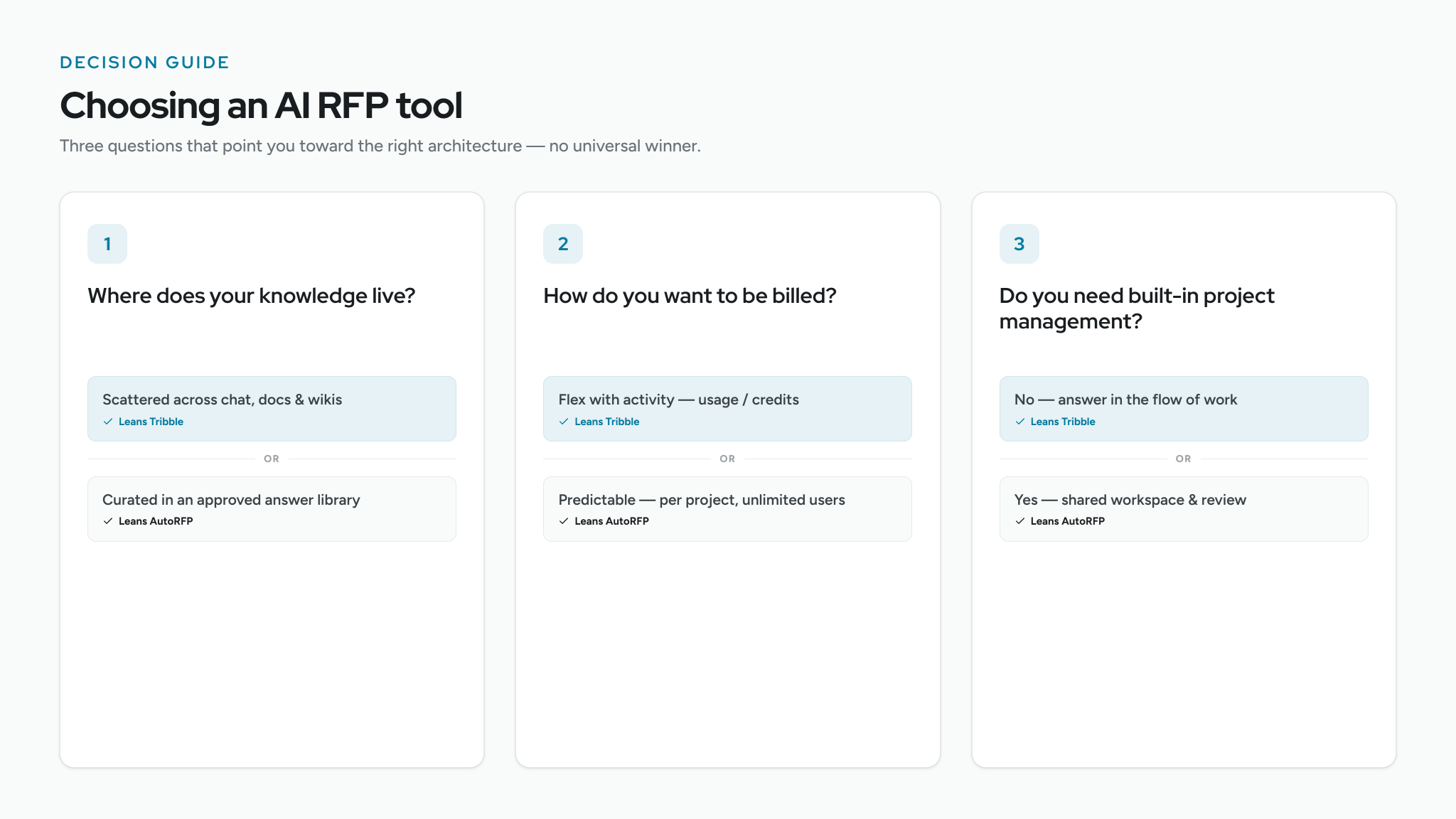
Tribble suits presales and solutions teams that live in Slack and want an AI agent that drafts from a governed knowledge layer with source trails and confidence flags. AutoRFP.ai suits response teams that want fast, library-backed first drafts inside a dedicated collaborative workspace with unlimited users and transparent per-answer Trust Scores. Which is "better" depends on what your team needs — where your knowledge already lives, how you bill, and how much project-management structure you want — and if you're still scoping the category, it helps to see how today's AI-native RFP tools stack up in a broader roundup.
What Should You Consider When Choosing Between Tribble and AutoRFP?
Both tools are AI-native, so the decision comes down to architecture and fit, not "does it have AI." Work through these criteria before a demo:
• Where your knowledge lives: Does the tool draft from your existing systems, or does it want its own content repository?
• AI drafting speed: How fast is a first draft on a large RFP, and what's the realistic accuracy before edits?
• Hallucination control: Are answers shipped with citations and a confidence indicator, or do you have to trust the output blindly?
• Source flexibility: Can you feed it internal docs, public content, and past responses — or only past RFP answers?
• Security questionnaires and DDQs: Does it handle InfoSec-style questionnaires as a first-class use case? Teams for whom this is the primary workload may also want to weigh dedicated DDQ software options.
• Collaboration and project management: Are there assignments, reviewer workflows, and task tracking?
• Integrations: Does it connect to your CRM, chat, and content stores out of the box?
• Pricing model: Per-user, per-project, or usage/credit-based — and how does cost scale with volume? Sanity-check both models against an independent RFP pricing and comparison guide.
• Security and compliance: SOC 2, ISO 27001, SSO — verify certifications, don't assume them.
• Analytics: Can you see throughput, win rates, and content freshness?
• Ease of implementation: How steep is onboarding, and is training required?
• Enterprise scalability: Will it hold up across many concurrent deals and large teams?
Tribble vs AutoRFP at a Glance
| Tribble | AutoRFP.ai | |
|---|---|---|
| Best for | Presales/solutions teams working in Slack | Response teams wanting library-backed drafts in a shared workspace |
| Architecture | AI presales agent over a governed knowledge layer | AI RFP platform over an approved content library |
| G2 rating | 4.8/5 (vendor-reported; a tracker lists 4.7 — confirm) | 4.9/5 (56 reviews, reported — confirm) |
| Pricing model | Quote-based, usage/credit packs | Published from $899/mo (annual); higher-volume $1,299/mo |
| Standout trait | Slack-native workflow + confidence flags | Unlimited users + transparent Trust Scores |
| Notable gap | No public pricing; some vague-answer reports | Steep learning curve; limited non-past-response uploads |
Figures are reported at time of writing. Confirm current specifics with each vendor.
Feature-by-Feature Comparison
This is the core side-by-side. Values come from the sources cited later in this post.
| Dimension | Tribble | AutoRFP.ai |
|---|---|---|
| Best for | Presales and solutions engineers embedded in Slack | RFP/security-questionnaire response teams in a dedicated workspace |
| Primary use cases | RFPs, DDQs, security questionnaires, technical sales knowledge | RFPs and security questionnaires |
| AI first drafts | Reported minutes-to-under-an-hour on large RFPs | Fast drafts pulled from approved past-response library |
| Knowledge sources | Governed internal + public sources, trainable | Approved past-response library (one reviewer notes no extra doc uploads) |
| Hallucination control | Source citations + confidence flags | Per-answer Trust Scores |
| Collaboration / PM | Slack-native; some reviewers cite limited task tracking | Collaborative response workspace with assignments |
| Meeting intelligence | Yes (Tribble Engage) | Not a stated focus |
| Integrations | Salesforce, Slack, Gong | Slack, Teams, Confluence, SharePoint, Google Drive, OneDrive, Notion, Salesforce, Zendesk, Intercom, Okta |
| User pricing | Usage/credit-based, quote only | Unlimited users included |
| Security/compliance | Confirm certifications with vendor | ISO 27001:2022 certified; SSO |
| G2 rating | 4.8/5 (reported; ~143 reviews, confirm) | 4.9/5 (56 reviews, reported) |
| Capterra | No verified listing found | 5.0 (1 review, reported) |
| Public pricing | None published | Published tiers on site |
Ratings, prices, and integration lists are reported at time of writing; verify each on the live vendor and review-site listings.
See how an agentic approach handles both RFPs and security questionnaires from your existing systems — book a walkthrough of Inventive AI.
Tribble: Overview, Features, Pricing and Reviews
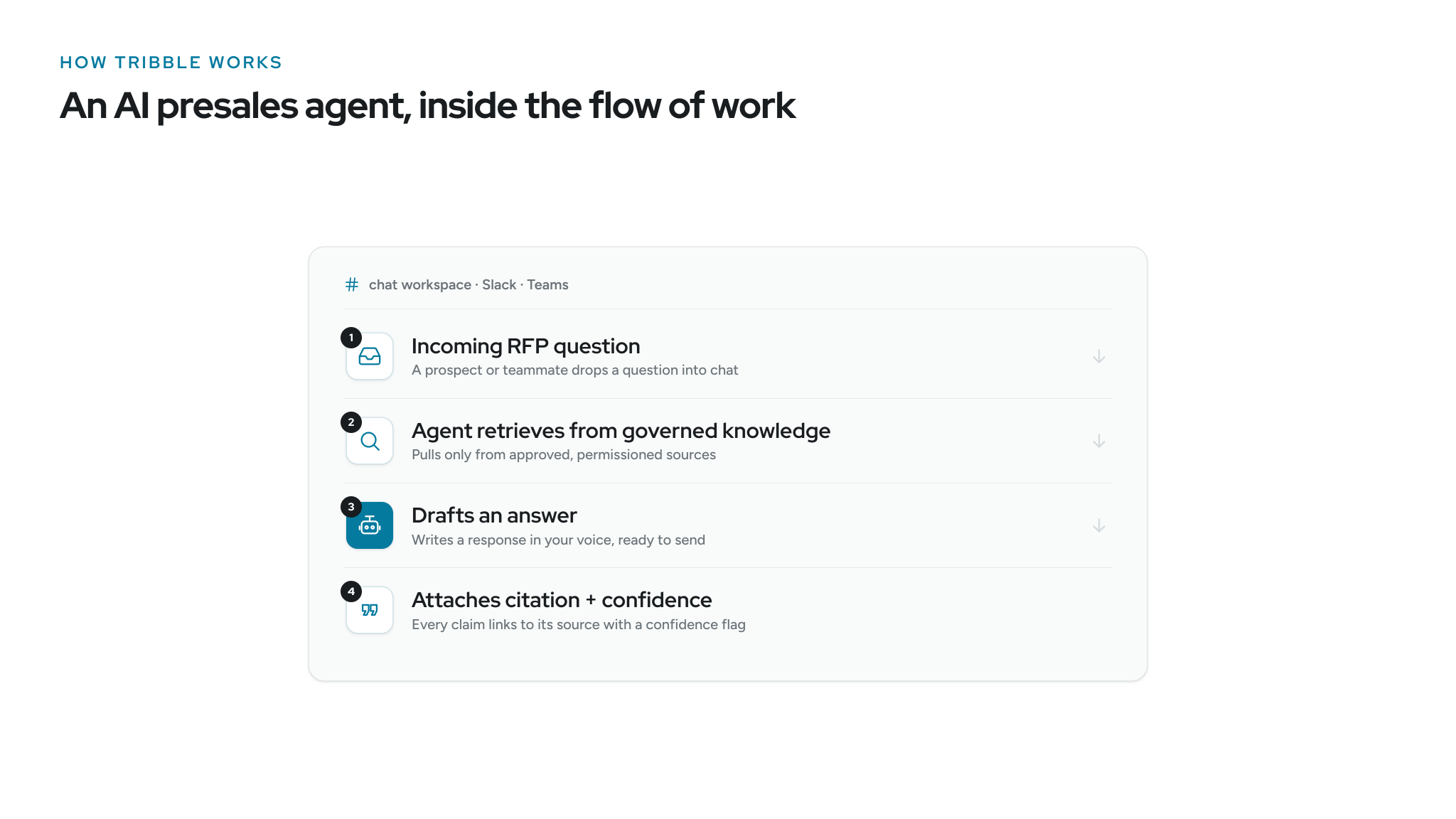
Tribble positions itself as an AI presales agent. Rather than a standalone response workspace, it drafts answers from a governed knowledge layer, ships them with source trails and confidence flags, and meets reps inside Slack. Tribble Engage adds meeting intelligence to the presales workflow. The pitch is adoption: put the agent where the team already works.
Best features
• Slack-native workflow that meets users in their existing workspace, which reviewers link to high adoption.
• Context-grounded, trainable answers drawn from approved internal and public sources.
• Source trails and confidence flags on generated answers, so reviewers can see where content came from.
• Fast AI first drafts on large RFPs — reported at minutes to under an hour versus days manually.
• Meeting intelligence via Tribble Engage for the broader presales motion.
• Handles DDQs and security questionnaires alongside RFPs.
Limitations (sourced)
• No published pricing makes budget modeling hard before a sales conversation
• Some reviewers report AI inaccuracy leading to vague responses (G2 pros and cons).
• Some reviewers feel it lacks dedicated project management and task-tracking tools (
• Verified third-party ratings are thin and recent, typical of a newer entrant.
• Capterra and TrustRadius listings could not be verified via search — cross-check independently.
• Teams wanting a broader feature set or clearer per-seat pricing often scan the Tribble competitors and alternatives landscape before committing.
Pricing
Quote-based. Tribble is reported to use an agentic, usage-based model built around monthly credit packs — credits consumed by the type and length of work — rather than per-user subscriptions. There is no public price; request a quote and model your expected volume. For a fuller look at its plans and user sentiment, see our Tribble AI pricing and reviews breakdown.
Ratings and reviews
G2 lists 4.8/5 (vendor-reported; a third-party tracker shows 4.7 — confirm on the live G2 listing), across roughly 143 reviews (reported; confirm). No Capterra or TrustRadius listing was verified.
"I love how Tribble generates a full first draft for big RFPs in under an hour, something that used to take me days." — G2 review
"Tribble is friendly, responsive, trainable, and context grounded in the most important internal and public knowledge sources… which makes its answers spot on 80-90% of the time with good prompting." — G2 review
AutoRFP.ai: Overview, Features, Pricing and Reviews
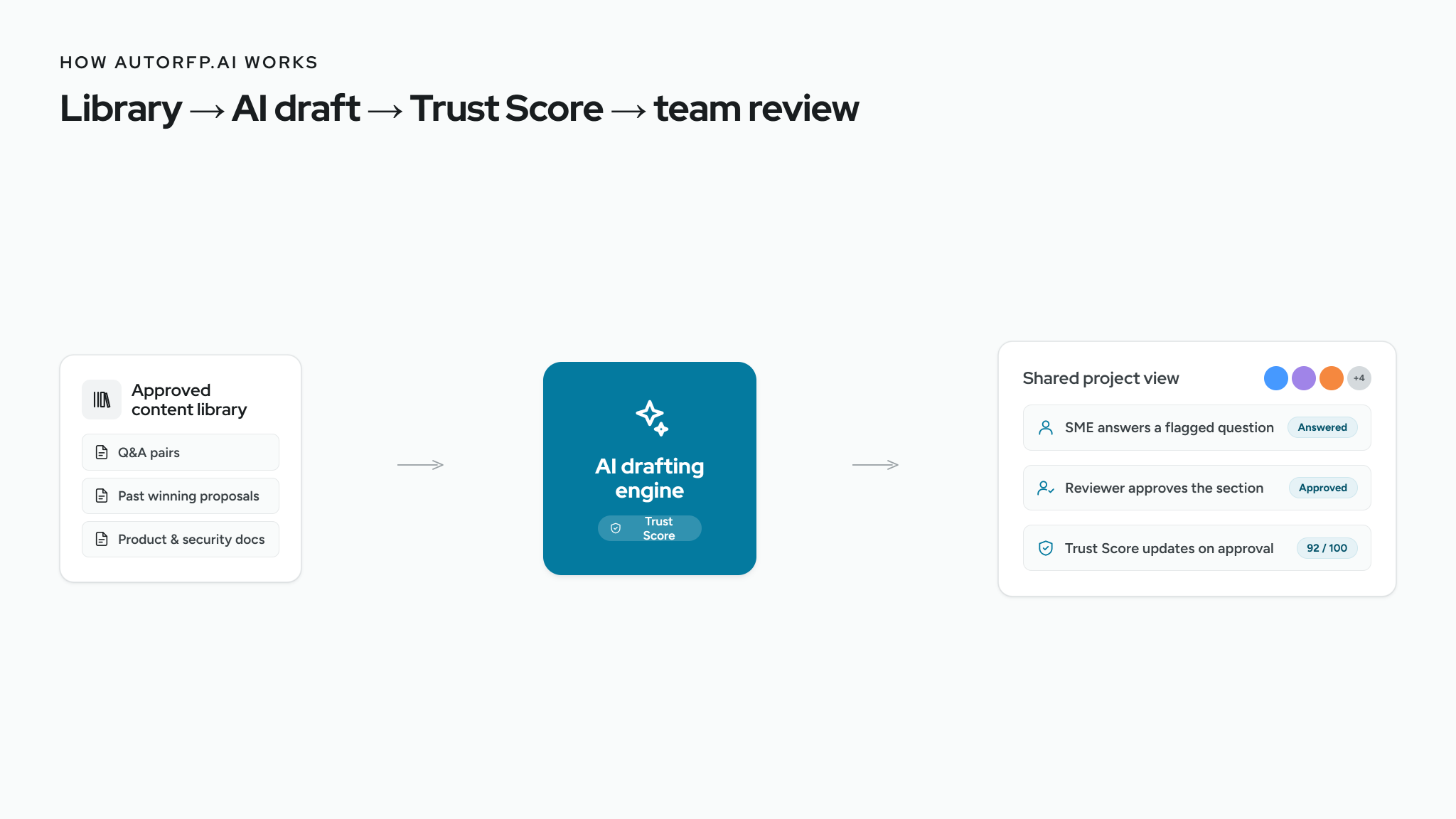
AutoRFP.ai is an AI-native RFP and security-questionnaire platform built around fast first drafts from an approved content library, a collaborative response workspace, and transparent per-answer Trust Scores. It's ISO 27001:2022 certified and prices with unlimited users, so cost is not tied to headcount.
Best features
• Fast, accurate AI first drafts pulled from an approved past-response library.
• Transparent per-answer Trust Scores so reviewers can gauge confidence.
• Unlimited-users pricing — anyone in the org can use it without per-seat fees.
• Reported significant time savings with fast initial setup.
• Broad integration list spanning chat, CRM, and content stores.
• ISO 27001:2022 certification and SSO for security-conscious buyers.
Limitations (sourced)
• Steep learning curve for first-time users without training (G2 pros and cons).
• One reviewer notes you cannot upload additional source documents beyond past RFP responses.
• Some reviewers cite limited template flexibility and interface design issues.
• Billing is project-based: the published tiers price per project volume, so per-project cost can weigh on lower-volume teams.
• Review history is thin (one Capterra review reported); weigh sample size.
• Teams weighing volume-based billing often review the AutoRFP alternatives and comparison options first.
Pricing
AutoRFP.ai publishes tiers: a Scale plan at $899/month billed annually (24 projects/year, unlimited users, SSO, 18+ integrations, ISO 27001:2022), and a higher-volume tier at $1,299/month for 50+ projects/year, with per-project cost decreasing as volume rises. A Capterra alternatives listing shows a lower "from $199/month, usage-based" figure — confirm current tiers with the vendor. Our AutoRFP.ai pricing and features review goes deeper on how these tiers play out in practice.
Ratings and reviews
G2 lists 4.9/5 across 56 reviews (reported on the seller page — confirm on the live G2 listing). Capterra shows 5.0 from 1 review. Additional reviews exist on Gartner Peer Insights.
"The AI is fast, accurate, and reliably pulls from our approved library of past responses." G2 review
"The learning curve is a little steep, but had I bothered to do any training at all instead of just diving in it might have been a little easier." G2 review
Note: Both tools are recent to the market, so their review histories are thin and skew positive from early adopters. Treat headline ratings as directional, not statistically settled, and lean on your own pilot.
AI Capabilities: How the Two Compare
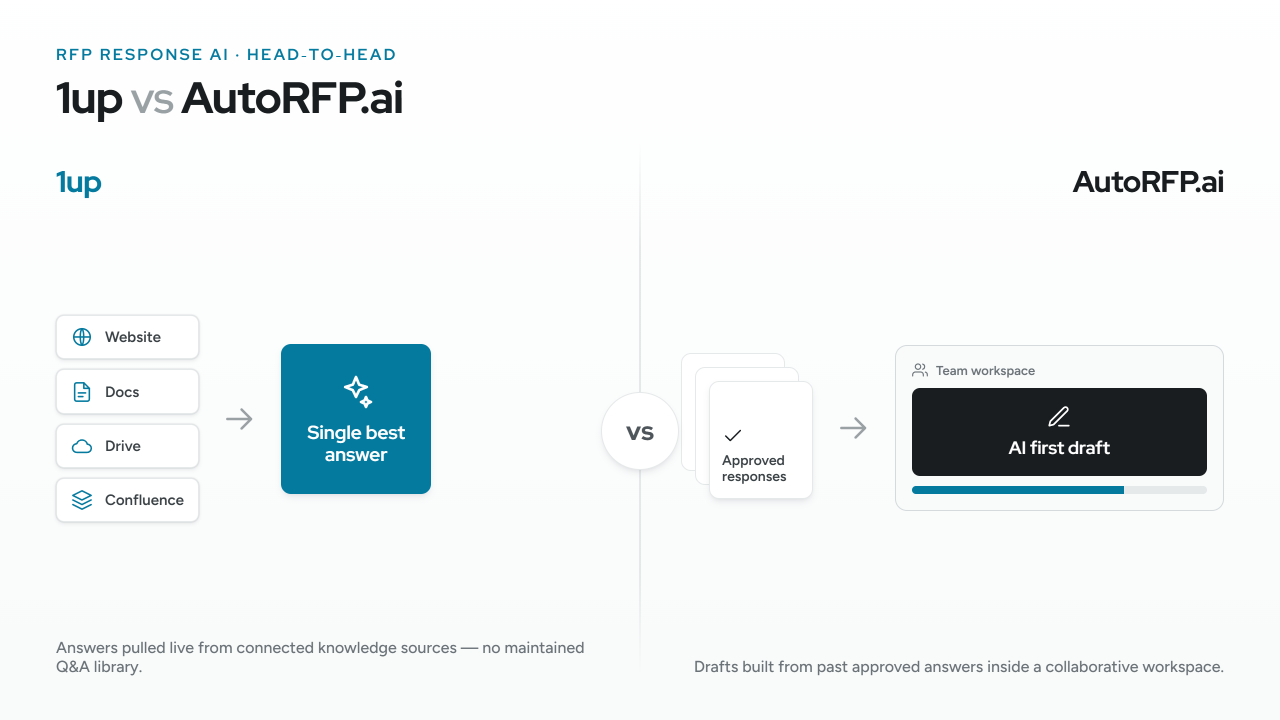
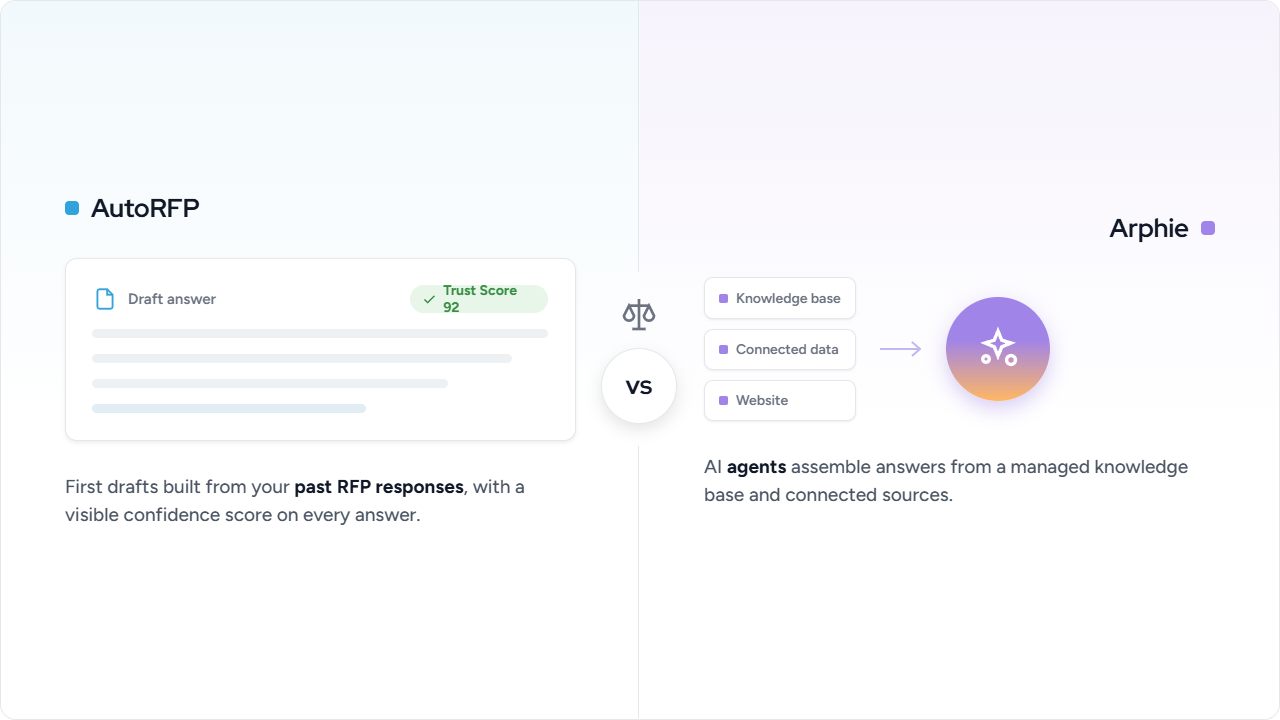
Both draft answers with AI and both attach a confidence signal — Tribble uses source citations and confidence flags, AutoRFP uses per-answer Trust Scores. The architectural difference is the knowledge source.
Tribble
- Drafts from a governed layer of approved internal and public sources; trainable over time.
- Reviewers report answers "spot on 80-90% of the time with good prompting," which implies prompting effort.
AutoRFP.ai
- Drafts from an approved past-response library; one reviewer notes you can't add other source documents.
- Emphasizes speed and reliable reuse of vetted answers.
Note: Both platforms depend on the quality of the content you feed them. If your source material is stale or contradictory, either tool can surface a confident-looking but outdated answer — so test accuracy on real edge-case questions during the trial. Teams that want conflict detection built into the drafting step can see how an agentic approach handles it in this AutoRFP vs Inventive breakdown.
Curious how a benchmark shakes out? RAD AI reported 2× more accurate responses than other RFP AI tools it tested — read the case study.
Integrations
AutoRFP publishes the broader out-of-the-box list; Tribble focuses on a tighter presales stack.
| Category | Tribble | AutoRFP.ai |
|---|---|---|
| Chat | Slack | Slack, Microsoft Teams |
| CRM | Salesforce | Salesforce |
| Content stores | — | Confluence, SharePoint, Google Drive, OneDrive, Notion |
| Support/CS | — | Zendesk, Intercom |
| Revenue intelligence | Gong | — |
| SSO | Confirm with vendor | Okta |
Integration lists reported at time of writing; confirm current connectors with each vendor.
Tribble vs AutoRFP Pricing: How Much Does Tribble Cost?
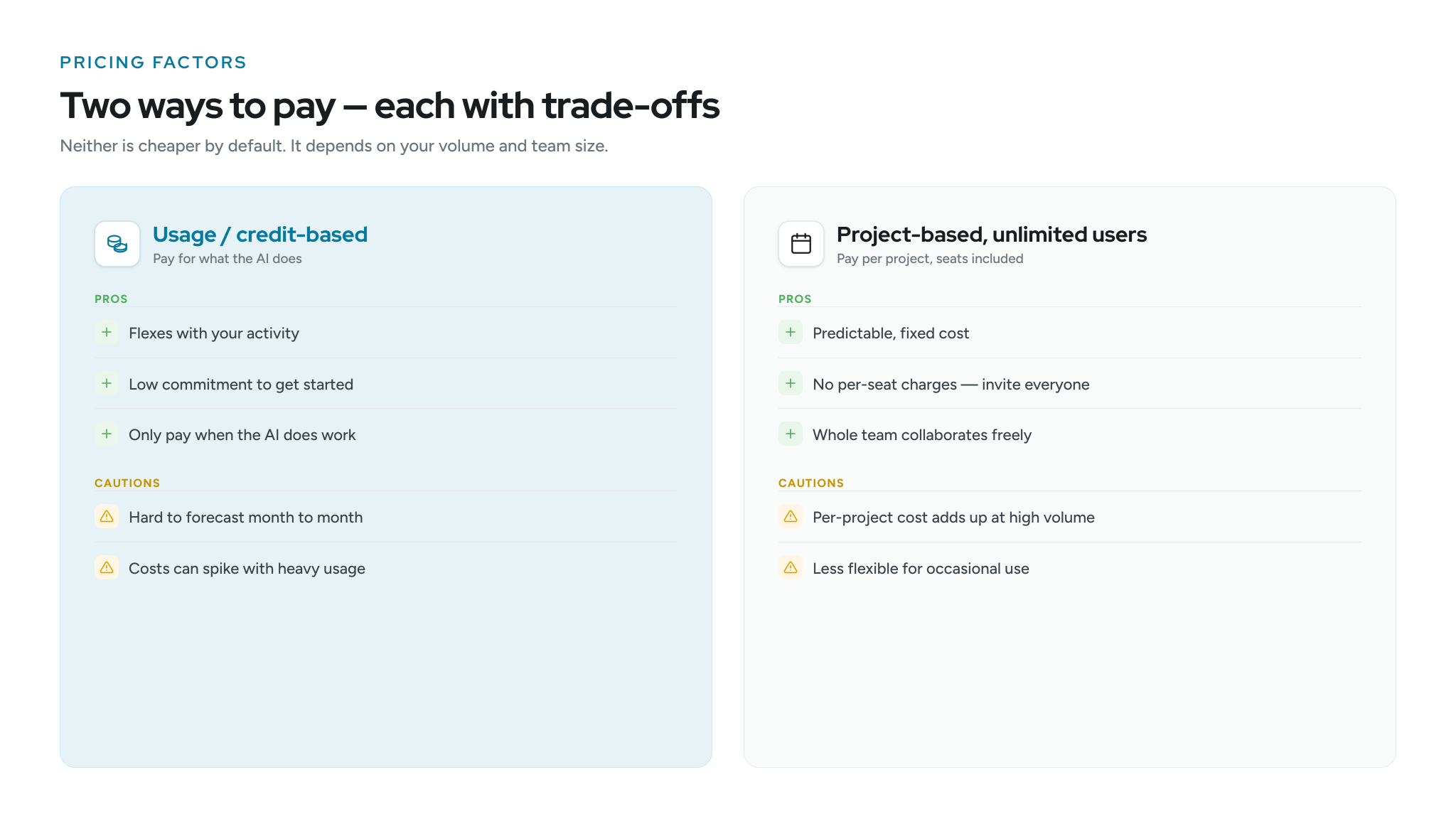
Tribble does not publish pricing. It's reported to use a usage-based, credit-pack model rather than per-seat subscriptions, so the cost depends on how much work you run through it. AutoRFP publishes tiers starting at $899/month (annual) with unlimited users, scaling to $1,299/month for higher project volumes.
The practical trade-off: AutoRFP's unlimited-user, project-count model is predictable if your project volume is steady, but per-project economics can pinch low-volume teams. Tribble's usage model can flex with activity but is hard to forecast without a quote. Model both against your real annual volume, and if you're a larger buyer mapping cost across vendors, the enterprise RFP software comparison is a useful reference.
Security and Compliance
AutoRFP.ai publicly states ISO 27001:2022 certification and Okta SSO support. Tribble's certifications weren't verified via search here — ask for its current SOC 2 / ISO documentation directly. For security-questionnaire-heavy teams, both are relevant, but verify the tool's own compliance posture before you route sensitive questionnaires through it. Buyers evaluating this use case specifically can review the best AI agents for security questionnaires.
Is Tribble Better Than AutoRFP?
Neither is universally better — it depends on what your team needs.
Choose Tribble if your presales and solutions engineers already work in Slack, you want an agent grounded in both internal and public sources with confidence flags, and meeting intelligence matters. Accept that pricing requires a quote and that some reviewers want more project-management structure.
Choose AutoRFP.ai if you want published, unlimited-user pricing, a dedicated collaborative workspace, transparent Trust Scores, ISO 27001:2022 out of the box, and a broad integration list. Accept a reported learning curve and the past-response-library constraint on source documents.
Also Worth Considering: Inventive AI
If you're comparing two AI-native tools, it's worth knowing a further shift is underway — the same move that saw AI-native RFP software replace legacy tools like Responsive and Loopio is now continuing toward a newer category of autonomous, AI-agentic proposal platforms that take a different architectural approach to drafting and governance. Inventive AI is one example of that category, offered here as context — not as the default pick.

Inventive AI is positioned as an autonomous AI-agentic platform for RFPs, RFIs, DDQs, and security questionnaires, with humans in the loop for approvals. Rather than teams maintaining a content library and writing drafts, agents run the workflow — understanding the RFP, finding information, drafting, validating, and flagging what needs human judgment. It's aimed at sales, presales, solution engineering, proposal, and InfoSec teams in mid-market and enterprise.
Key capabilities of Inventive AI
• Fast first drafts that customers report sharply cut turnaround — MaxVal reported answering 80 RFP questions in about three hours, work that had taken close to a week.
• Knowledge Hub that connects to existing systems (SharePoint, Google Drive, Salesforce, Confluence, Notion, Zendesk, Okta, websites) and live-syncs on source changes — no separate repository to maintain.
• Content Governance Agent that detects conflicting info, flags outdated content, and surfaces duplicates.
• Context Engine that tailors responses to each deal using customer priorities, CRM data, and sales notes.
• Hallucination control: every response ships with citations and a confidence score, and flags "information unavailable" rather than guessing.
• Competitive Intelligence Agent that compares positioning against named competitors inside the response.
• Format flexibility across Excel and narrative, with reviewer assignments and approval workflows.
• Response quality independently described by RAD AI as 2× more accurate than other RFP AI tools it tested.
Ready to see Inventive AI in action. Book a demo

.avif)