VisibleThread Price, Features, Reviews & Ratings for 2026
Against this backdrop, this blog examines VisibleThread’s pricing, features, strengths, and limitations through the lens of government and technical RFPs, and compares its approach with agentic AI platforms like Inventive AI to assess how well each supports modern RFP execution.
VisibleThread is a proposal and compliance software platform used heavily by government contractors and other regulated, document-intensive teams. It began as a language-analysis toolset — best known for reading long solicitations, extracting requirements, and scoring readability — and has since grown into a broader platform that spans opportunity search, bid/no-bid analysis, compliance matrices, bid writing, and an AI assistant. If you are evaluating it, the questions that usually matter are what it does today, what it costs, how real users rate it, and where it fits best. This guide covers VisibleThread’s pricing, features, ratings, strengths, and limitations, and points to alternatives worth comparing.
Proposal work is under real time pressure: Gartner has projected that sales teams using generative AI for proposals will spend meaningfully fewer hours per RFP while protecting win rates. Tools in this space differ in where they help — some focus on analyzing and checking documents, others on generating and managing full responses — so the right fit depends on your team’s mix of compliance rigor and drafting volume.
Key takeaways
- VisibleThread is a proposal and compliance platform aimed at government, defense, and other regulated teams that need rigorous document analysis, requirement extraction, and readability review across the bid lifecycle.
- The platform now spans more than analysis: opportunity search, bid/no-bid analysis, compliance matrices, acronym checks, amendment handling, bid writing, a proposal Kanban board, and an AI assistant called Visi.
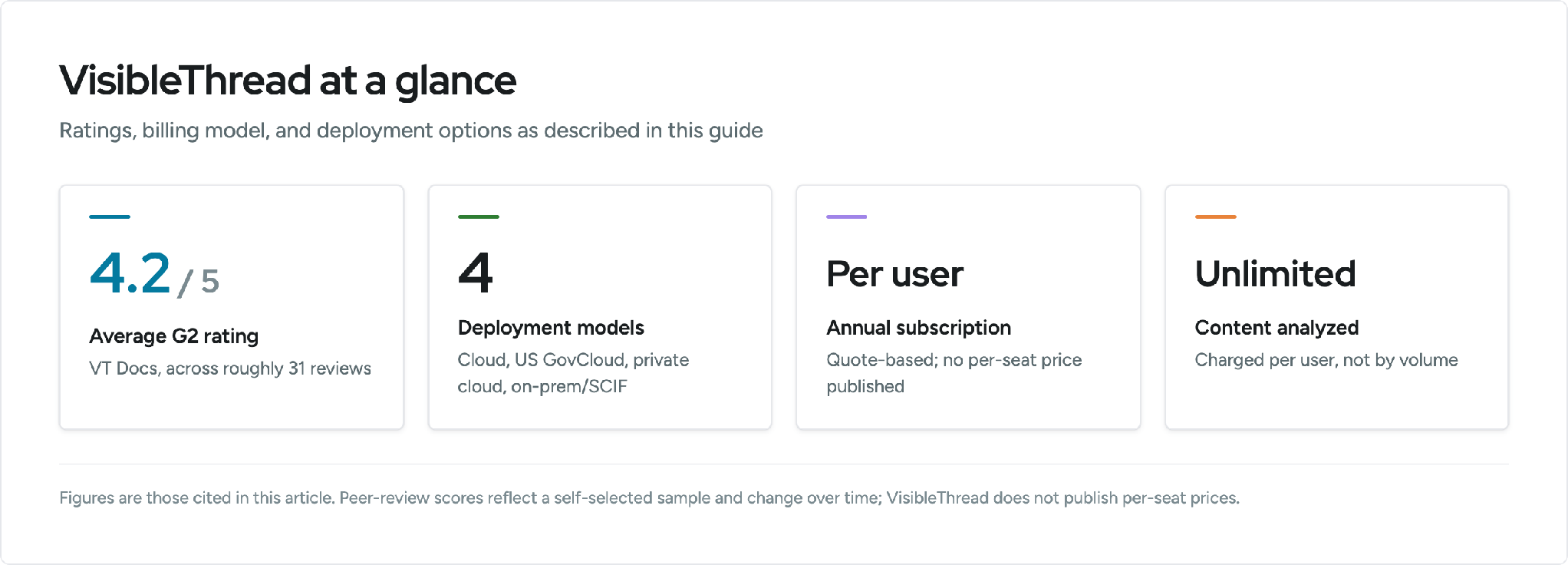
- Pricing is quote-based and tailored, charged as an annual, per-user subscription; it varies with team size, modules, and deployment type, and content analyzed is unlimited.
- Secure deployment is a notable strength — VisibleThread offers cloud, US GovCloud (FedRAMP Moderate, NIST SP 800-171, FIPS), private cloud, and on-premises/SCIF/air-gapped options.
- Reviewers praise fast compliance-matrix generation and document analysis; common criticisms include a learning curve and manual editing to reach submission-ready drafts. VisibleThread holds a 4.2/5 average on G2.
What is VisibleThread?
VisibleThread is a software platform for teams that respond to complex, compliance-driven solicitations — most prominently U.S. federal and defense RFPs, along with SOWs and contracts. Its own positioning describes an end-to-end proposal workflow “from sales to contract — write, score, compare, comply, win.”
Historically, VisibleThread was known for two products: VT Docs, for document analysis and compliance review, and VT Writer, for readability and plain-language scoring. The current platform keeps that analytical core and adds capabilities aimed at the whole bid lifecycle, including an AI assistant (Visi), opportunity search, bid/no-bid analysis, a proposal Kanban board, amendment handling, and bid writing. Its primary users are proposal managers, bid writers, capture and business-development teams, and contracts/compliance staff in defense and aerospace, engineering and construction, financial services, government, healthcare, and IT services.
VisibleThread key features
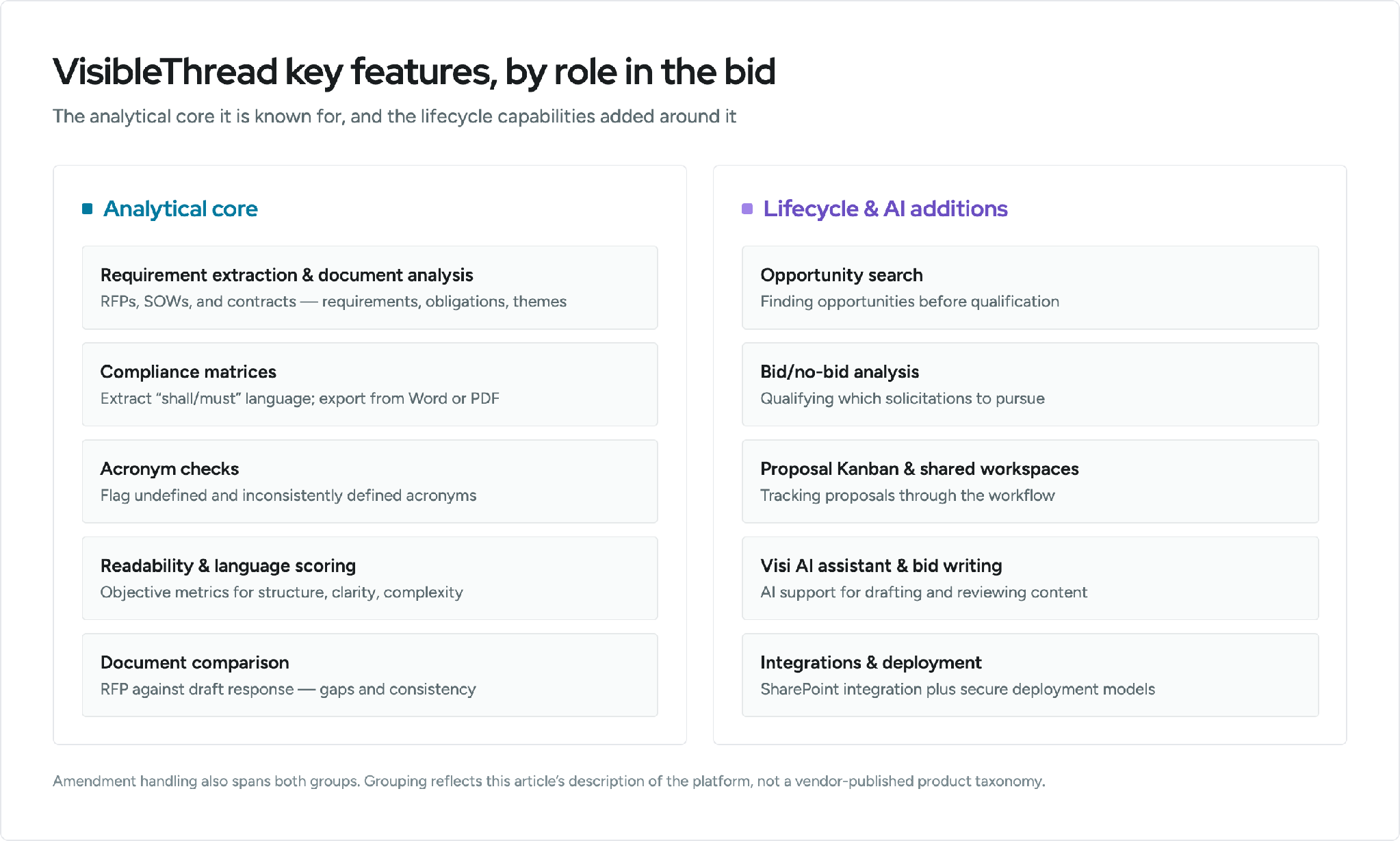
VisibleThread’s capabilities center on reading solicitations accurately, keeping proposals compliant, and improving writing quality. Core features include:
- Requirement extraction and document analysis. Read RFPs, SOWs, and contracts to surface requirements, obligations, and recurring themes during bid and review stages.
- Compliance matrices. Extract mandatory “shall/must” language and export structured matrices from Word or PDF — one of the platform’s most-cited time-savers.
- Acronym checks. Detect acronyms and definitions, flag undefined ones, and catch inconsistent definitions across a document.
- Readability and language scoring. Apply objective metrics to assess sentence structure, clarity, and complexity — the heritage of VT Writer.
- Document comparison. Compare related files (for example an RFP against a draft response) to find gaps and check consistency.
- Opportunity search, bid/no-bid, and workflow. Newer capabilities for finding opportunities, qualifying them, and tracking proposals through a Kanban board and shared workspaces.
- Visi AI assistant and bid writing. AI support for drafting and reviewing proposal content within the platform.
- Integrations and deployment. SharePoint integration plus a wide range of secure deployment models (see pricing below).
For a broader view of what to look for across this category, Inventive’s 15 best RFP software guide and its government AI RFP response software comparison compare tools on features, fit, and pricing.
VisibleThread pricing
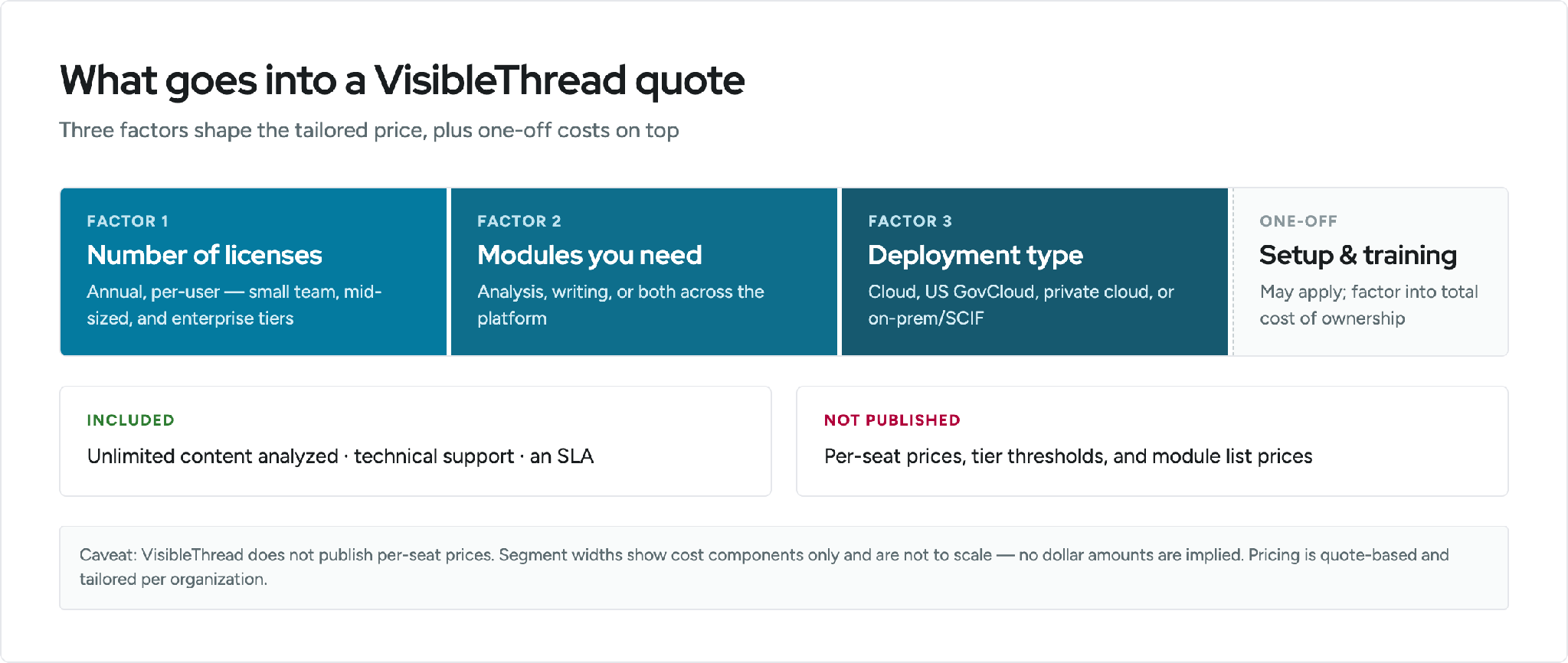
VisibleThread does not publish per-seat prices. According to its pricing page, cost is tailored to each organization and shaped by three factors: number of licenses, the modules you need, and deployment type. Key facts to plan around:
Because pricing depends on modules and deployment, teams that need both analysis and writing capabilities — or a high-security deployment — should expect a custom quote and factor setup and training into total cost of ownership. If you are weighing a build-or-buy decision, Inventive’s build vs. buy for RFP software guide is a useful framework.
VisibleThread reviews and ratings
At the time of writing, VisibleThread (VT Docs) holds an average of 4.2 out of 5 on G2 across roughly 31 reviews, and it maintains profiles on TrustRadius, Capterra, GetApp, and SoftwareAdvice. Common themes:
- Praised: fast compliance-matrix generation, reliable requirement extraction and acronym checking, time savings in early-stage review, and strong security/deployment options for regulated environments.
- Raised as limitations: a learning curve tied to specialized terminology and navigation, manual editing needed to reach submission-ready drafts, and output quality that varies with input quality. Some reviewers also cite limited multilingual support and gaps such as exclusion-term controls in Discovery mode.
As always, peer-review scores reflect a self-selected sample and change over time, so it is worth reading recent reviews from teams whose size, industry, and use case resemble your own.
VisibleThread strengths and limitations
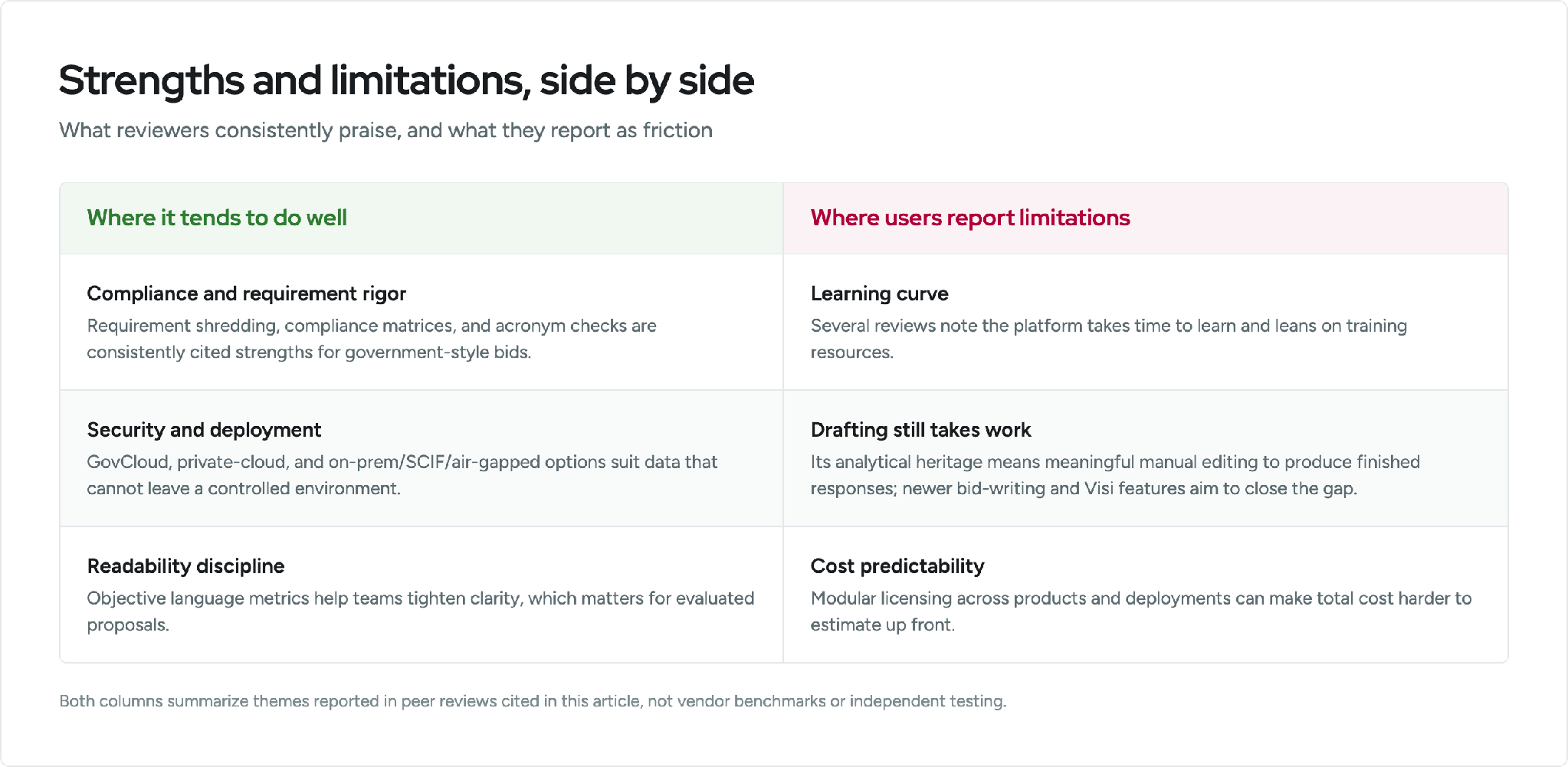
Where VisibleThread tends to do well
- Compliance and requirement rigor. Requirement shredding, compliance matrices, and acronym checks are consistently cited strengths for government-style bids.
- Security and deployment. GovCloud, private-cloud, and on-prem/SCIF/air-gapped options make it viable where data cannot leave a controlled environment.
- Readability discipline. Objective language metrics help teams tighten clarity, which matters for evaluated proposals.
Where users report limitations
- Learning curve. Several reviews note that the platform takes time to learn and leans on training resources.
- Drafting still takes work. Its analytical heritage means teams often do meaningful manual editing to produce finished responses, though newer bid-writing and Visi features aim to close that gap.
- Cost predictability. Modular licensing across products and deployments can make total cost harder to estimate up front.
Who VisibleThread is best for
VisibleThread is a strong fit for government, defense, and other regulated proposal teams whose top priorities are compliance rigor, requirement traceability, readability, and secure or air-gapped deployment. Capture, proposal-management, and contracts/compliance teams working federal solicitations tend to get the most value.
Teams whose primary need is high-volume, narrative-heavy response generation across many RFP types — sales, security, and commercial as well as government — should compare VisibleThread against platforms built around end-to-end response creation. Inventive’s enterprise RFP software comparison is a useful reference for that segment.
VisibleThread alternatives to consider
End-to-end RFP and proposal response platforms:
- Inventive AI — an AI-native platform that generates and manages responses for RFPs, RFIs, DDQs, and security questionnaires; customers report outcomes such as 90% faster responses at MaxVal and 422% ROI at AssetWorks.
- Responsive (formerly RFPIO) — an established response-management platform with a large content library and broad integrations; see its pricing, features, and reviews.
- Loopio — a widely used RFP and questionnaire tool known for its content library and intake workflow; see its pricing, features, and reviews.
For more on how RFIs, RFPs, and RFQs differ when you are scoping tools, see this RFI vs. RFP vs. RFQ guide.
How to choose: analysis, generation, or both
Rather than starting from a vendor, start from the work:
- Analysis vs. generation. If your bottleneck is reading solicitations and proving compliance, a document-analysis tool leads. If it is producing many complete drafts, a response-generation platform leads. Some teams need both.
- Security and deployment. Regulated and classified work may require GovCloud, private cloud, or air-gapped deployment — a hard requirement that narrows the field quickly.
- Traceability and accuracy. Look for requirement mapping, source citations, and consistency checks so reviewers can verify every answer.
- Collaboration and lifecycle. Assignments, approvals, and content-freshness controls keep multi-team bids accurate over time.
- Total cost of ownership. Weigh modules, seats, setup, and training — not just the headline price.
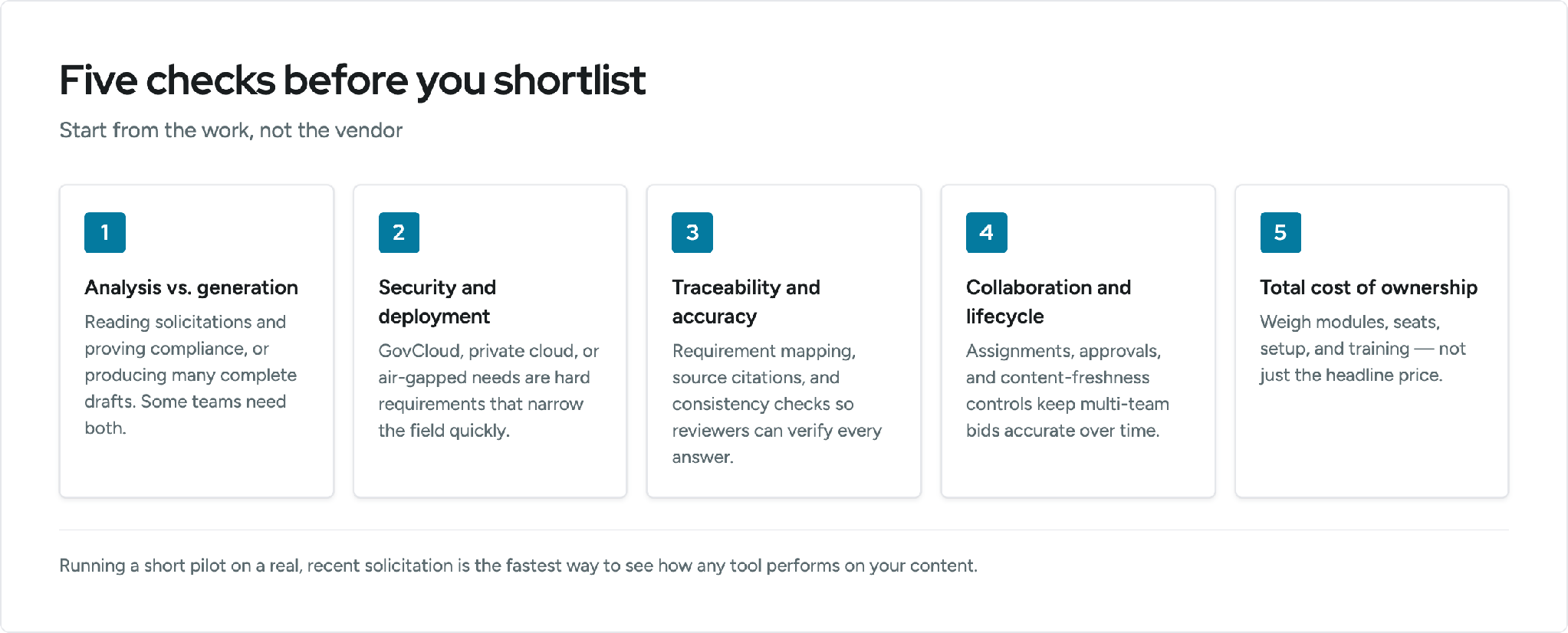
Running a short pilot on a real, recent solicitation is the fastest way to see how any tool — VisibleThread or an alternative — performs on your content.
Frequently asked questions
What is VisibleThread used for?
VisibleThread is used by proposal, capture, and compliance teams — especially government and defense contractors — to analyze solicitations, extract requirements, build compliance matrices, check acronyms, score readability, and manage bids. Its platform spans document analysis through bid writing, with an AI assistant and secure deployment options.
How much does VisibleThread cost?
VisibleThread uses a tailored, quote-based model billed as an annual, per-user subscription. Price depends on the number of licenses, the modules you need, and your deployment type (cloud, US GovCloud, private cloud, or on-premises). Content analyzed is unlimited, technical support and an SLA are included, and one-off setup and training costs may apply, so it is best to request a quote for your team.
What are VT Docs and VT Writer?
VT Docs is VisibleThread’s document-analysis product for requirement extraction, compliance matrices, and acronym checks; VT Writer focuses on readability and plain-language scoring. Both sit within the broader VisibleThread platform, which also adds opportunity search, bid/no-bid analysis, bid writing, and the Visi AI assistant.
Is VisibleThread good for government and defense proposals?
Yes — government and defense proposal teams are its core audience. Its compliance-matrix and requirement-analysis features suit federal solicitations, and its GovCloud, private-cloud, and on-premises/SCIF/air-gapped deployment options support work with strict security requirements.
What are the best VisibleThread alternatives?
It depends on the job. For readability and content governance, teams compare Acrolinx, Writer, and Grammarly Business. For end-to-end response generation and management, they compare Inventive AI, Responsive, and Loopio. Because VisibleThread often complements a response platform rather than replacing one, shortlist by the specific gap you are trying to fill.
Evaluating proposal and RFP tools? Inventive AI is an AI-native platform for RFPs, RFIs, DDQs, and security questionnaires — book a demo to see how it handles your content.

.avif)