DDQ templates: types and examples by industry
A practical guide to DDQ templates: the main types, real example questionnaires by industry with sources, response templates you can download, and how to respond faster.
A due diligence questionnaire looks different depending on who is asking and why. An investor vetting a fund, a bank screening a counterparty, and a buyer assessing a SaaS vendor all send a DDQ, but each asks about different things. Using the right DDQ template saves you from writing responses from scratch and makes sure you cover what the buyer expects.
This guide covers the main types of DDQ templates, real example questionnaires by industry with links to the recognized standards, response templates you can download, and how to respond to a DDQ faster. If you need the fundamentals first, start with our DDQ meaning guide; this article stays focused on templates and examples.
The main types of DDQ templates
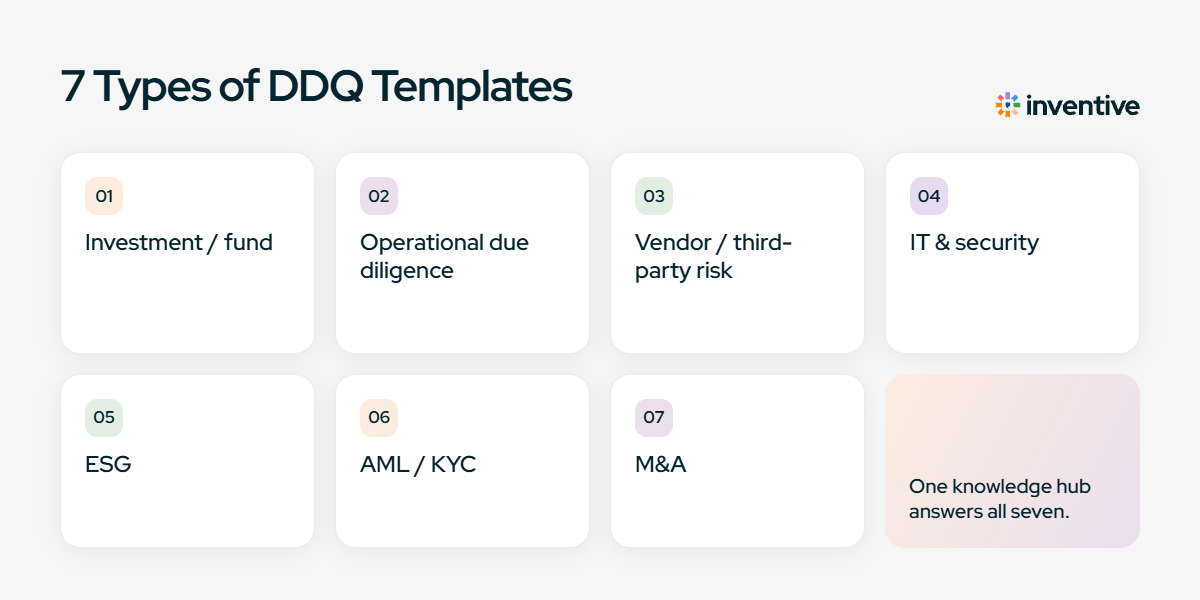
Most DDQs fall into one of seven types. The template you choose should match the risk being assessed.
DDQ examples by industry
You are usually on the receiving end of a DDQ: an investor sends one to your fund, a buyer sends one to your company, a bank sends one to your institution. Each industry has a recognized questionnaire, so you can see what you will be asked and prepare your answers in advance instead of scrambling each time.
For each context below, here is the standard DDQ, what it asks you to prove, and the response template to prepare your answers.
Private equity and venture capital
If you manage a fund, limited partners will assess you with the ILPA Due Diligence Questionnaire, the model form from the Institutional Limited Partners Association. Expect to provide:
- Your track record across prior funds, including gross and net IRR and DPI.
- Your team structure and key-person provisions.
- Your fee structure, carried interest, and any offsets.
Prepare these responses once with our private equity DDQ template.
Hedge funds
If you manage a hedge fund, allocators will assess you with the AIMA Due Diligence Questionnaires, the Alternative Investment Management Association's standard for investment managers and funds of funds. Expect to provide:
- Your strategy, the instruments you trade, and your typical leverage.
- Your service providers, prime broker, administrator, and auditor, and how often the fund is valued.
- Your risk management framework and position limits.
Prepare your DDQ responses with our AIMA DDQ template.
Banking and financial services (AML / KYC)
If you are a bank or financial institution, counterparties and correspondents will assess you with the Wolfsberg Correspondent Banking DDQ (CBDDQ), the financial-crime standard from the Wolfsberg Group. Expect to prove:
- Your ultimate beneficial ownership and group structure.
- Your sanctions screening program and the lists you screen against.
- That your AML program is independently tested, and how often.
Prepare your responses with our finance and banking DDQ template, plus the downloadable AML/KYC response template in the section below.
IT, security, and vendor risk
If you are a vendor, buyers will assess you with the Shared Assessments SIG (Standardized Information Gathering) questionnaire, the third-party risk standard covering security, continuity, and data handling. Expect to prove:
- The certifications you hold, such as SOC 2 Type II or ISO 27001, and their dates.
- How you encrypt customer data at rest and in transit.
- Your incident response and breach notification process.
Prepare your responses with our cybersecurity DDQ template, IT infrastructure DDQ, or supplier risk assessment template.
ESG
If investors or buyers assess your ESG practices, they will often use the UN PRI Responsible Investment DDQs, the Principles for Responsible Investment questionnaires for hedge funds and private markets. Expect to prove:
- Your ESG policy and who holds board-level accountability for it.
- How you measure and report greenhouse gas emissions and set targets.
- How you assess ESG risk in your supply chain or portfolio.
Download a DDQ response template by industry
Prepare your answers once, then reuse them every time you receive that DDQ. Start from the one that matches your industry.
- Private equity DDQ — view the template
- Hedge fund (AIMA) DDQ — view the template
- Finance and banking DDQ — view the template
- Cybersecurity DDQ — view the template
- IT infrastructure DDQ — view the template
- Operational due diligence checklist — view the checklist
- Supplier/vendor risk DDQ — view the template
Need one we don't cover elsewhere? Download these response templates directly. Each pairs every question with space to prepare your answer and the evidence to attach:
ESG DDQ response template
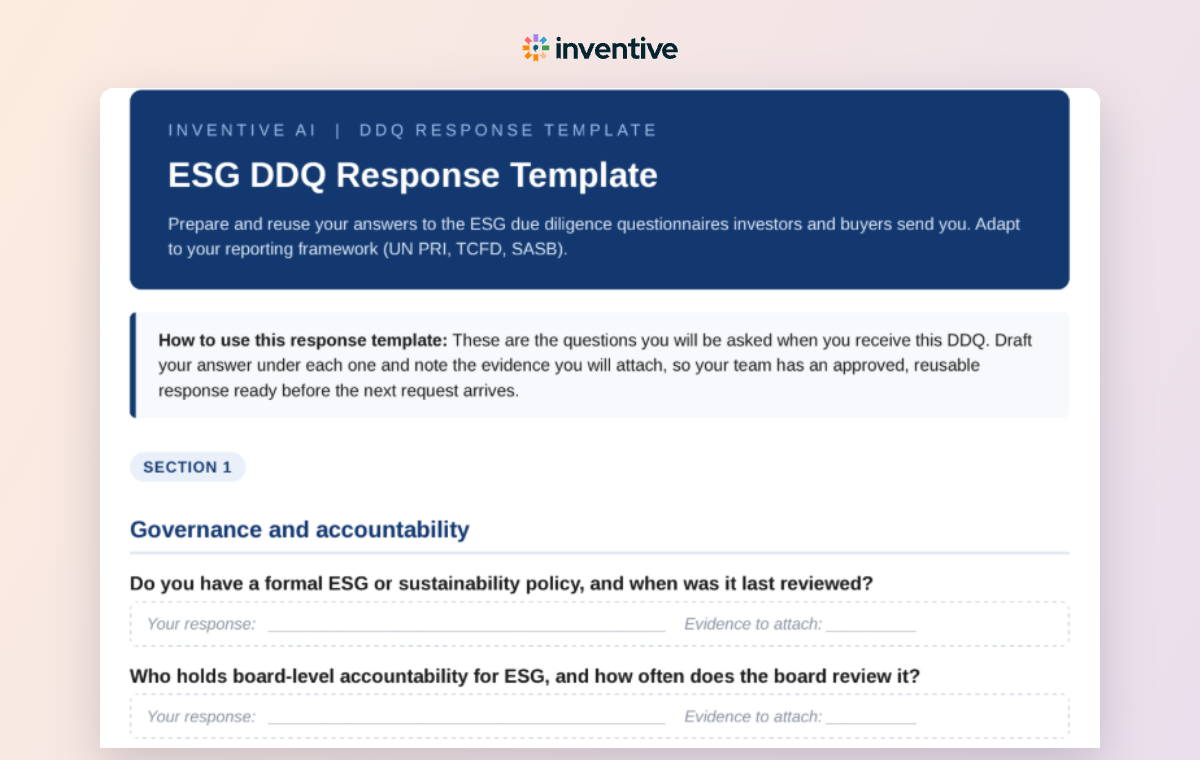
This template lists the ESG questions investors and buyers ask most and gives you space to write your answer and note the evidence for each one. It covers your ESG policy and board oversight, greenhouse gas emissions and targets, diversity and safety, anti-corruption, and ESG risk in your supply chain.
AML / KYC DDQ response template

This template lists the anti-money-laundering and KYC questions banks and counterparties ask, following the Wolfsberg CBDDQ structure. It covers beneficial ownership, sanctions and PEP screening, your AML program and testing, KYC checks, and transaction monitoring, with space for your answer and supporting evidence.
Insurance DDQ response template

This template lists the due diligence questions carriers, brokers, MGAs, and program partners are asked before appointment and at renewal. It covers licensing and financial-strength ratings, underwriting, claims and reinsurance, compliance, and data security, with space for your answer and evidence.
What a good DDQ response template includes
Whatever the type, a strong DDQ response template shares the same backbone, so your prepared answers cover everything an assessor looks for. Check yours includes:
- Company and ownership information. Legal entity, structure, ownership, and key contacts.
- The core risk area. The heart of the questionnaire, whether that's investment strategy, security controls, or financial crime.
- Governance and controls. Your policies, oversight, and how you enforce them.
- Third parties and service providers. Who else is involved and how you manage them.
- Compliance and certifications. Relevant standards, audits, and evidence, with dates.
- Supporting documents. The attachments assessors expect, such as audited financials or a SOC 2 report.
How to respond to a DDQ
When a DDQ lands, it can pull in several teams and take days. A repeatable process keeps each one faster and more consistent than the last.
- Centralize your source answers. Keep your approved answers, policies, certifications, and past DDQs in one place, so responders aren't hunting through inboxes and drives.
- Map incoming questions to what you already have. Most questions repeat across DDQs. Match each one to an existing approved answer before writing anything new.
- Route only new or material questions to experts. Send the genuinely new items to the right subject-matter expert, and reuse the standard answers.
- Attach evidence and keep it current. Support each answer with its source document, and check that certifications and figures are the latest version before you submit.
- Review, then log the outcome. Have a reviewer approve anything material, then save the final answers back to your library so the next DDQ starts further ahead.
For more on scaling this, see our guides on automating due diligence questionnaires and streamlining the DDQ process.
Answer DDQs faster with Inventive AI
Filling each DDQ from scratch is slow, and the questions repeat across every request. This is what DDQ and RFP response software is built for.
Inventive AI is an autonomous AI agent platform for DDQs, RFPs, RFIs, and security questionnaires. It drafts answers to a DDQ by retrieving them from your past questionnaires, policies, and approved company knowledge, then attaches a source citation and a confidence score to each one, and flags anything it cannot support for review. Content Governance detects outdated or conflicting answers before you submit.
The repetitive questions answer themselves from your own knowledge, and your experts spend their time only on what is new. Customers report responses up to 90% faster.