Conveyor AI Pricing, Features, and Reviews (2026 Guide)
In this blog, we’ll break down Conveyor AI pricing and reviews. We'll also explore when teams may need a more robust RFP automation platform to support their next stage of growth.
Conveyor AI is a customer-trust automation platform that helps SaaS companies respond to security questionnaires, host a Trust Center, and share compliance documentation with prospects. If you are evaluating it, the questions that usually matter most are what it does, what it costs, how real users rate it, and where it fits best. This guide walks through Conveyor AI’s pricing, features, ratings, strengths, and limitations, so you can decide whether it matches your security-review and proposal workflows.
Interest in AI for this kind of work is rising quickly — McKinsey reports that a large majority of companies plan to invest in generative AI over the next few years — and tools like Conveyor sit at the center of that shift for security and GRC teams. The right fit depends less on any single vendor’s marketing and more on your questionnaire volume, your compliance requirements, and how much of your proposal work extends beyond security reviews.
Key takeaways
- Conveyor AI is a customer-trust and security questionnaire automation platform, best known for its Trust Center and AI-assisted questionnaire responses.
- Core capabilities include AI answer suggestions, a Trust Center knowledge base, automated questionnaire completion, a shareable security portal, and integrations such as Slack.
- Conveyor holds a 4.6/5 average on G2, and in 2025 it raised a $20M Series B to expand its agentic AI for customer-trust automation.
- Public pricing includes a free plan and a Professional plan starting at $9,600/year (billed annually), with usage governed by Trust Center and questionnaire credits.
- Conveyor is a strong fit for security and compliance teams; organizations that also need broad RFP, RFI, and DDQ proposal automation often evaluate it alongside dedicated proposal platforms.
What is Conveyor AI?
Conveyor AI is a platform for automating the “customer trust” side of B2B sales: the security reviews, vendor questionnaires, and compliance documentation that buyers request before signing. Rather than having a security or GRC team answer the same questions for every deal, Conveyor lets companies publish a self-serve Trust Center, share audit reports and certifications under NDA, and generate AI-assisted answers to incoming security questionnaires.
The company positions itself around “agentic” automation for security reviews. In 2025 it raised a $20M Series B to expand that work, and TechCrunch has covered its use of AI to automate vendor security reviews. That focus on security and trust workflows is the clearest way to understand where Conveyor fits — and where a different tool might suit teams whose needs extend well beyond security questionnaires.
Conveyor AI key features
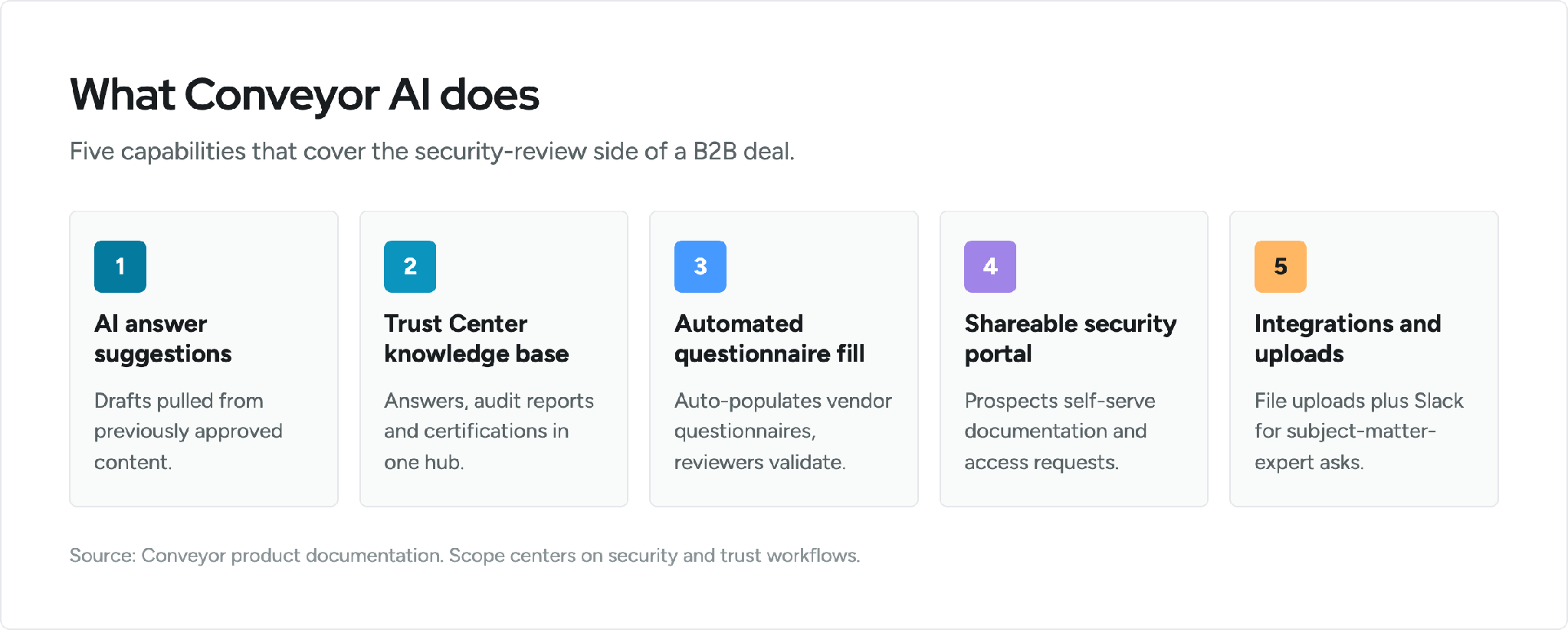
Conveyor’s capabilities cluster around answering security questionnaires and sharing trust documentation:
- AI-powered answer suggestions. Conveyor suggests answers from previously approved content, which speeds up repetitive security-questionnaire responses. As with any retrieval-based approach, output quality depends on how complete and current the underlying answer library is.
- Trust Center knowledge base. Teams store common answers, documents, audit reports, and certifications in a centralized hub that can be shared with prospects.
- Automated questionnaire response. The platform can auto-fill vendor security questionnaires from existing answers; reviewers still validate outputs for nuanced or customer-specific questions.
- Shareable security portal. A self-serve Trust Center lets prospects access security documentation, request access, and get instant answers without a manual back-and-forth.
- Integrations and file uploads. Conveyor supports document uploads and integrations, including a Slack integration commonly used for subject-matter-expert “Ask” workflows.
For a broader view of tools in this space, Inventive’s guide to the best AI agents for security questionnaires compares options on features and fit.
Conveyor AI pricing
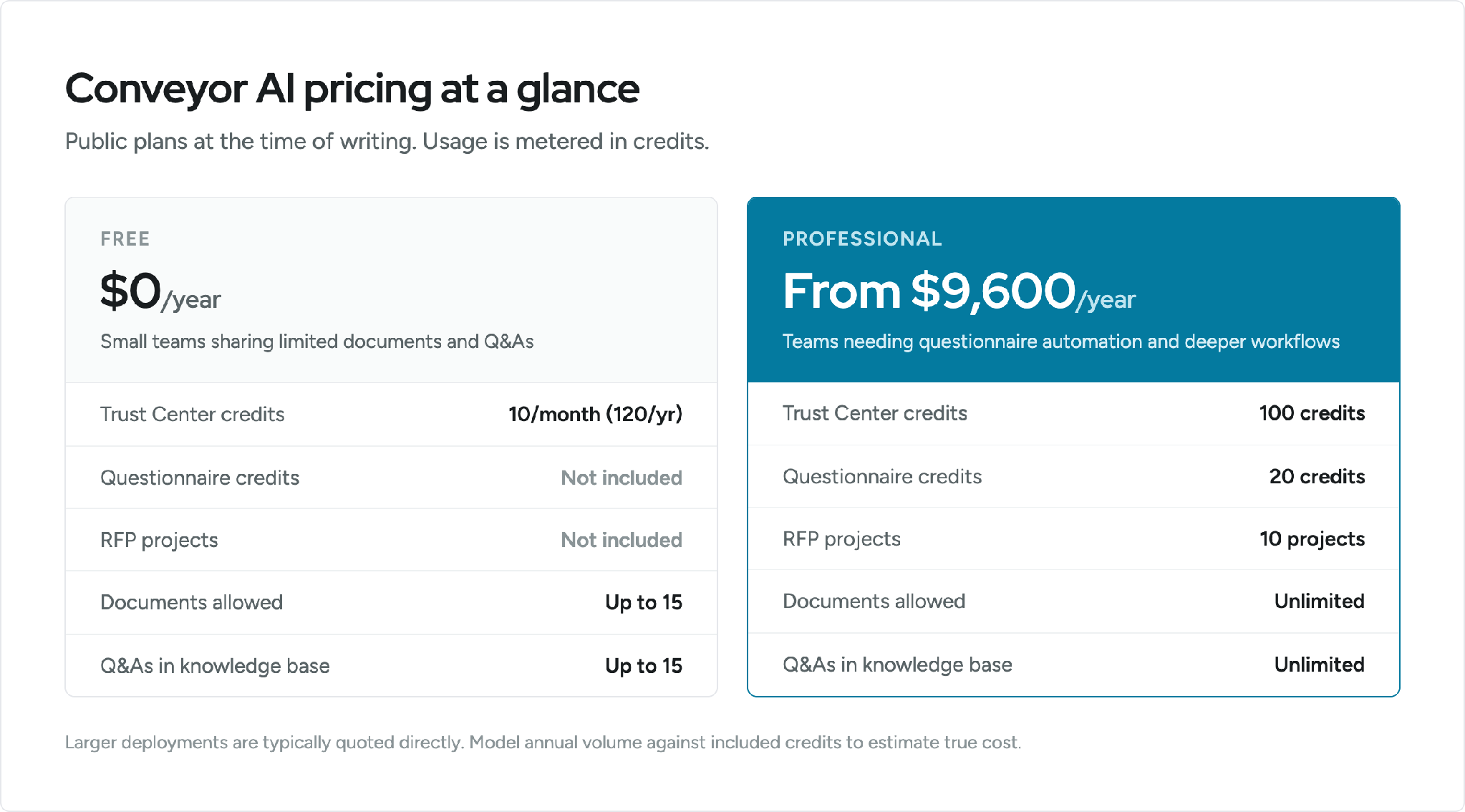
Conveyor publishes more pricing detail than many tools in this category. At the time of writing, the public plans are:
The free plan is a low-commitment way to publish a basic Trust Center, while the Professional plan adds questionnaire automation and higher limits. Because usage is metered in credits, teams with high questionnaire or RFP volume should model their annual volume against the included credits to estimate true cost. Beyond the published tiers, larger deployments are typically quoted directly.
Conveyor AI reviews and ratings
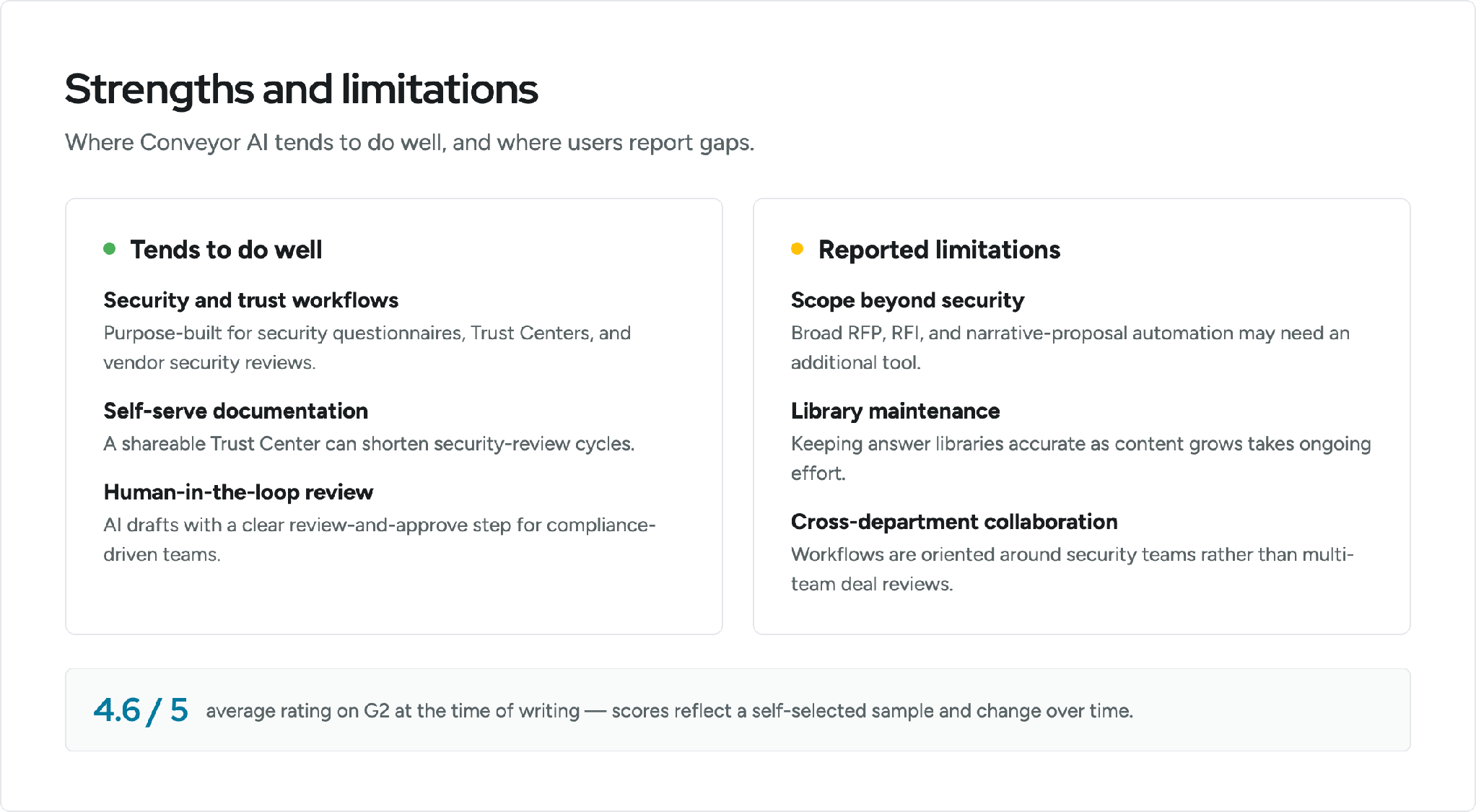
At the time of writing, Conveyor carries an average rating of 4.6 out of 5 on G2. Common themes in user feedback include:
- Praised: meaningful time savings on security questionnaires, strong AI accuracy on first-pass answers, and an easy-to-share Trust Center that reduces manual back-and-forth with prospects.
- Raised as limitations: the need to review AI output for nuanced or customer-specific questions, maintenance effort to keep the answer library current, and a scope centered on security and trust workflows rather than full proposal automation.
As with any peer-review source, scores reflect a self-selected sample and change over time, so it is worth reading recent reviews from teams whose size and use case resemble your own.
Conveyor AI strengths and limitations
Like most tools, Conveyor is stronger in some scenarios than others.
Where Conveyor AI tends to do well
- Security and trust workflows. Conveyor is purpose-built for security questionnaires, Trust Centers, and vendor security reviews — the core of its value.
- Self-serve documentation. A shareable Trust Center lets prospects access compliance materials directly, which can shorten security-review cycles.
- Human-in-the-loop review. The workflow suits compliance-driven teams that want AI drafts with a clear review-and-approve step.
Where users report limitations
- Scope beyond security. Conveyor centers on security and trust content; teams needing broad RFP, RFI, and narrative-proposal automation may need an additional tool.
- Library maintenance. Keeping answer libraries accurate as content grows takes ongoing effort.
- Cross-department collaboration. Workflows are oriented around security teams; organizations coordinating sales, solutions, legal, and proposal teams on large deals should confirm it fits their review process.
Who Conveyor AI is best for
Conveyor is a strong fit for security, GRC, and compliance teams at SaaS companies that field frequent security questionnaires and want a self-serve Trust Center to speed up vendor reviews. Teams whose work is predominantly security-review and DDQ oriented tend to see the fastest payback; guides like how to answer a security questionnaire and the SaaS security questionnaire guide pair well with that workflow.
Organizations whose proposal work extends well beyond security — high-volume RFPs and RFIs, long-form narrative proposals, and multi-department reviews across sales, solutions, legal, and compliance — should confirm whether Conveyor’s security-centric scope covers their full lifecycle, or whether they need a dedicated proposal platform alongside it.
Conveyor AI alternatives to consider
Conveyor is focused on security and trust workflows, so teams that also need full RFP, RFI, and DDQ proposal automation sometimes evaluate a broader platform alongside it. One option in that category is Inventive AI, an AI-native platform for RFPs, RFIs, DDQs, and security questionnaires that adds a context engine, source-cited answers, and content-governance checks; customers report outcomes such as 90% faster responses at MaxVal and 422% ROI at AssetWorks. For a direct feature-by-feature view, see the Conveyor vs. Inventive AI comparison.
For a wider set of options — including other security-questionnaire and trust-automation tools — see the dedicated Conveyor alternatives and competitors guide.
How to choose security questionnaire and proposal software
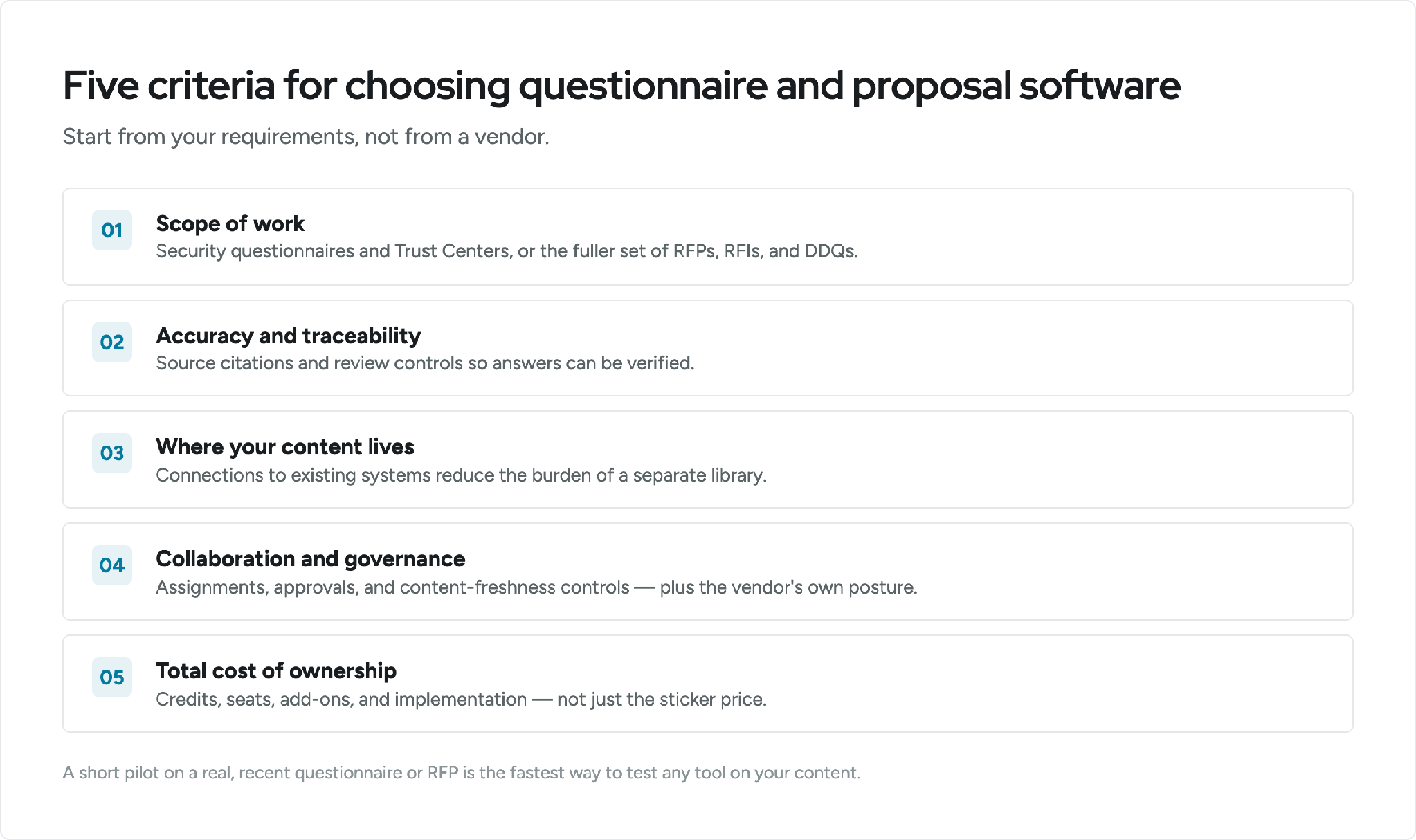
Rather than starting from a vendor, start from your requirements. A few criteria that reliably separate the right tool from the wrong one:
- Scope of work. Match the tool to what you actually respond to — security questionnaires and Trust Centers, or the fuller set of RFPs, RFIs, and DDQs.
- Accuracy and traceability. Look for source citations and review controls so answers can be verified — essential for security and compliance content.
- Where your content lives. Tools that connect to your existing systems reduce the burden of maintaining a separate library.
- Collaboration and governance. Assignments, approvals, and content-freshness controls keep multi-team responses accurate over time. Confirm any vendor’s own posture too, such as SOC 2 compliance.
- Total cost of ownership. Weigh credits, seats, add-ons, and implementation, not just the sticker price.
Running a short pilot on a real, recent questionnaire or RFP is usually the fastest way to see how any tool performs on your content.
Frequently asked questions
What is Conveyor AI used for?
Conveyor AI is used to automate security questionnaires and share trust documentation with prospects. It lets teams reuse approved answers, host audit reports and certifications in a Trust Center, and provide a self-serve security portal, which speeds up vendor security reviews. It is centered on security and trust workflows rather than end-to-end RFP or RFI proposal management.
How much does Conveyor AI cost?
Conveyor offers a free plan ($0/year) with limited documents, Q&As, and Trust Center credits, and a Professional plan starting at $9,600/year billed annually that adds questionnaire automation, RFP projects, and higher limits. Because usage is metered in credits, total cost depends on your questionnaire and RFP volume, and larger deployments are typically quoted directly.
Is Conveyor AI good for enterprise RFP and proposal management?
Conveyor works well for security questionnaires, DDQs, and Trust Center workflows. Organizations with broad, enterprise-scale proposal needs — high-volume RFPs and RFIs, long-form narrative proposals, and multi-department review cycles — should confirm that its security-centric scope covers their full lifecycle or plan to pair it with a dedicated proposal platform.
How accurate is Conveyor AI for security questionnaires?
Conveyor uses AI to suggest answers from previously approved content, and users generally report strong first-pass accuracy and meaningful time savings on security questionnaires. As with any retrieval-based tool, reviewers still validate outputs for nuanced or customer-specific questions, and accuracy improves as the underlying answer library is kept current.
What are the best Conveyor AI alternatives?
Teams that outgrow a security-only scope and need full RFP, RFI, and DDQ automation often evaluate Inventive AI, an AI-native proposal platform, alongside Conveyor. For a broader comparison of security-questionnaire and trust-automation tools, see the Conveyor alternatives and competitors guide.
Evaluating tools for security questionnaires and RFPs? Inventive AI automates RFPs, RFIs, DDQs, and security questionnaires with source-cited answers — book a demo to see how it handles your content.

.avif)