QorusDocs Pricing in 2026: Real Costs, Tiers & Hidden Fees
In this blog, we’ll review QorusDocs' pricing, features, and limitations to help you decide if it’s the right fit for your growing team, or if Inventive AI is the more robust solution for enterprise-level RFP needs.
If you’ve tried to find out what QorusDocs costs, you’ve hit the same wall every proposal and bid team hits: no public price, a “contact sales” button, and a custom quote you can’t sanity-check against anything. This page lays out what’s actually known about QorusDocs pricing in 2026 — the model, a realistic per-seat estimate to plan around, the Microsoft 365 dependency, and the setup and renewal costs that never show up in the first quote — so you can walk into that sales call already knowing roughly what a fair number looks like.
QorusDocs pricing at a glance
QorusDocs does not publish pricing. Both G2 and Capterra list it as “no pricing available,” and the vendor runs a sales-led, quote-based model — so your number depends on how many seats you need, which tier you land on, and how much onboarding is involved.
There’s no official figure to quote, so treat the following as a planning estimate, not a price list:
- Per user: estimated at around $100 per user/month, billed annually. Enterprise proposal platforms in this category cluster in that range; confirm your actual number with a direct quote.
- Small team (10 seats): on the order of ~$12,000/year in licensing at that estimate, before onboarding and any Microsoft 365 costs.
- Enterprise (100+ seats): custom annual contracts that scale into six figures, negotiated on seats, modules, and scope.
- No public self-serve tier: QorusDocs is evaluated through a guided demo or a scoped pilot rather than an open free trial.
QorusDocs pricing snapshot (2026 — planning estimate) Model: no public pricing — custom, quote-based, billed annually · Estimated: ~$100 / user / month · Example: a 10-seat team ≈ ~$12,000 / year in licensing, before onboarding and Microsoft 365 costs · Enterprise (100+ seats): six figures on custom terms QorusDocs publishes no official pricing. The per-seat figure is an estimate to plan against — confirm with a written quote.

A caveat worth repeating: because the vendor packages by team size, modules, and deployment scope, two companies of the same headcount can land on very different numbers. Use the estimate to frame the conversation, not to lock a budget.
How QorusDocs pricing works
Per-seat licensing. QorusDocs is a per-user SaaS subscription, usually billed annually for larger rollouts. Because it’s priced per seat, cost scales directly with how many people need access — something to weigh if you want reviewers and occasional contributors in the tool, not just full-time proposal writers. Plan around roughly $100 per user/month until you have a quote in hand.
The Microsoft 365 dependency. QorusDocs positions itself as “AI proposal software for Microsoft 365” and is built natively into Word, PowerPoint, Outlook, and SharePoint/Teams. For teams already standardized on Microsoft, that’s a real fit and a genuine selling point. For teams that aren’t, the licensing needed to get there is effectively part of the QorusDocs cost of ownership, and worth modeling before you compare quotes.
Tiers. QorusDocs packages into multiple levels, with higher tiers unlocking more advanced automation, analytics, integrations, and support. If your evaluation depends on deeper integrations or admin controls, confirm which tier they sit in, because tier placement is usually what moves the quote.
Implementation and onboarding. Setup to ingest your historical content, templates, and permissions is typically a separate, one-time line item on top of the subscription. The more customization your deployment needs, the larger that number gets.
What a QorusDocs deal is likely to cost
Working from the ~$100 per user/month planning estimate, a rough build looks like this for a 10-person proposal team:
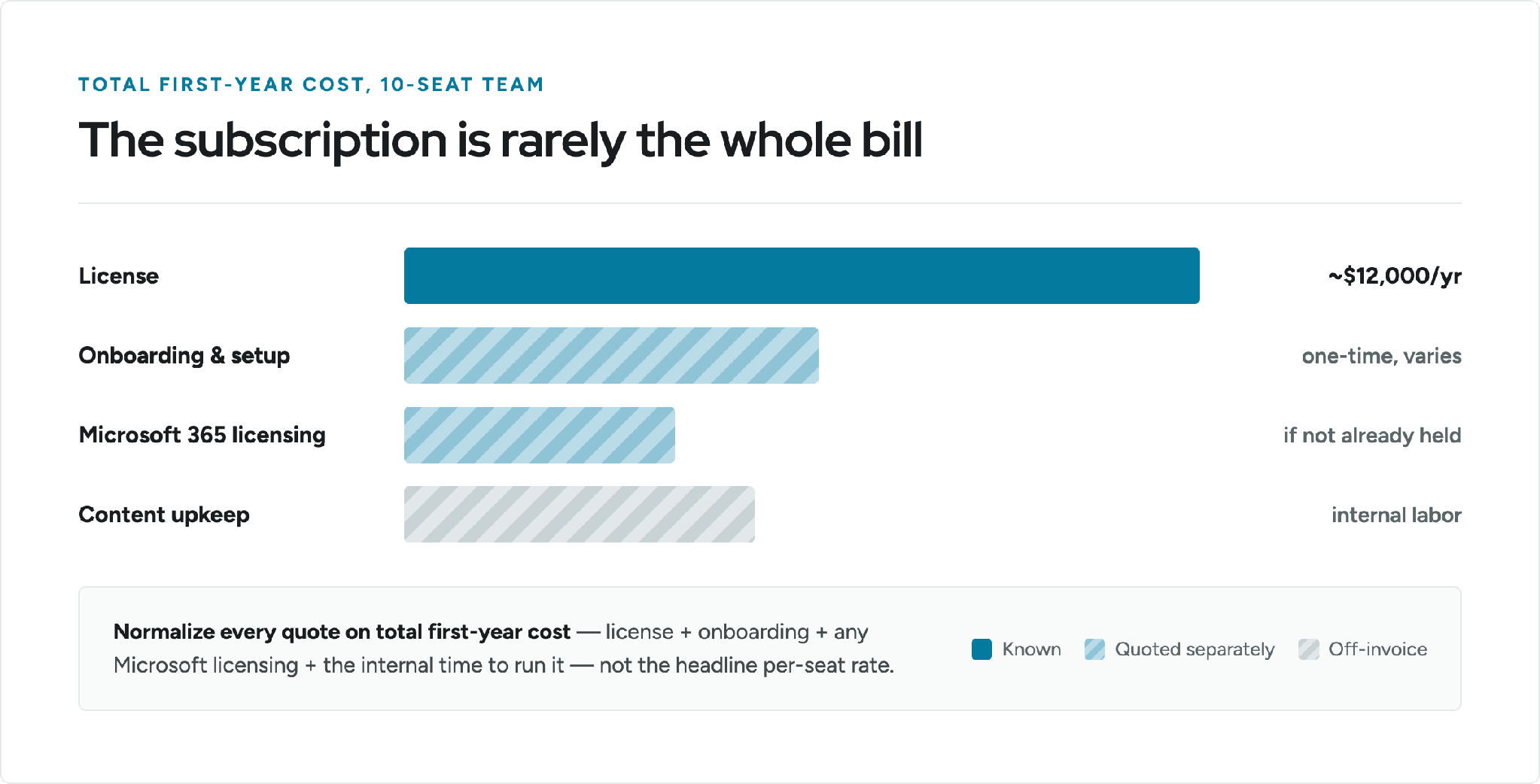
- License: ~$12,000/year (10 seats × ~$100/user/month)
- Onboarding: a one-time implementation fee on top, scaling with complexity
- First-year total: meaningfully higher than the license alone once onboarding and any Microsoft licensing are added
Scale to 100 seats and licensing moves into six figures a year before add-ons, on fully custom terms. If your team runs a high volume of RFPs, it’s worth reading the true cost of manual RFP work alongside any quote, because the status quo has a price too.
Compare it to a usage-based model. At 10+ seats, per-seat pricing adds up fast. Inventive AI charges on usage, not headcount, so cost tracks the work you do rather than the number of logins. See how Inventive AI pricing compares →
Hidden costs to budget for
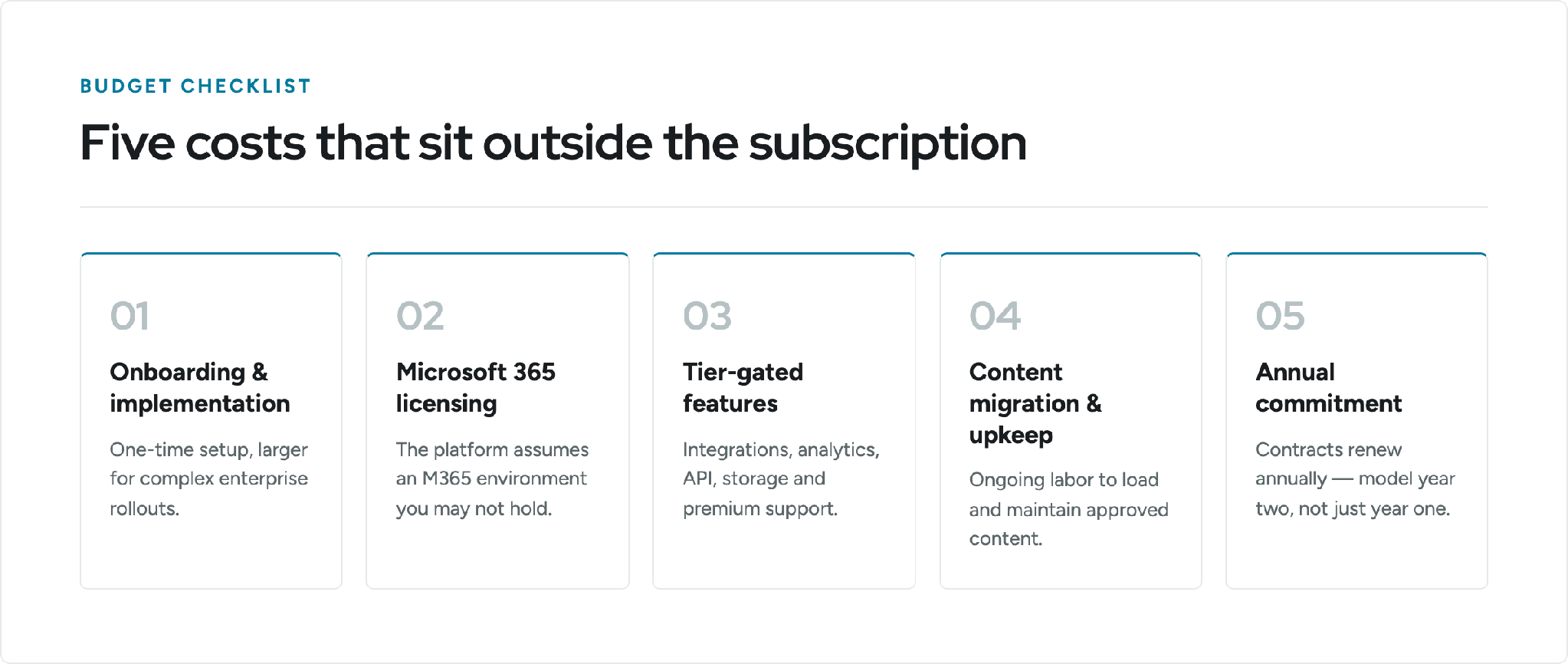
The subscription is rarely the whole bill. Budget for several add-ons and indirect costs that are common with enterprise proposal software like QorusDocs:
- Onboarding / implementation — a one-time setup cost, larger for complex enterprise rollouts.
- Microsoft 365 licensing — the platform assumes an M365 environment; budget for any licensing you don’t already hold.
- Tier-gated features — advanced integrations, analytics, API access, added storage, and premium support tiers can require a higher tier or cost extra.
- Content migration and upkeep — like any library-based tool, someone has to load and maintain approved content. That’s ongoing labor, not a line on the invoice, and it’s the cost buyers underestimate most.
- Annual commitment — enterprise contracts are typically annual, so model the renewal, not just year one.
When you compare quotes, normalize on total first-year cost — license plus onboarding plus any Microsoft licensing plus the internal time to run it — rather than the headline per-seat rate. That’s the number that actually hits your budget. Our build-vs-buy guide for RFP software walks through how to frame that math.
See the AI-native alternative to QorusDocs. No Microsoft 365 dependency, no per-seat tax, and a knowledge base that stays current automatically instead of relying on manual upkeep. Explore the top QorusDocs alternatives →
How QorusDocs pricing compares
QorusDocs sits in a category where almost nobody publishes rates. Direct competitors like Loopio and Responsive (RFPIO) are also quote-based, while document-led tools such as Proposify publish lower per-seat pricing because they solve a narrower, presentation-focused problem. That makes headline comparisons misleading — a cheaper per-seat rate can hide a narrower feature set, and a quote-based tool can come in lower or higher than a published one depending on your scope.

The practical move is to pull quotes from two or three tools in parallel and compare them on total first-year cost and fit for your workflow. Our best RFP software guide and enterprise RFP software comparison are a good starting shortlist.
Get more contextual responses than QorusDocs. Inventive AI’s Context Engine tailors every answer to the specific deal and ships each one with citations and a confidence score. See how it works →
If you’re price-checking QorusDocs against an AI-native option
One reason teams price-check QorusDocs is that per-seat, Microsoft-centric licensing gets expensive as more contributors need access — and the per-seat model can discourage putting the whole revenue team in the tool.
A different pricing approach in the category is usage-based rather than per-seat: Inventive AI, for example, prices on usage instead of seats, which changes the math when adoption is broad. On outcomes, its published case studies report 90% faster responses and a 50% higher win rate at Insider and 422% ROI at AssetWorks Facilities. If the seat model or Microsoft dependency is your sticking point with QorusDocs, the QorusDocs alternatives guide lays out the options, and you can see how usage-based RFP pricing compares.
Frequently asked questions
How much does QorusDocs cost?
QorusDocs doesn’t publish pricing — it’s a custom, sales-led quote. As a planning estimate, budget around $100 per user per month on an annual contract, so a 10-seat team is on the order of ~$12,000/year in licensing before onboarding and Microsoft 365 costs. Treat that as an estimate and confirm with a direct quote.
Does QorusDocs publish its pricing?
No. G2 and Capterra both list QorusDocs as “no pricing available,” and the vendor uses a sales-led, custom-quote model. What you pay depends on seats, the tier you choose, the modules you need, and your deployment scope.
Is QorusDocs priced per user?
Yes — it’s a per-seat SaaS subscription, usually billed annually for larger teams. Cost therefore scales with how many people need access, which is the main lever on the quote.
Does QorusDocs offer a free trial?
QorusDocs is sold through a sales-led process, so evaluation is typically a guided demo or a scoped pilot rather than an open self-serve free trial or public free tier. Ask about a pilot when you request a quote.
Do I need Microsoft 365 to use QorusDocs?
QorusDocs is built for Microsoft 365 (Word, PowerPoint, Outlook, SharePoint/Teams). Teams already on M365 get a natural fit; teams on other stacks should factor any additional Microsoft licensing into the total cost of ownership.
What hidden costs come with QorusDocs?
Common extras include onboarding and implementation, higher-tier feature gating (integrations, analytics, API), storage and support tiers, and the ongoing labor to maintain the content library. Enterprise contracts are typically annual, so budget for renewal as well as year one.
How does QorusDocs pricing compare to other RFP tools?
Most direct competitors (Loopio, Responsive) are also quote-based; document-led tools like Proposify publish lower per-seat rates for a narrower use case. Compare on total first-year cost and workflow fit rather than headline rate — see our best RFP software guide and QorusDocs alternatives.


.avif)