How to write an RFP: Structure, requirements and best practices
Writing a strong RFP response takes strategy, not just effort. Use these practical tips and AI-backed guidance to submit better responses and win more.
TL;DR
- An RFP is written by the buyer to define requirements and invite comparable vendor proposals. The vendor's reply is the proposal, and confusing the two is the most common terminology error.
- A complete RFP document has eight sections: introduction, scope of work, requirements, timeline, vendor qualifications, evaluation criteria, submission instructions, and terms.
- The RFP package is broader than the RFP document. It adds the pricing workbook, requirements matrix, questionnaires, and draft contract that make bids genuinely comparable.
- Requirements should separate mandatory from desirable, state measurable acceptance criteria, and describe outcomes rather than prescribing a solution.
- Publishing evaluation criteria and weightings upfront improves bid quality, because vendors invest effort where the points actually are.
- Most weak RFPs fail on four things: vague requirements, unrealistic timelines, undisclosed budget, and no pricing template, all of which produce bids you cannot compare.
Writing an RFP is a document design problem. The quality of the bids you receive is set almost entirely by the quality of the document you issue, and most of the frustration buyers report during evaluation traces back to decisions made while drafting.
This guide covers how to structure an RFP, what belongs in the wider package, how to write requirements that produce comparable responses, and the mistakes that most often lead to bids you cannot fairly compare. It is written for the buyer side. Vendors preparing a reply will find the mechanics in the guide to writing an RFP response.
What should an RFP include?
A standard RFP document contains eight sections, ordered so a vendor can read it once and understand what to bid on, how to bid, and how they will be judged.
Sections can be reordered or combined for smaller procurements, but omitting evaluation criteria or submission instructions reliably produces bids that cannot be compared side by side.
What is an RFP package and what does it include?
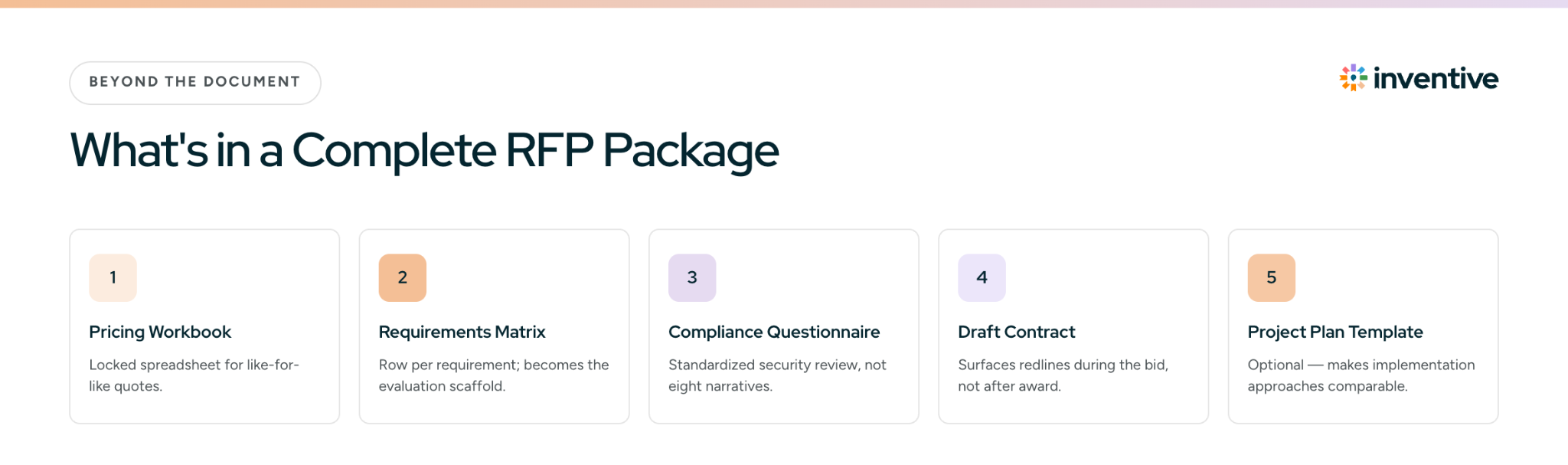
An RFP package is the full set of documents issued to vendors, of which the RFP itself is one part. The document states requirements, and the package supplies the templates, forms, and reference material vendors need to respond in a standardized way.
The distinction matters because comparability comes from the package rather than the document. Two vendors reading identical requirements will still produce incomparable bids if neither was given a pricing template.
A complete package typically adds:
- Pricing workbook: A locked spreadsheet with defined line items, so quotes normalize into a like-for-like comparison rather than arriving in five different structures.
- Requirements matrix: A row per requirement where vendors confirm compliance, partial compliance, or exception, which becomes your evaluation scaffold.
- Security or compliance questionnaire: Standardized so security review does not require reading eight differently organized narratives.
- Draft contract or key terms: Surfacing redlines during the bid rather than after award, when your leverage has gone.
- Project plan template: Optional, but it makes implementation approaches comparable rather than stylistic.
The pricing workbook is the single highest-return attachment. Without it, commercial comparison consumes more evaluation time than every other criterion combined.
How to write RFP requirements
Requirements are where most RFPs fail. Write outcomes with measurable acceptance criteria, and separate what is mandatory from what is merely desirable.
Four rules that produce better bids:
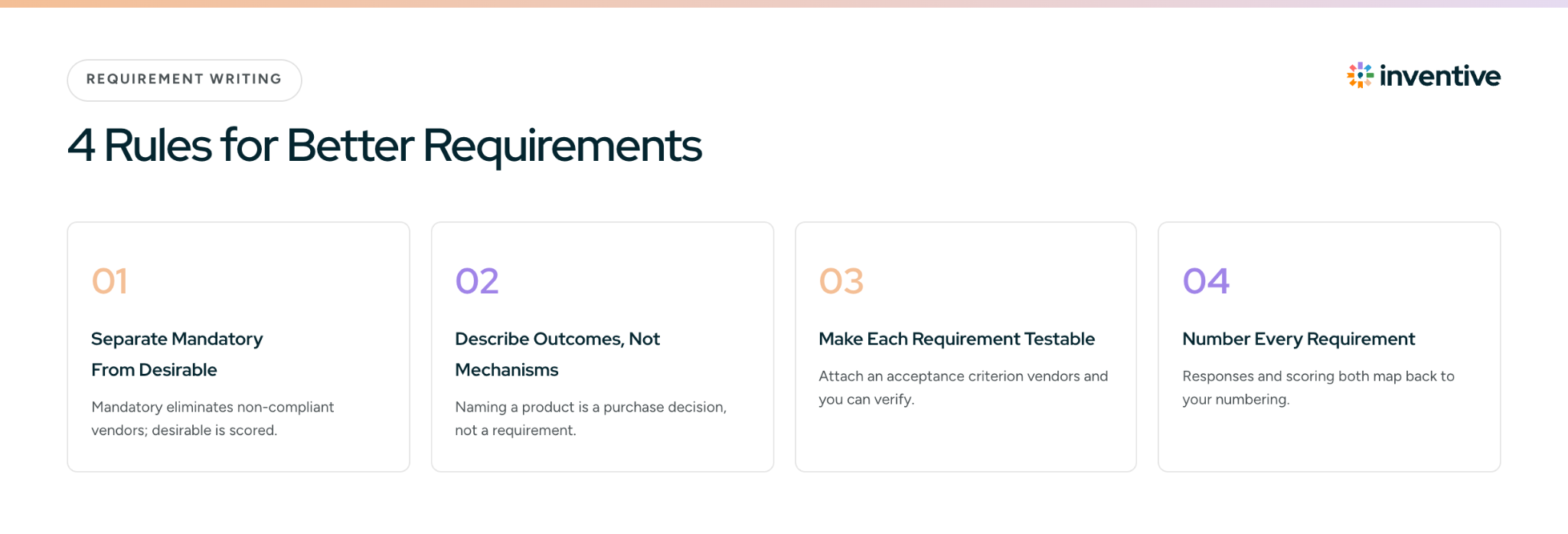
- Separate mandatory from desirable explicitly: Mandatory requirements are pass or fail and eliminate non-compliant vendors before scoring. Desirable requirements are scored. When everything reads as mandatory, capable vendors self-select out over a requirement you would have traded away.
- Describe the outcome, not the mechanism: Stating that the system must support single sign-on via SAML 2.0 is a requirement. Stating that it must use a named product is a purchase decision disguised as one, and it removes the better solutions you issued an RFP to find.
- Make each requirement testable: Attach an acceptance criterion a vendor can confirm and you can later verify. Intuitive interface is not testable. A new user completing the core workflow without training within ten minutes is.
- Number every requirement: Vendors respond against your numbering, and your evaluation scores against it. Unnumbered prose requirements produce responses you cannot map back.
How to write requirements for different categories
The pattern holds regardless of what you are buying. For any category, requirements fall into five groups, and working through them in order surfaces the gaps:
- Functional: What the solution must do, expressed as user or business outcomes.
- Technical: Integration points, architecture constraints, data residency, performance thresholds.
- Security and compliance: Certifications required, regulatory obligations, data handling terms.
- Service and support: Response times, escalation paths, availability targets, support coverage hours.
- Commercial: Pricing model, contract length, renewal terms, exit and data portability.
Two examples of how the emphasis shifts. For a business intelligence platform, implementation speed and data source connectivity usually dominate, so acceptance criteria should name the specific source systems and the required time to first dashboard. For a cybersecurity or network service, the weight moves to measurable service levels, so requirements should state detection or response time thresholds and the evidence vendors must supply to prove them.
In both cases the improvement comes from the same move: converting a capability claim you cannot verify into a threshold you can.
How to set RFP evaluation criteria
Publish your evaluation criteria and weightings in the RFP. Vendors concentrate effort where the points are, so undisclosed criteria produce bids optimized for the wrong things.
A workable model for most enterprise procurements:
Three practices separate a defensible evaluation from a decorative one. Score against evidence rather than assertion, since a claim with no supporting artifact is unverified. Run a moderation session where reviewers with large score divergences reconcile, because divergence usually signals an ambiguous response rather than genuine disagreement. And record the rationale alongside the score, since that record is what defends the award if an unsuccessful bidder challenges it.
Buyers building a formal framework will find more depth in the guides to RFP evaluation criteria and RFP scoring templates, alongside the wider vendor selection criteria most procurement teams apply.
The RFP process, step by step
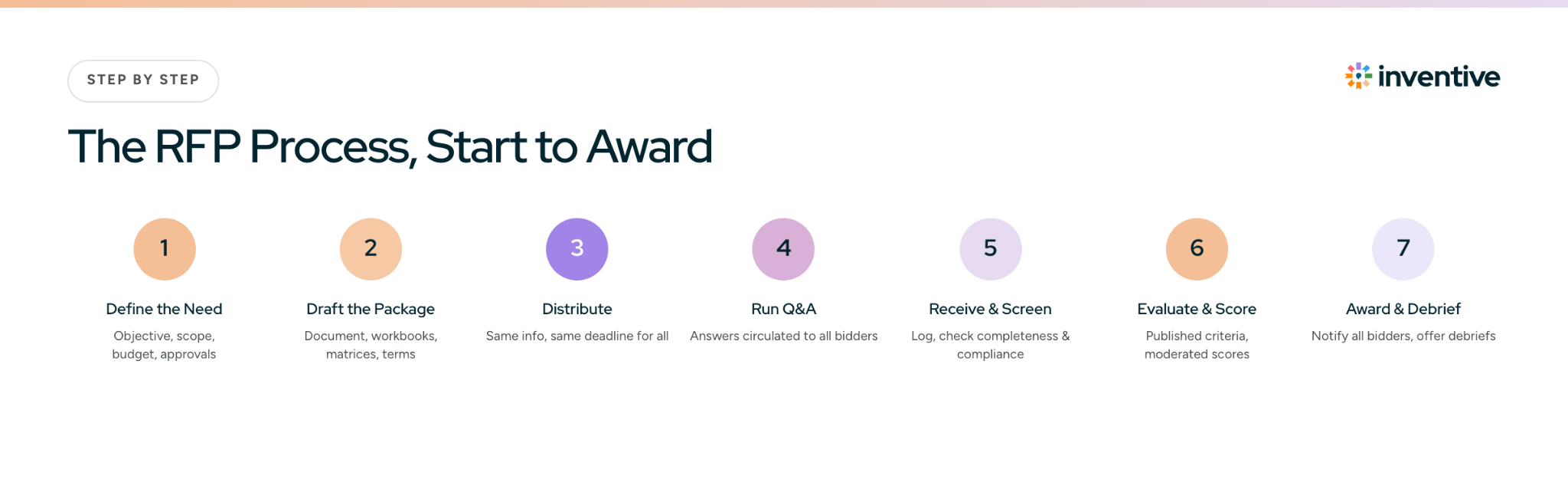
The RFP process runs from defining the need through to award, with the drafting quality determining how much work the later stages take.
- Define the need: Agree the business objective, success metrics, scope boundaries, budget guardrails, and approval path before drafting. Rework here is cheap and rework after issue is not.
- Draft the package: Build the document and the supporting workbooks, matrices, and draft terms. Have legal review contractual terms before issue rather than during negotiation.
- Distribute: Share the RFP through the right channels to reach qualified vendors, such as approved vendor lists, procurement portals, direct invitations, or email. Clearly communicate timelines, contact rules, Q&A cut-offs, confidentiality expectations and data room software usage rules.
- Run the Q&A window: Collect written questions, answer them, and circulate answers to all bidders. A well-run Q&A materially improves bid quality and is the cheapest correction mechanism you have.
- Receive and screen: Log submissions with timestamps, check completeness and mandatory compliance, and issue clarification requests with deadlines.
- Evaluate and score: Score against published criteria, moderate divergences, run demos or reference checks on the shortlist.
- Award and debrief: Notify the winner, inform unsuccessful vendors, and offer debriefs. Vendors who receive a debrief bid better next time, which improves your own future field.
How long should an RFP process take?
Allow vendors three to four weeks to respond for moderate-complexity procurements, and six to eight weeks where the solution requires technical discovery, subcontractor input, or a site visit.
Compressed timelines do not accelerate procurement. They narrow the field to vendors with idle capacity rather than vendors best suited to the work, and they produce padded pricing because bidders price uncertainty when they lack time to scope properly. Public-sector procurement frequently sets statutory minimum notice periods, which should be treated as a floor rather than a target.
Build the internal calendar backwards from the award date, including the Q&A window, evaluation period, moderation session, and contracting time. Evaluation is the stage most often underestimated, since it requires several senior people simultaneously.
Common RFP writing mistakes
Most problems buyers experience during evaluation were created during drafting. Seven recurring causes:
- Vague requirements: Terms like best in class and industry leading cannot be bid against or verified, so every vendor claims them and the requirement scores nothing.
- No pricing template: Free-format pricing arrives in incompatible structures, and normalizing it consumes more evaluation time than any other task.
- Undisclosed budget: Withholding a range produces bids spread across an order of magnitude, most of which are unusable. A band with rationale attracts realistic proposals.
- Everything marked mandatory: Over-specified mandatory requirements eliminate good vendors over details you would have negotiated.
- Unrealistic timelines: Short windows reduce both the number and quality of bids, and the effect compounds if your organization does it repeatedly.
- Hidden evaluation criteria: Vendors cannot optimize for criteria they cannot see, so the bids you receive are optimized for what they guessed.
- Late-stage legal terms: Introducing contract terms after award that never appeared in the RFP damages trust and frequently restarts negotiation.
When to use an RFP
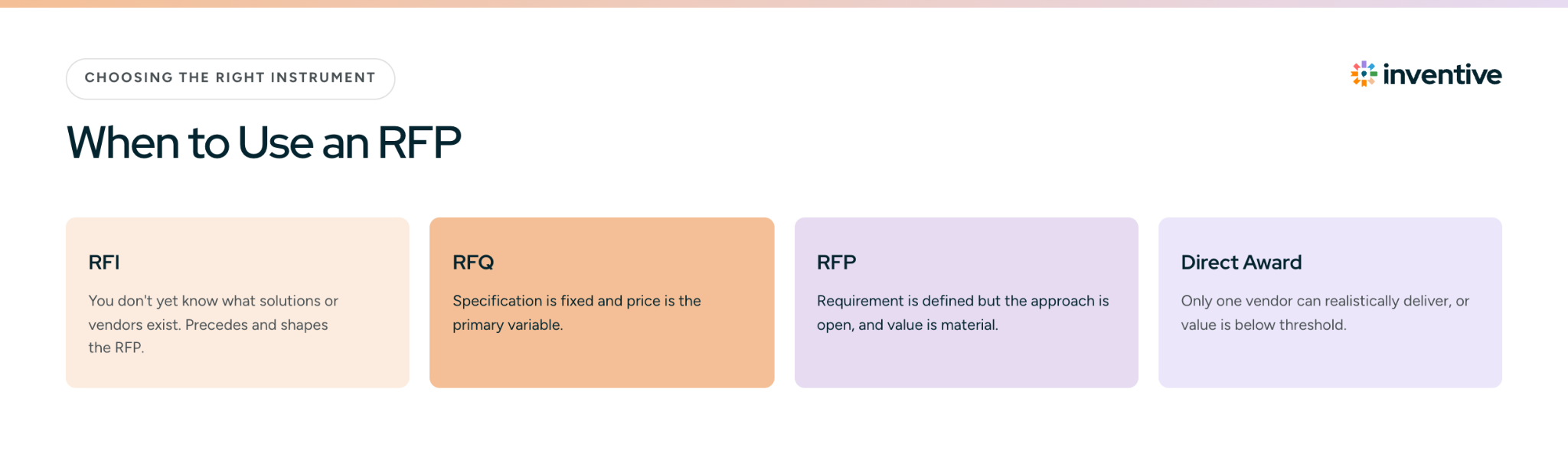
Use an RFP when you know the problem but not the solution, and want vendors to propose an approach you can compare. Use a different instrument when that is not the case.
- RFI: When you do not yet know what solutions exist or which vendors are capable. It precedes the RFP and shapes its requirements.
- RFQ: When the specification is fixed and price is the primary variable. An RFP here wastes effort on both sides.
- RFP: When the requirement is defined but the approach is open, the value is material, and several qualified vendors exist.
- Direct award: When only one vendor can realistically deliver, or the value falls below your procurement threshold. Running an RFP with a predetermined outcome burns vendor goodwill you will need later.
The background on the document itself, including its components and how it differs from related instruments, sits in the guide to what an RFP is, and section-level detail in the breakdown of important RFP sections.
How AI helps with RFP creation and evaluation
AI reduces the manual load at two points in the cycle: assembling the package and analyzing responses.
- Requirement drafting: Generating first-draft requirements from a category template and your stated objectives, which teams then edit rather than write from blank.
- Consistency checking: Flagging contradictions between the scope, requirements, and evaluation criteria before issue, which is where most vendor clarification questions originate.
- Response analysis: Comparing vendor submissions against the requirements matrix systematically and surfacing where responses diverge, rather than reading eight documents in sequence.
- Content reuse: Adapting requirements and terms from prior procurements in the same category instead of rebuilding them.
The judgment stays human. Weighting decisions, mandatory requirement selection, and the award itself depend on organizational context that sits outside any document.
How Inventive AI supports RFP teams
Inventive AI helps RFP teams reduce the manual work involved in finding, drafting, reviewing, and maintaining proposal content. Teams can work from approved sources, keep responses consistent, and manage the process in one shared workspace.
- AI-assisted drafting: Generates first drafts from approved content and previous documents, giving teams a starting point they can review and refine instead of writing from scratch.
- Centralized knowledge: Keeps templates, previous responses, and reference material in one place, with connections to Google Drive, SharePoint, and Notion.
- Conflict detection: Flags contradictions across sections so teams can resolve inconsistencies before an RFP is issued or a response is submitted.
- Outdated content detection: Identifies superseded information, expired certifications, and stale references before they make their way into a proposal.
- Collaborative workflow: Gives proposal, sales, and subject-matter teams a shared workspace for section ownership, reviews, and version tracking.
The results can extend beyond faster drafting. Insider achieved a 50% higher win rate and 90% faster RFP responses using Inventive AI. See the full results in the Insider case study.
.avif)






.avif)