Loopio vs AutoRFP: Features, Pricing & AI Capabilities for 2026
Loopio vs AutoRFP compared on pricing, setup time, AI response quality, and governance, a framework for choosing the right RFP software in 2026.
Every RFP season looks the same. A spreadsheet nobody trusts. A Slack thread asking if anyone has the answer. A deadline that won't move.
Loopio and AutoRFP are often the first platforms teams evaluate while automating the RFP response process. One is built for governance. The other is built for speed. Choosing the wrong platform can leave your team locked into a year-long contract that doesn't fit its workflow.
This guide compares both platforms on pricing, AI architecture, governance, and support. It is based on verified sales data, G2 reviews, Gartner Peer Insights, and vendor documentation.
Last reviewed: July 2026. Based on verified sales intelligence, G2, Gartner Peer Insights, and vendor-published materials. Pricing and features change, confirm current specifics directly with each vendor before purchasing.
TL;DR
- Loopio works for teams that need a governed content library, formal approval routing, and an audit trail.
- AutoRFP works for teams that need a published price, a faster setup, and don't have a dedicated content manager.
- Neither platform is the right fit for every team, the best choice depends on how you manage content, collaborate, and scale proposal operations.
What Matters Most When Choosing RFP Software?
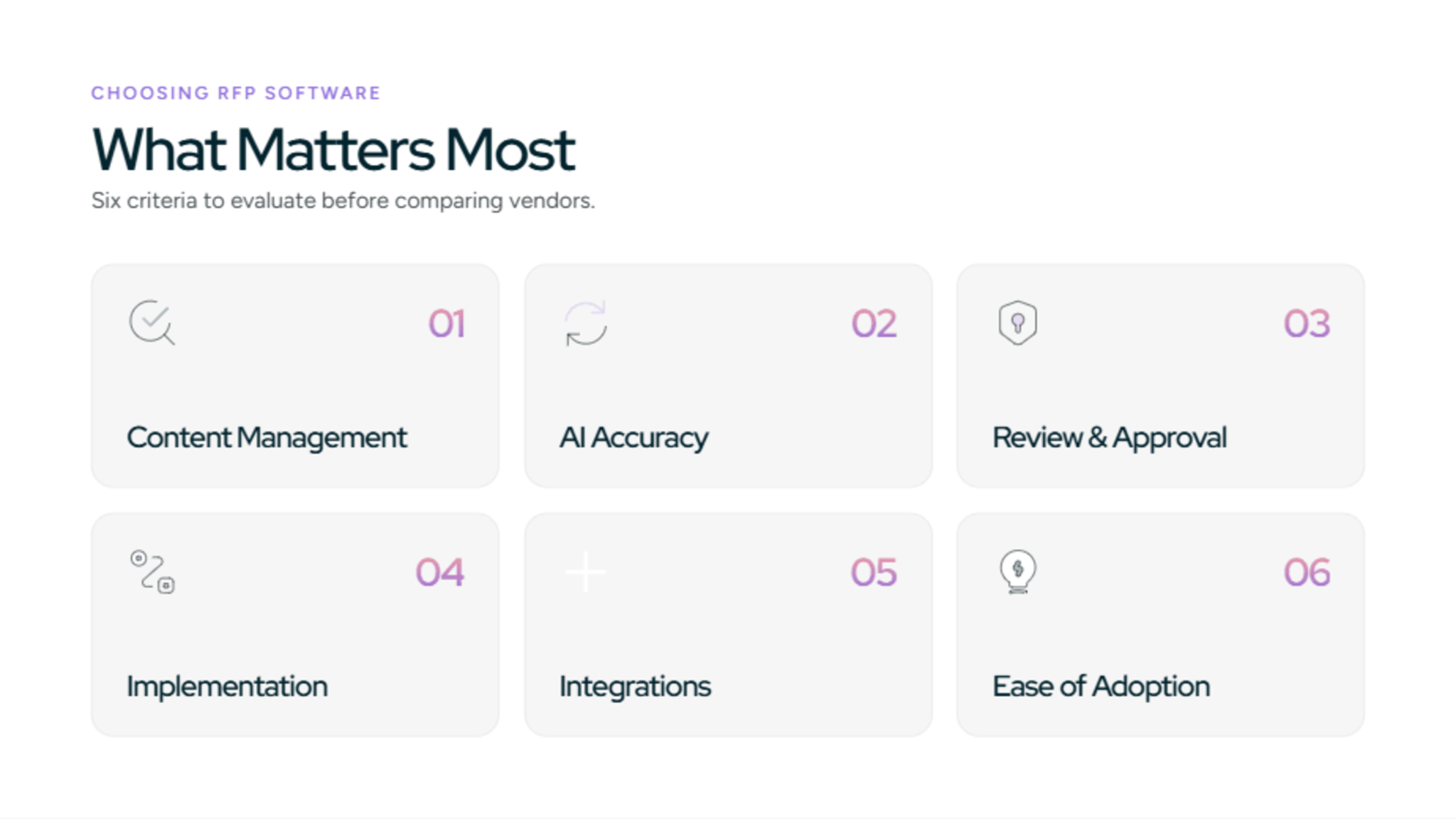
Most RFP platforms can generate responses. The real difference is how they manage content, maintain accuracy, and scale with your team's workflow. Evaluate these six criteria before comparing vendors.
1. Content Management
Every platform depends on accurate company knowledge. The difference is how that knowledge is managed.
- Does it require a structured content library?
- How easy is it to keep answers up to date?
- Can teams quickly find approved content?
If maintaining content becomes a full-time job, adoption often drops over time.
2. AI Accuracy
AI can speed up response drafting, but accuracy matters more than speed.
Look for platforms that help your team:
- Verify AI-generated answers
- Review low-confidence responses
- Reduce outdated or duplicate content
The best AI reduces review time, not just writing time.
3. Review and Approval Workflows
Most RFPs require input from sales, product, legal, security, and compliance.
Ask whether the platform can:
- Assign questions to SMEs
- Track approvals
- Maintain version control
- Support audit requirements
These workflows become increasingly important as proposal volume grows.
4. Implementation and Maintenance
Getting started is only part of the investment. A platform that's quick to deploy but difficult to maintain may create more work later.
Consider:
- Time to onboard
- Content migration effort
- Ongoing library maintenance
- Training requirements
5. Integrations
Your RFP software should fit into your existing technology stack.
Check for integrations with:
- CRM platforms
- Document management systems
- Collaboration tools
- Productivity suites
Strong integrations reduce manual work and improve content reuse.
6. Ease of Adoption
Even the most capable platform delivers little value if teams don't use it consistently.
Look for:
- An intuitive interface
- Minimal training requirements
- Easy SME collaboration
- Workflows that fit existing processes
Higher adoption leads to better content quality and faster response cycles.
Loopio vs AutoRFP: Quick Comparison
Here's a side-by-side overview of the key differences before we dive into a detailed comparison of features, pricing, and implementation.
| Criteria | Loopio | AutoRFP.ai |
|---|---|---|
| Best for | Mid-market and enterprise teams with a dedicated proposal operations role | Lean teams without a dedicated content manager |
| Gartner rating | 4.3/5 | 4.8/5 |
| AI capabilities | Retrieves answers from a structured content library and uses AI to draft or refine responses | Generates draft responses using semantic search across connected company knowledge |
| Strategic agents | No dedicated autonomous AI agents; focuses on content retrieval and drafting | No dedicated autonomous AI agents; focuses on AI-assisted response generation |
| Response quality | Strong when the content library is well maintained; performance depends on library quality | Produces strong first drafts, but responses should be reviewed before submission |
| AI Content governance | Approvals, permissions, and audit trails, but no AI-driven monitoring for outdated, duplicate, or conflicting content | Basic review workflows, but no AI-driven governance for content quality, conflicts, or knowledge health. |
| Conflict handling | Doesn't automatically detect conflicting answers; reviewers must identify inconsistencies manually | Claims to resolve conflicting answers based on recency and context but doesn't explain why one response was selected |
| Integrations | Salesforce (via Agentforce), Microsoft 365, SharePoint, Teams, Word, HubSpot, Slack | Salesforce, Google Drive, Microsoft Teams, Slack, Notion |
| Ease of use | Powerful but has a learning curve, especially for occasional users | G2 reviewers report the interface is less intuitive initially, and imports still require manual column mapping. |
| Pricing | Custom annual contract ($15000–$150,0000/year based on recent deals) | Published plans from $499–$1,299/month, plus a custom Enterprise tier |
| Setup time | Standard onboarding of about 30 days | Vendor claims setup in 48 hours; third-party reviews report implementation typically takes several days to weeks |
Not sure which criteria matter most for your team?
Work through Inventive AI's RFP software buying guide before reading two full vendor profiles.
Download the EbookLoopio Review: Key Features, Limitations, Pricing & Ratings
Loopio is an RFP response management platform designed for mid-market and enterprise teams managing RFPs, security questionnaires, DDQs, and web-based questionnaires. Its core strength is structured content management and proposal governance.
Loopio's best features
- Centralized content library with role-based access controls for approved responses
- Magic AI retrieves relevant answers from the content library and uses an OpenAI-powered drafting layer to refine responses
- Confidence scores highlight responses that may require reviewer validation
- Lock approved responses to prevent AI from rewriting compliance-sensitive content
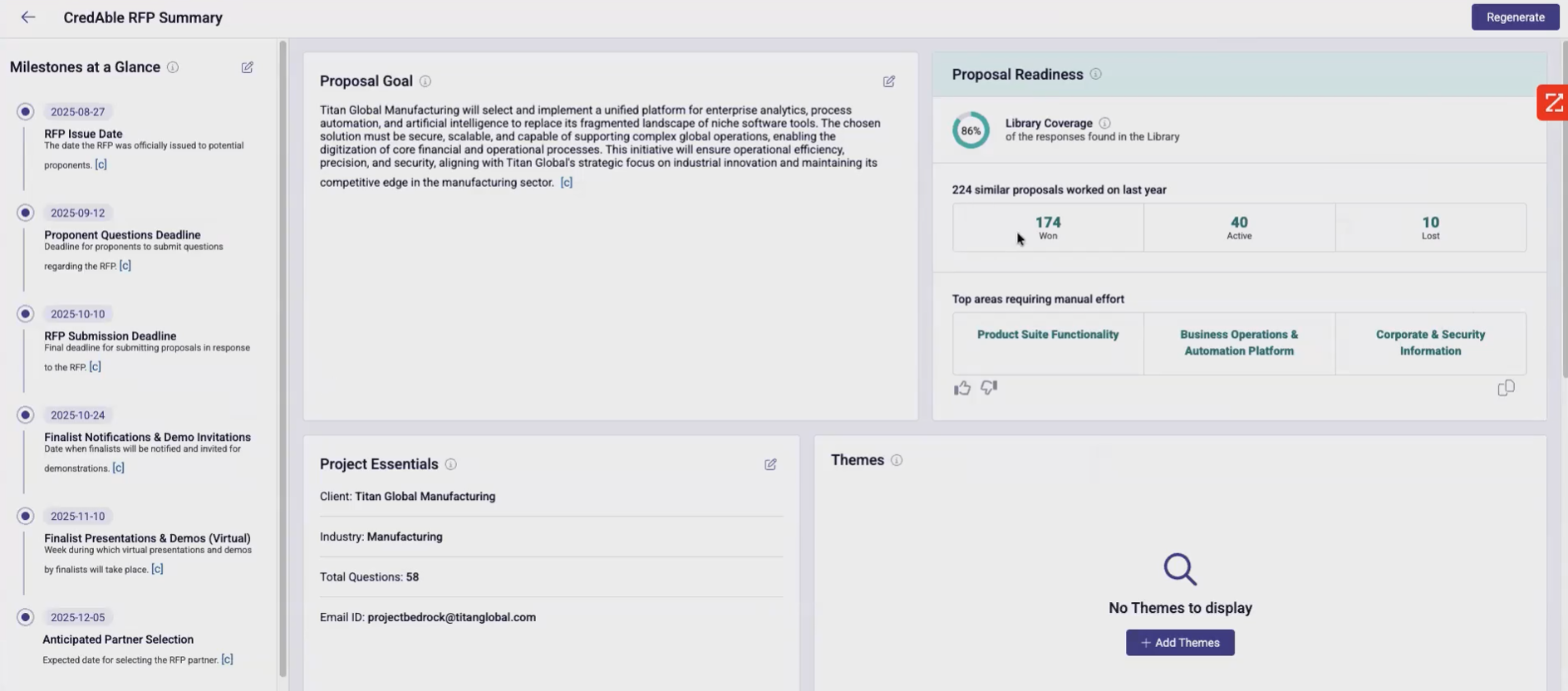
- Go/no-go readiness score shows proposal coverage before submission
- Chrome extension for completing questionnaires directly in customer portals
- Integrates with Salesforce, Microsoft 365, SharePoint, Teams, Word, HubSpot, and Slack
Loopio's limitations
- G2 reviewers report AI drafting works best for repetitive, lower-complexity questions
- Uses OpenAI models for drafting rather than a proprietary LLM
- No inline source citations for AI-generated responses, making verification more manual
- Doesn't automatically detect conflicting answers across the content library
- G2 reviewers describe the interface as functional but note a learning curve for occasional users
- User-based pricing can become expensive for organizations with many occasional SME contributors
- Multiple reviewers report the content library requires ongoing maintenance to remain effective as it grows
- Onboarding and professional services may incur additional costs
Loopio pricing
Loopio doesn't publish pricing. Vendr reports contracts ranging from approximately $15,000 to more than $150,000 annually, depending on company size and deployment.
Loopio ratings
G2: 4.6/5
Gartner Peer Insights: 4.3/5
Capterra: 4.6/5
What real users say
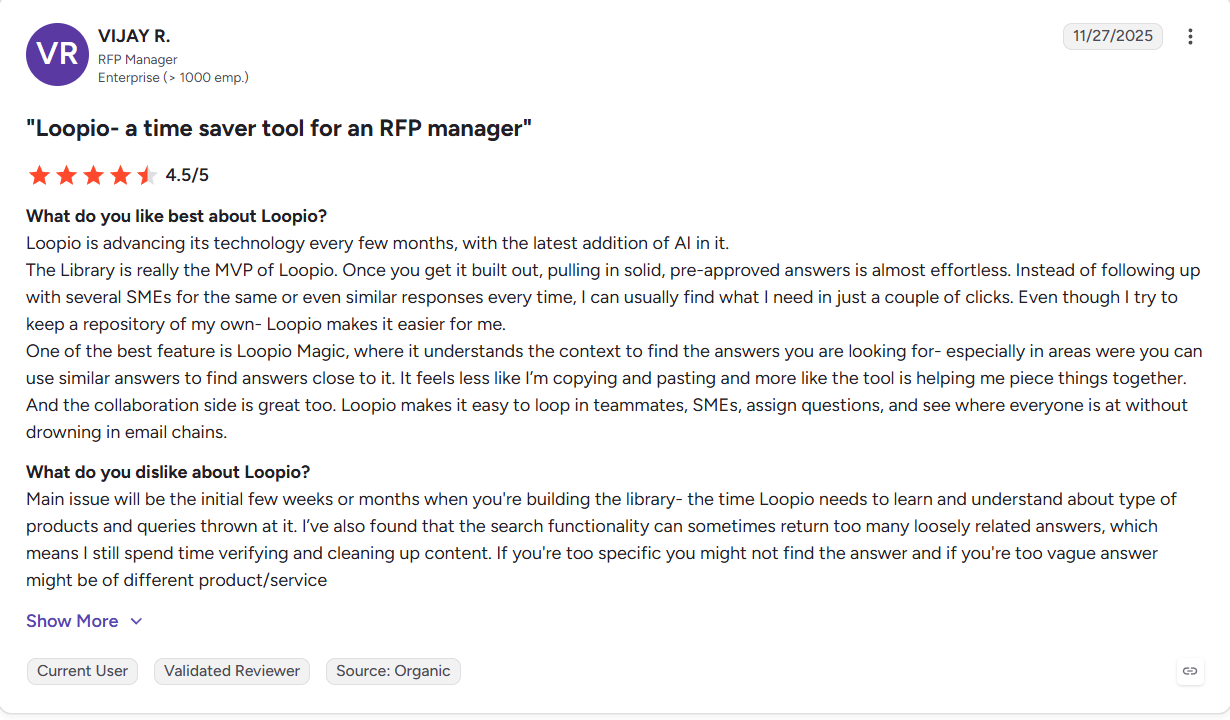
"The Library is really the MVP of Loopio, one of the best features is Loopio Magic, where it understands the context to find the answers you're looking for." Vijay R., RFP Manager, Enterprise (1000+ employees), G2 review, Nov 2025
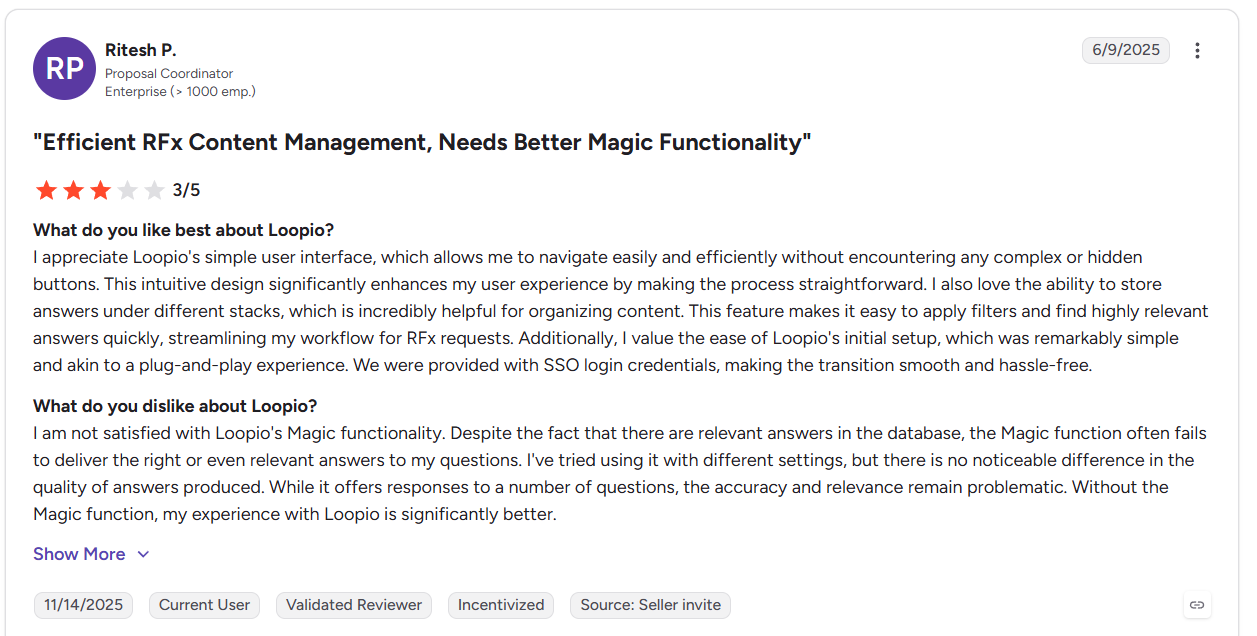
According to G2, Ritesh P., Proposal Coordinator at an enterprise company, praised Loopio's intuitive interface, organized content library, and easy setup, but noted that Loopio Magic often failed to surface the most relevant answers despite having the right content in the library.
Also Read: Why AI-Native RFP Software is Replacing Legacy Tools Like Responsive and Loopio
AutoRFP.ai Review: Key Features, Limitations, Pricing & Ratings
AutoRFP.ai is an AI-powered RFP response platform designed for lean proposal teams that want to automate response drafting without maintaining a traditional content library.
AutoRFP.ai's best features
- Automatically drafts responses using your team's existing approved content
- Confidence scores help reviewers prioritize responses that need verification
- Doesn't require a structured content library; learns from approved responses over time
- Claims to resolve conflicting answers based on recency and context
- Browser extension supports questionnaires in customer portals, along with Excel, Word, and PDF files
- Integrates with Salesforce, Google Drive, Slack, Microsoft Teams, and Notion
AutoRFP.ai's limitations
- G2 reviewers report a learning curve, with some users requiring several weeks to become proficient
- Resolves conflicting answers automatically but doesn't explain why one response was selected over another
- Third-party reviews report questionnaire imports still require manual column mapping
- Although AutoRFP.ai advertises a 48-hour setup, third-party reviews report implementation typically takes several days to weeks
- Built for lean and mid-sized teams, with lighter approval workflows than many enterprise organizations require
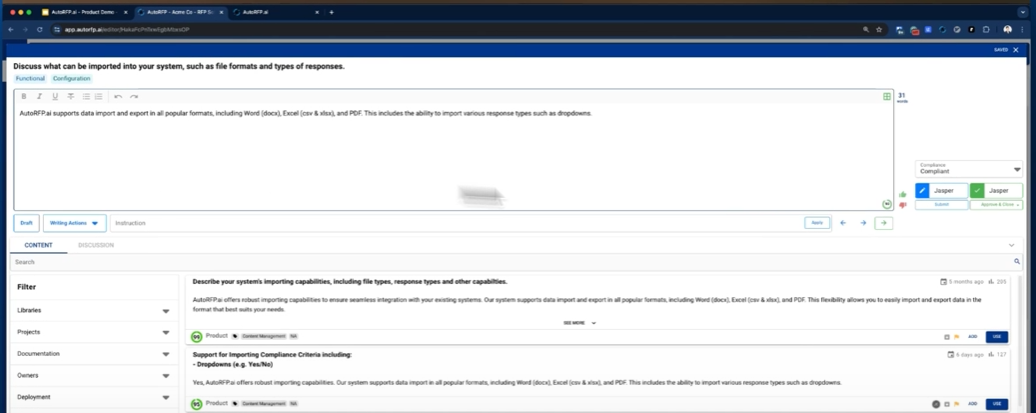
AutoRFP.ai pricing
Published pricing includes:
- Start: $499/month (12 projects)
- Scale: $899/month (24 projects)
- Accelerate: $1,299/month (50 projects)
- Enterprise: Custom pricing
All plans include unlimited users.
AutoRFP.ai ratings
G2: 4.8/5
Gartner Peer Insights: 4.8/5
What real users say
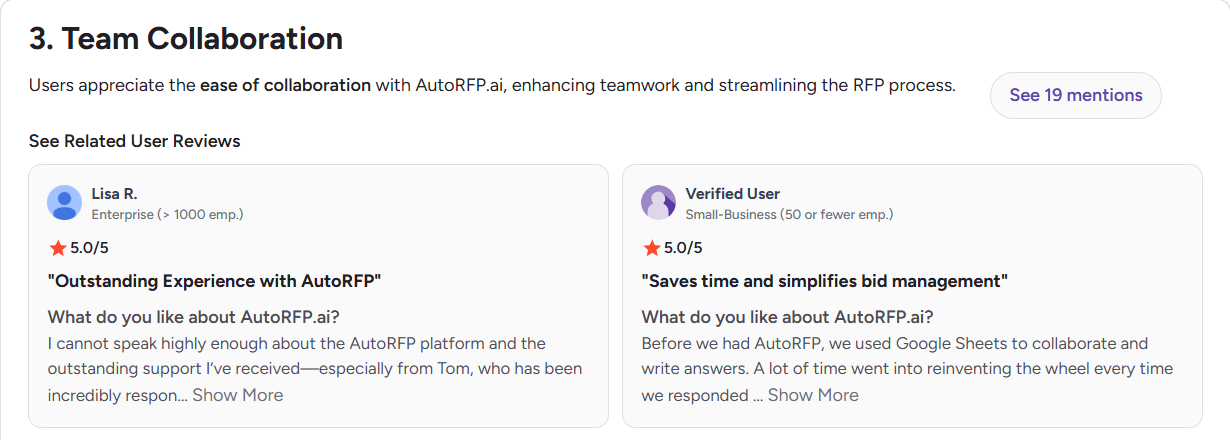
According to G2, Kristen C. said AutoRFP.ai improves collaboration and proposal management, though navigating back to in-progress projects wasn't always intuitive and required some getting used to.
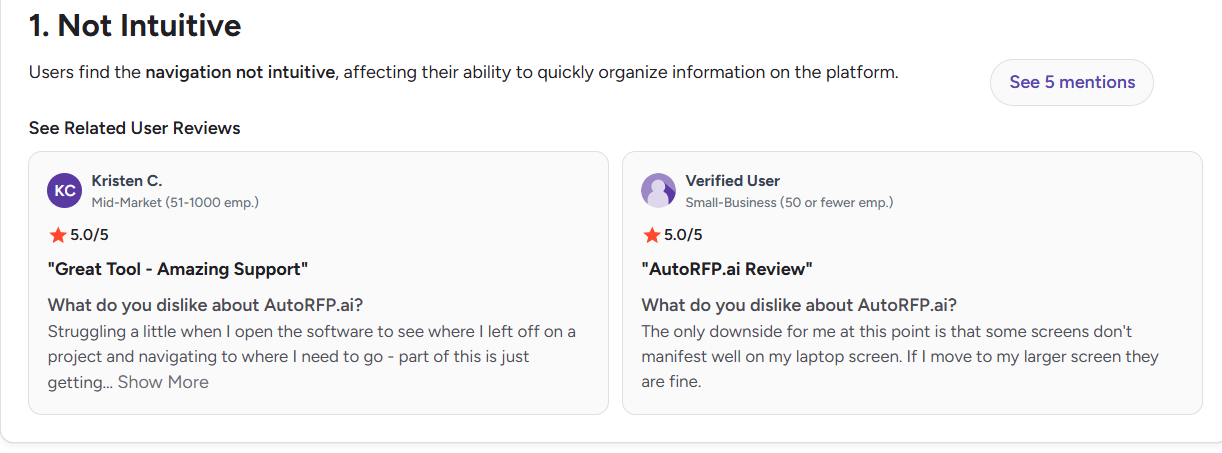
According to G2, Lisa R. praised AutoRFP.ai for improving team collaboration and customer support, while Kristen C. noted that the interface has a learning curve, particularly when navigating ongoing projects.
Also Read: Top AutoRFP AI Alternatives & Competitors For 2026
Loopio vs AutoRFP: Feature-by-Feature Comparison
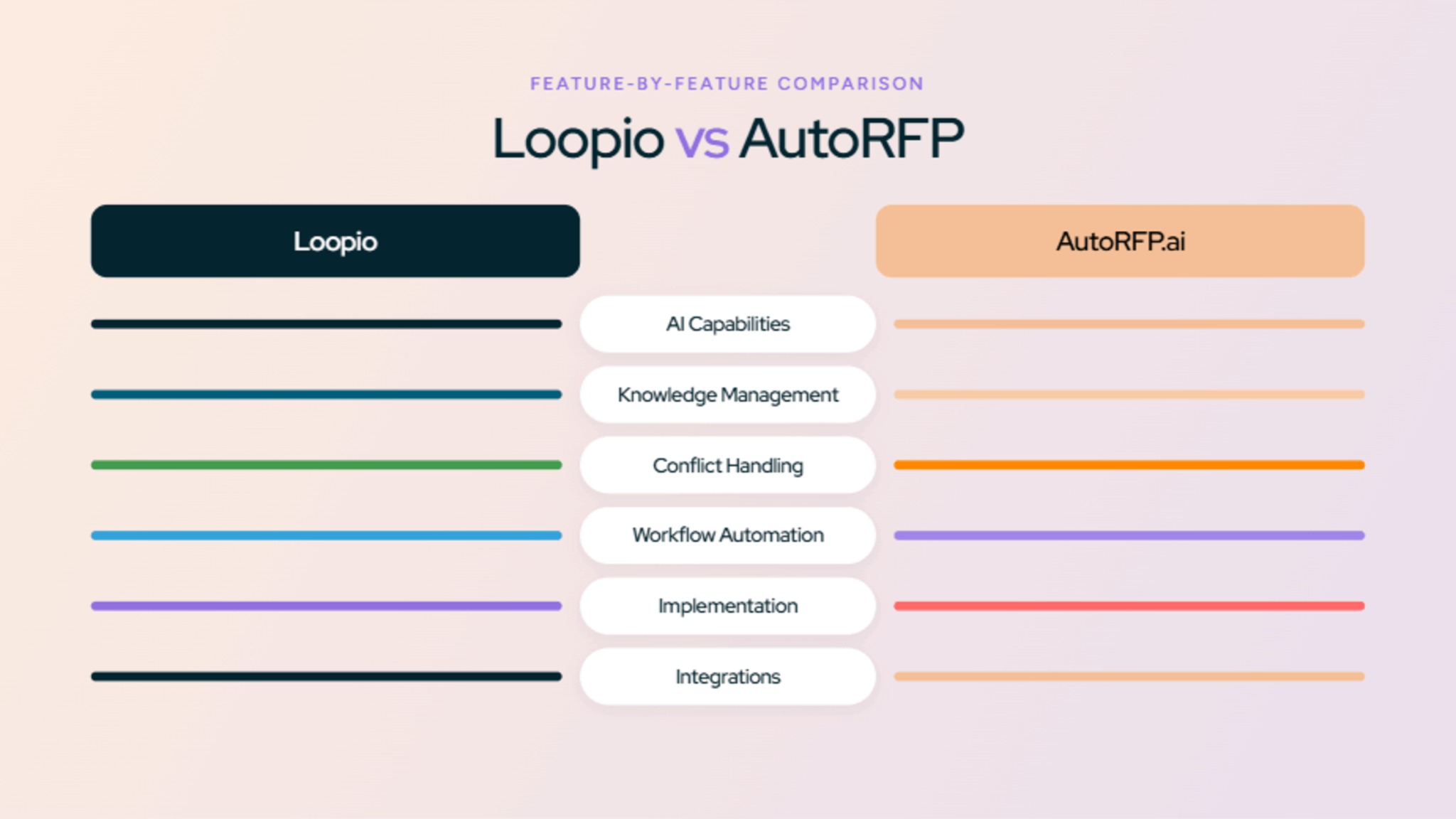
Both Loopio and AutoRFP cover the core RFP response workflow, but they take different approaches to AI, content management, governance, and collaboration.
AI Capabilities
Loopio
- Retrieves approved answers from a structured content library instead of generating responses from scratch
- Magic AI matches relevant content and uses OpenAI models to draft or refine responses
- Confidence scores indicate whether a response may require reviewer validation
AutoRFP.ai
- Uses AI to generate draft responses from your organization's existing knowledge
- Displays a Trust Score to indicate confidence in each AI-generated response
- G2 reviewers report a learning curve before teams become comfortable using its AI capabilities
Key takeaway: Loopio emphasizes governed content reuse, while AutoRFP.ai prioritizes AI-generated drafting.
Knowledge Management
Both platforms rely on accurate company knowledge, but they manage that knowledge differently.
Loopio
- Organizes content into a structured library using Stacks, Categories, and Subcategories
- Uses freshness scores to identify content that may need review
- Requires ongoing library maintenance as content grows
AutoRFP.ai
- Doesn't require a structured content library; learns from approved responses instead
- Reduces the need for manual tagging and library administration
- Still relies on reviewers to keep approved content accurate
Key takeaway: Loopio offers more structured governance, while AutoRFP.ai reduces administrative overhead.
Conflict Handling
Conflict detection helps identify when stored answers provide inconsistent information.
Loopio
- Doesn't automatically detect conflicting answers
- Reviewers must identify and resolve inconsistencies manually
AutoRFP.ai
- According to AutoRFP.ai, conflicting answers are resolved using recency and context
- Doesn't explain which response was selected or why, limiting reviewer visibility into AI decisions
Key takeaway: Loopio leaves conflict detection to reviewers, while AutoRFP.ai automates conflict resolution with limited transparency.
Workflow Automation
Loopio
- Routes responses through contributors and reviewers
- Includes a go/no-go readiness score to measure proposal completion
- Supports structured approval workflows across multiple departments
AutoRFP.ai
- Designed for lean teams with lightweight collaboration workflows
- Tracks project progress in real time
- Formal approvals typically happen outside the platform
Key takeaway: Loopio supports structured enterprise workflows, while AutoRFP.ai focuses on speed and collaboration.
Implementation
Loopio
- Standard onboarding typically takes around 30 days
- Teams migrating from manual processes should expect additional time to build and organize a content library
- Onboarding and professional services may incur additional costs
AutoRFP.ai
- Advertises setup in 48 hours
- Third-party reviews report implementation typically takes several days to weeks
Key takeaway: AutoRFP.ai generally offers a faster implementation, while Loopio requires more upfront investment in content management.
Integrations
Loopio
- Integrates with Microsoft 365, SharePoint, Teams, Word, Salesforce, HubSpot, Slack, and Agentforce
- Strong fit for organizations already invested in the Microsoft and Salesforce ecosystem
AutoRFP.ai
- Integrates with Salesforce, Google Drive, Slack, Microsoft Teams, and Notion
- Well suited for teams using modern cloud collaboration tools
Key takeaway: Loopio provides broader enterprise integrations, while AutoRFP.ai emphasizes lightweight collaboration platforms.
Security and Compliance
Loopio
- Provides audit trails and enterprise security controls
- Supports data hosting in US and EU regions
- Organizations with strict compliance requirements should request detailed security documentation during evaluation
AutoRFP.ai
- States SOC 2 and ISO 27001 compliance
- States that customer data isn't used to train its AI models
- Security documentation should be requested during vendor evaluation
Key takeaway: Both platforms offer enterprise security capabilities, but buyers should validate certifications and documentation during procurement.
Analytics
Loopio
- Tracks content health, proposal performance, and response completion metrics
- Reporting focuses on content governance and library usage
AutoRFP.ai
- Reports Trust Scores and productivity metrics
- Reporting is more focused on AI performance than long-term content governance
Key takeaway: Loopio provides deeper reporting for content management, while AutoRFP.ai focuses on AI-assisted productivity.
Customer Support
Loopio
- Includes onboarding with a dedicated Customer Success Manager
- Provides ticket-based support
- Holds a 9.7/10 support score on G2
AutoRFP.ai
- Provides live chat support
- Doesn't publicly offer a dedicated Customer Success Manager for every account
Key takeaway: Loopio offers a more structured enterprise support model, while AutoRFP.ai emphasizes faster day-to-day support.
Inventive AI: An AI-First Alternative for End-to-End RFP Automation
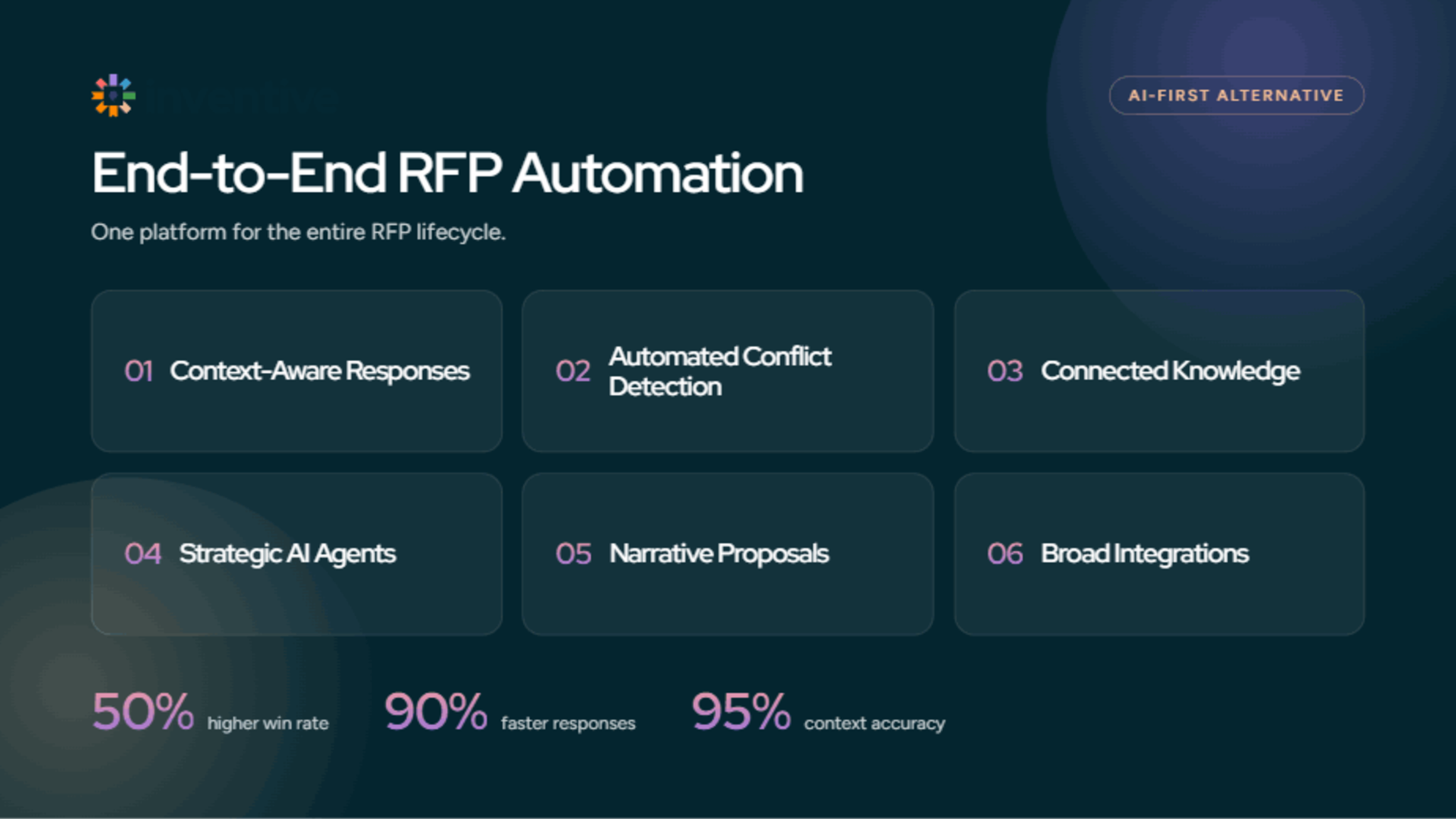
If you're evaluating Loopio and AutoRFP but need more than AI-assisted drafting or a traditional content library, Inventive AI offers a different approach. It combines AI agents, connected knowledge sources, and automated review workflows to support the entire RFP lifecycle, from understanding requirements to preparing submission-ready responses.
Response Quality
- Produces context-aware responses tailored to the specific RFP instead of reusing the closest matching historical answer.
- Its Context Engine pulls information from documents, meeting notes, CRM records, and other connected sources to generate responses based on relevant business context.
- According to Inventive AI's customer case studies, RAD AI achieved a 50% higher win rate and responded to RFPs 90% faster after implementing the platform.
Conflict Detection
- Automatically identifies conflicting information across connected knowledge sources before responses are submitted.
- Reviewers make the final decision on which answer to keep, and that decision is retained for future RFPs to reduce repeated reviews.
Knowledge Management
- Connects to existing business knowledge instead of requiring teams to build and maintain a separate Q&A library.
- Automatically reflects updates made in connected sources, reducing duplicate content and manual library maintenance.
Content Governance
- Reduces the effort required to maintain a centralized Q&A library by using connected knowledge sources instead.
- According to Inventive AI, teams can work without relying on a traditional content library while maintaining human review before submission.
AI Agents
- Competitive Analysis Agent: Compares your responses against competitor positioning to help strengthen proposal messaging.
- Analyzer Agent: Reviews drafts for compliance gaps, contradictions, tone, and proposal readiness before submission.
- Iteration Agent: Refines responses using natural language instructions instead of manual editing.
Integrations
- Integrates with Okta, Google Workspace, Salesforce, HubSpot, SharePoint, Confluence, Notion, Slack, Teams, and other business tools.
- Enables teams to work within their existing systems instead of moving content between multiple applications.
Narrative Proposal Generation
- Generates both structured questionnaire responses and long-form narrative proposals from the same platform, eliminating the need for separate proposal writing tools.
Inventive AI's Limitations
- Analytics are still maturing. G2 reviewers would like more advanced reporting, customizable dashboards, and deeper usage insights.
- No native Jira integration. Teams using Jira may need alternative workflows or custom integrations.
- Limited mobile experience. G2 reviewers note the lack of a dedicated mobile app makes on-the-go access less convenient.
- Advanced AI features take time to master. While the platform is easy to adopt, some reviewers say learning the AI agents and automation capabilities takes time.
Ratings and reviews
Pricing
Simple and transparent, usage-based: you pay per RFP or security questionnaire you actually work on, not per seat, with unlimited users included on every plan.
What real users say about Inventive AI
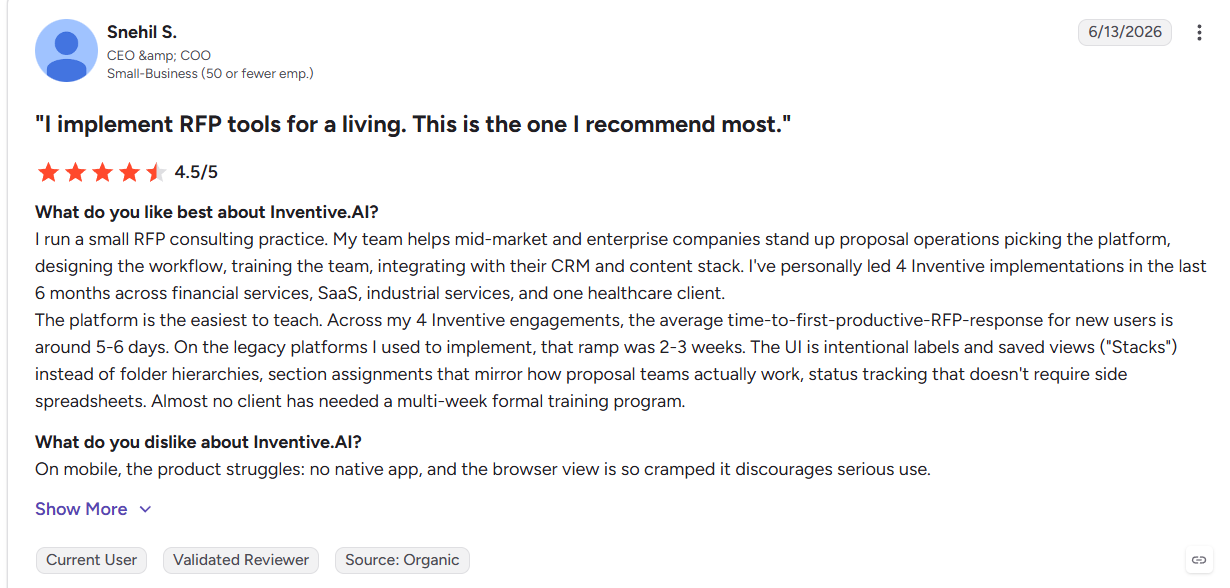
According to G2, Snehil S., CEO & COO, said Inventive AI is one of the easiest RFP platforms to implement and teach, helping new users become productive quickly, though he noted the mobile experience could be improved due to the absence of a native app.
Best for
Teams looking to automate the full RFP lifecycle while reducing reliance on traditional Q/A libraries.
Stop solving the same conflict twice.
Inventive AI's Conflict Detection flags contradictions automatically, lets your team make the final call, and remembers the answer for every RFP after.
Book a DemoWhich Platform Should You Choose?
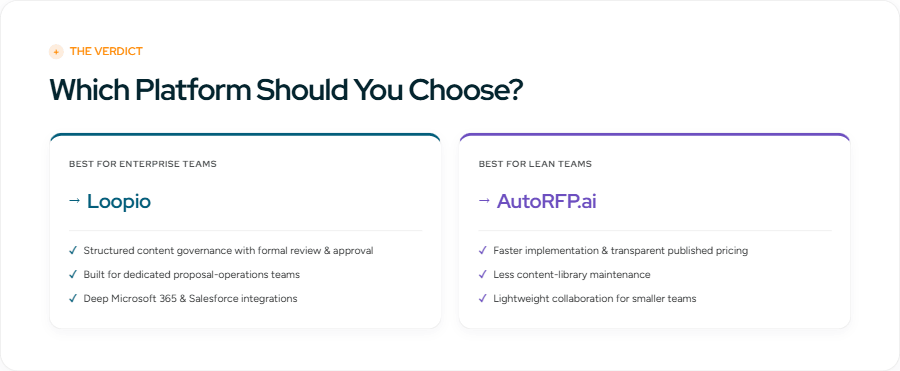
Both Loopio and AutoRFP help teams respond to RFPs faster, but they're designed for different workflows. Use the table below to identify which platform best matches your team's priorities.
| If your priority is... | Choose | Why |
|---|---|---|
| Structured content governance | Loopio | Built around a centralized content library with formal review and approval workflows. |
| Enterprise proposal operations | Loopio | Better suited for organizations with dedicated proposal teams and complex collaboration needs. |
| Microsoft and Salesforce ecosystem | Loopio | Offers deeper integrations across Microsoft 365, SharePoint, Teams, and Salesforce. |
| Faster implementation | AutoRFP.ai | Published onboarding timeline is shorter, with less upfront content setup than a traditional content library. |
| Reducing content library maintenance | AutoRFP.ai | Learns from approved responses instead of requiring a structured Q&A library. |
| Transparent pricing | AutoRFP.ai | Offers publicly available pricing plans instead of custom enterprise quotes. |
| Lean proposal or sales teams | AutoRFP.ai | Better aligned with teams that don't have a dedicated proposal operations or content management role. |
| Lightweight collaboration | AutoRFP.ai | Designed for simpler review workflows with fewer administrative steps. |
Still Haven't Found the Right Fit?
If neither platform fully meets your requirements, for example, if you're looking for AI agents, connected knowledge sources, automated conflict detection, or end-to-end RFP automation, it's worth evaluating newer AI-first platforms such as Inventive AI before making a final decision.
More Reads
- Loopio vs Inventive AI: Better RFP Software?
- AutoRFP vs Inventive AI: Which Wins More Deals?
- Best Loopio Competitors & Alternatives for RFP Response Process in 2026
Frequently Asked Questions
Do Loopio and AutoRFP support security questionnaires and DDQs?
Yes. Both handle RFPs, security questionnaires, and DDQs from the same underlying platform, so you're not choosing a tool that only covers one use case.
Can you try Loopio or AutoRFP before signing a contract?
Only AutoRFP offers a self-serve option: a 30-day free trial. Loopio's pricing page has no trial, only a "Book a Demo" and a custom quote through sales. If testing the product hands-on before a sales call matters to you, that's a real structural difference between the two.
Does either platform offer a public API for custom integrations? Not clearly. AutoRFP.ai lists pre-built connectors for Salesforce, Slack, Microsoft Teams, SharePoint, Confluence, Google Workspace, OneDrive, and Notion, but doesn't publish a dedicated developer API. Loopio's integrations are similarly pre-built rather than open API-based. For anything outside either list, expect a direct conversation with support rather than a self-serve build.
Do Loopio and AutoRFP support multi-language RFP responses?
Yes, both do, but differently. AutoRFP translates responses across 30+ languages as part of its core workflow. Loopio's multi-language library sits in its Enhanced tier, with full project translation offered as a separate add-on rather than a default feature.
What user permission levels do Loopio and AutoRFP offer?
Loopio uses four access levels: No Access, Participant, Creator, and Full Access, controlling who can build projects, edit the library, or review responses. AutoRFP uses three roles: User, Content Manager, and Administrator, with granular org-wide controls over project creation, data export, and cross-project content access. Both support confidential/restricted projects for sensitive RFPs.

.avif)