No Bid Explained: When to Compete and When to Walk Away
No bid explained: what it means, when to pass on an RFP, a weighted decision scorecard, a no-bid letter template, and common mistakes.

Not every RFP is worth answering. "No bid" is the decision to pass on one, and when made well, it is one of the most valuable moves a proposal team makes. This guide explains what no bid means, when to walk away, how to make the call with a repeatable framework, and how to decline professionally without burning the relationship.
Key takeaways
- "No bid" usually means a vendor's decision to decline an RFP or tender. It can also mean a government "no-bid contract," awarded without competition.
- Saying no to the wrong opportunities protects the time and people you need to win the right ones.
- Decide against fixed criteria, not gut feel, and decide early, before you sink hours into a losing proposal.
- Some conditions, like a mandatory requirement you cannot meet, should trigger an automatic no bid regardless of how attractive the deal looks.
- Declining well, with a short no-bid letter, keeps the door open for future work.
What does "no bid" mean?
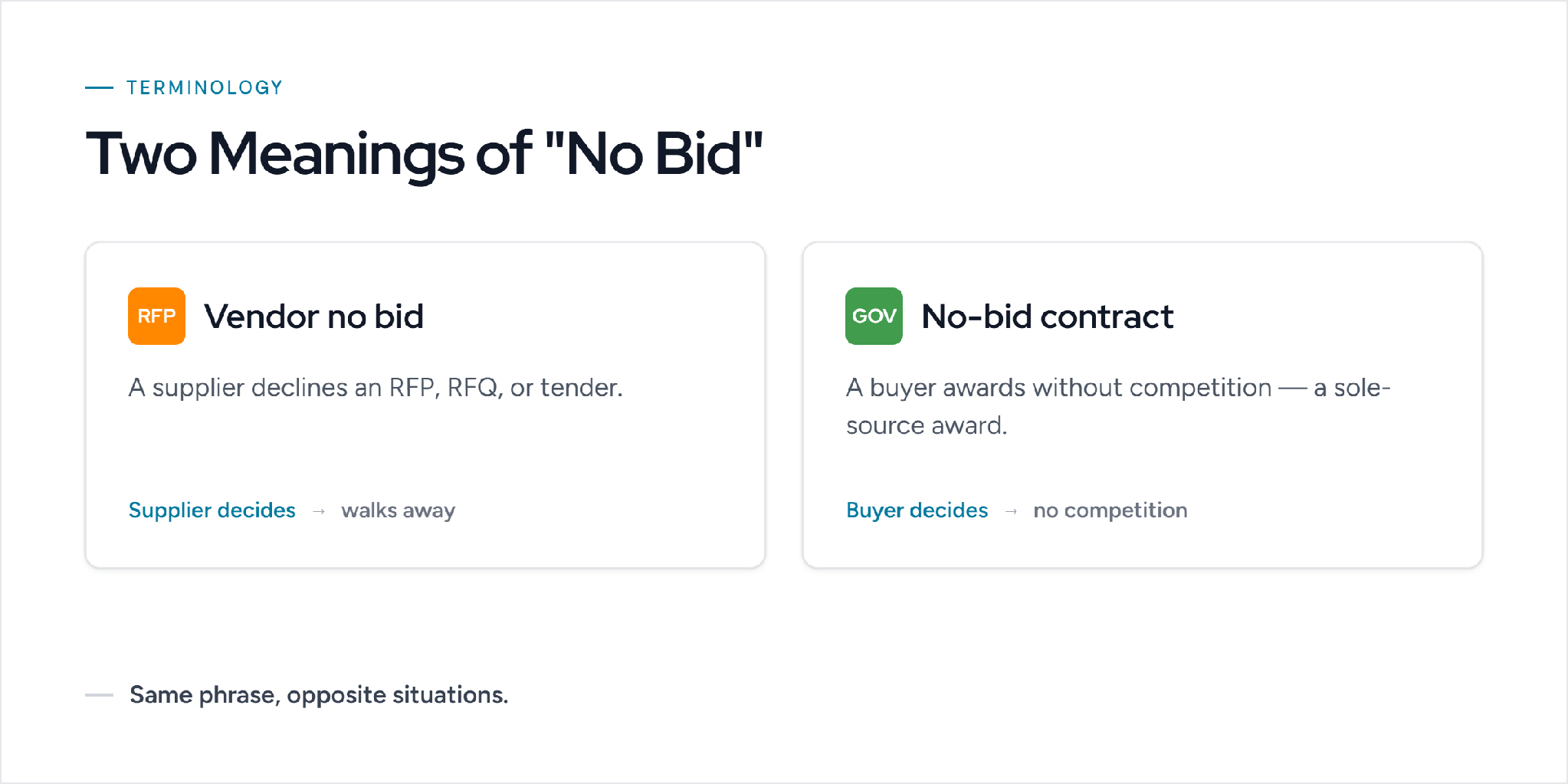
In proposals and procurement, "no bid" is the decision not to submit a response to an RFP, RFQ, or tender. A team reviews the opportunity, concludes it is not worth pursuing, and formally passes. The choice is the output of a bid/no-bid decision, called a go/no-go decision.
There is a second, separate meaning worth clearing up. In government contracting, a "no-bid contract" is one awarded to a single vendor without a competitive process, also called a sole-source award. The two share a phrase but describe opposite situations: one is a supplier choosing not to compete, the other is a buyer choosing not to run a competition.
Read more: Understanding No-Bid Contracts in Government Deals
Why the no-bid decision matters
Bidding is expensive. A serious proposal ties up the experts, writers, and reviewers who also deliver the work you have already won. Every hour spent on an unwinnable RFP is an hour taken from a winnable one.
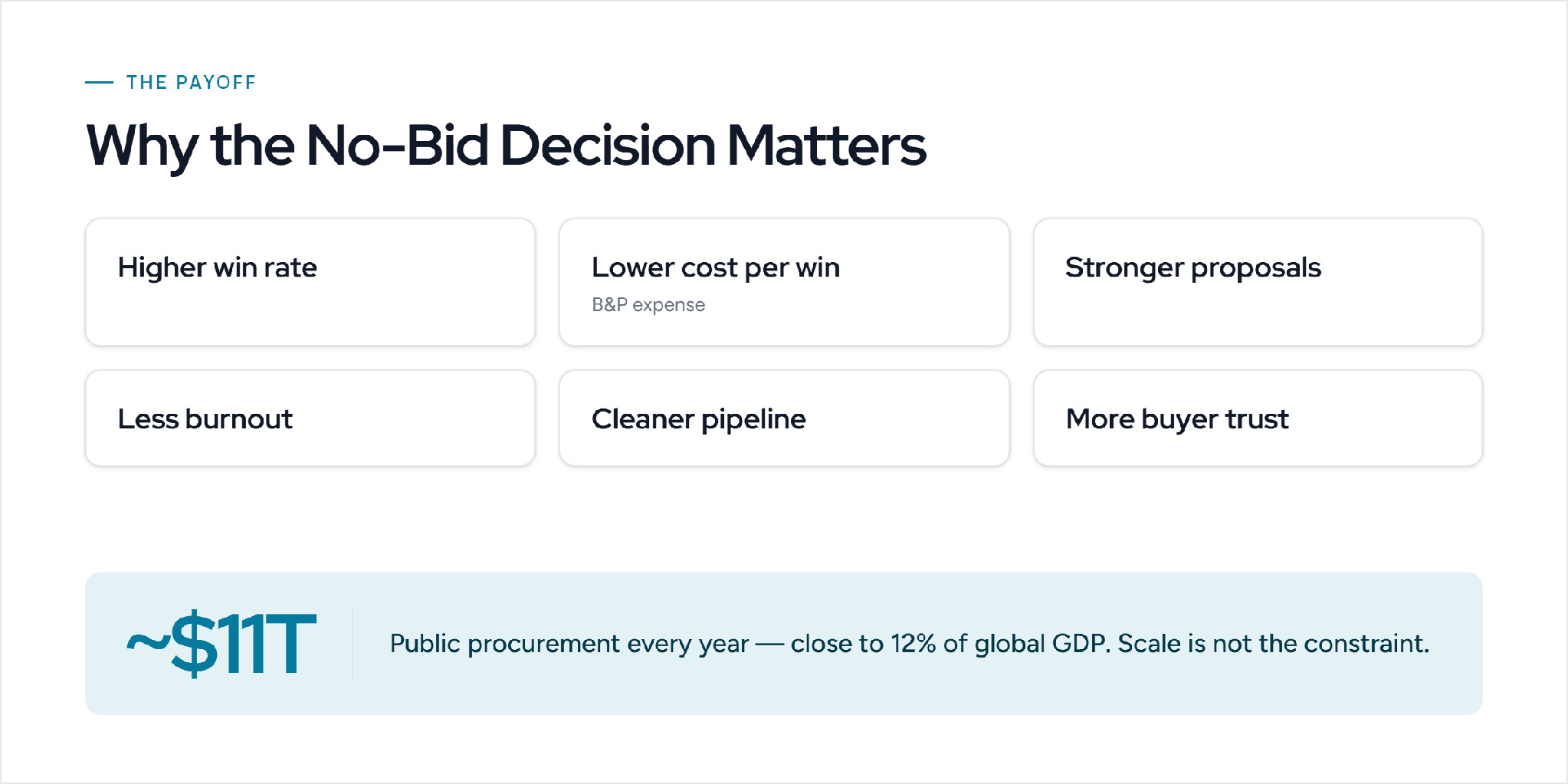
That is why a no-bid gate earns its place. A disciplined process delivers:
- A higher win rate. You put your effort into the bids you can win, so you win a larger share of what you submit.
- A lower cost per win. Fewer, better bids mean less money spent chasing each deal you close. US contractors track this cost as bid and proposal (B&P) expense under FAR 31.205-18.
- Stronger proposals. When your team is not stretched across five long shots, each bid gets the time and review it needs to win.
- Less burnout. Turning down the wrong deals protects the people you need for the right ones.
- A cleaner pipeline. Passing early keeps your forecast honest, so sales and delivery plan around deals you can actually win.
- More trust from buyers. When you bid only on work you can deliver, buyers see that you respect their time.
Scale is not the constraint. Public procurement alone is worth about $11 trillion a year, close to 12% of global GDP, according to the World Bank. The discipline is choosing the right bids and declining the rest.
When to submit a no bid
Submit a no bid when the odds of winning are low or the project is a poor fit. Here are the clearest signals:
- No relationship, no edge. You do not know the buyer, you are not the incumbent, and the RFP looks written for a vendor who is.
- Weak fit. The requirements do not match what you do, so you would have to over-promise to compete.
- Not enough time. You cannot write a strong response, or deliver the work if you win, in the time given.
- Bad economics. The margin is too thin, or the work costs too much to deliver.
- A requirement you cannot meet. The RFP demands a certification, location, or track record you do not have.
- Terms you cannot accept. The risk, liability, or payment conditions are ones you cannot agree to.
A single flag is often manageable. But when several show up together, or you hit even one requirement you simply cannot meet, it is a clear no bid.
5 hard disqualifiers that make the no-bid decision for you
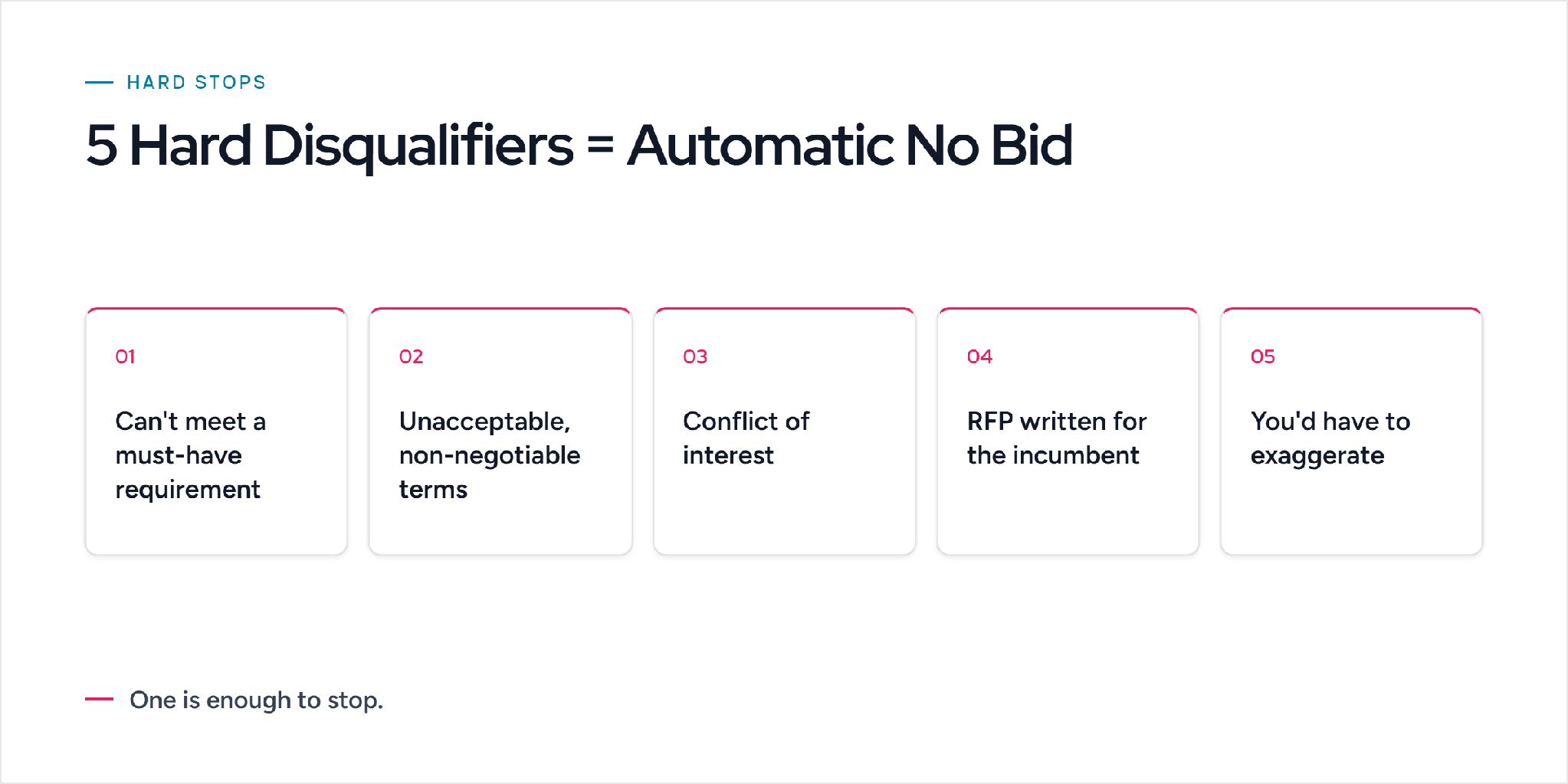
Some problems end the decision on their own. However good the opportunity looks, treat each of these as a hard stop that overrides your scorecard:
- You cannot meet a must-have requirement. The RFP requires a specific certification, security clearance, location, or track record, and you do not have it.
- The terms are unacceptable and cannot be changed. For example, the contract demands unlimited liability, or payment terms that would strain your cash flow, and the buyer will not negotiate.
- You have a conflict of interest. Something about your role or existing contracts rules you out. This happens often in government work.
- The RFP is written for the current vendor. The requirements are ones only the incumbent can realistically meet, so the competition is not genuinely open.
- You would have to exaggerate what you can do. If the only way to qualify is to overpromise, winning just creates a problem you cannot deliver on.
If even one of these is true, stop there. A high score on everything else does not make up for a single requirement you cannot meet.
The go/no-go decision: how to decide, step by step
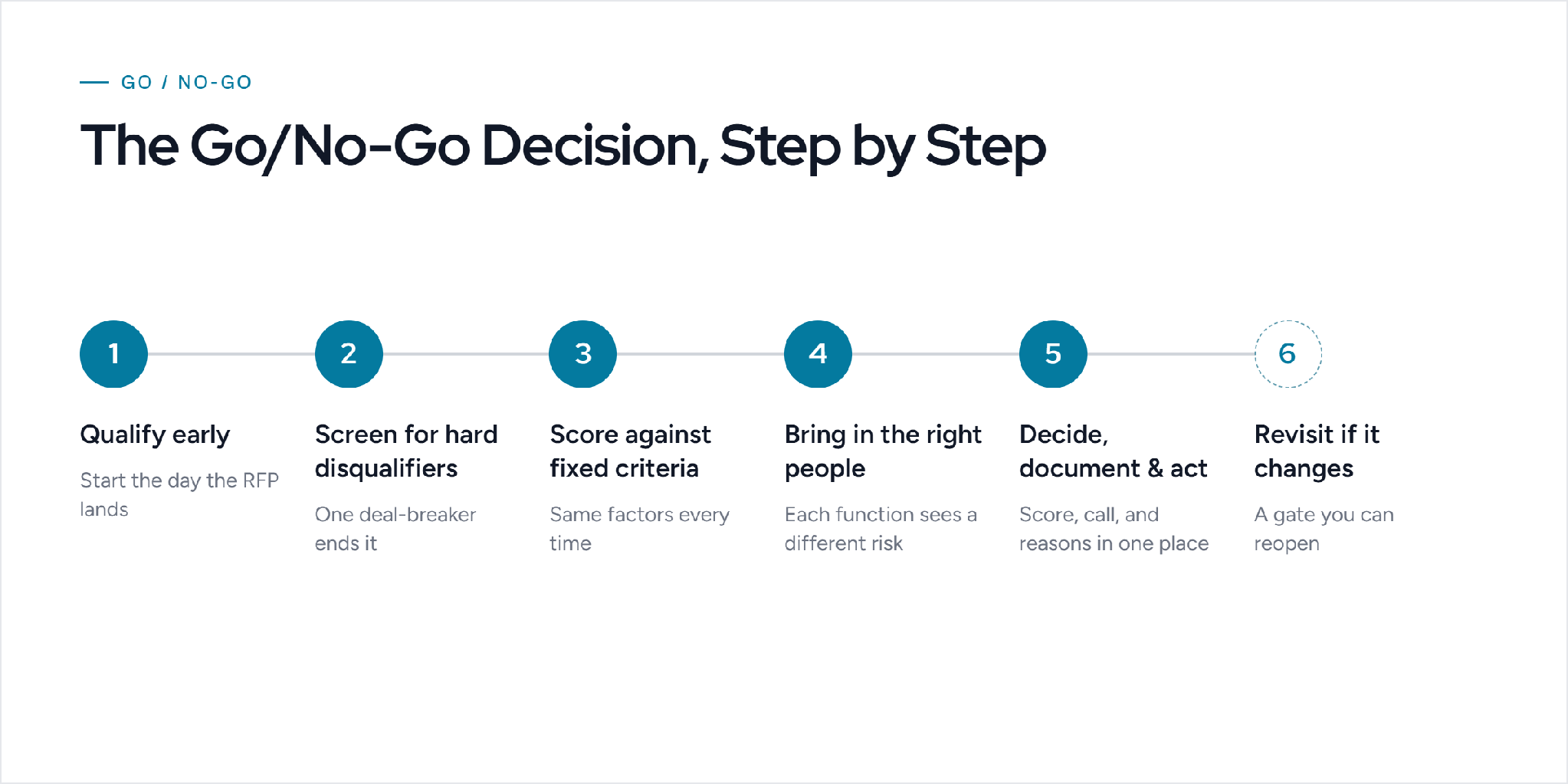
The go/no-go decision (also called the bid/no-bid decision) is the formal review where you decide whether to pursue an RFP or pass on it. Done well, it is quick, honest, and based on the same criteria every time, so the choice rests on evidence rather than opinion.
Qualify early, before anyone writes
Start the review the day the RFP lands, not the week it is due. The later you decide, the more hours your team has already spent on a bid you may not submit. Deciding early also leaves time to act on a "go": you can line up partners, gather past-performance proof, and ask the buyer clarifying questions before the deadline. Assign one owner to open the review so it does not sit waiting.
Screen for hard disqualifiers first
Before you score anything, check for the deal-breakers covered above: a must-have requirement you cannot meet, terms you cannot accept, or a conflict of interest. If even one is present, stop and record a no bid. Screening first saves the team from evaluating an opportunity that was never viable.
Score against fixed criteria
If the opportunity clears the hard disqualifiers, score it on the same factors every time. Group them under the three questions every go/no-go answers:
- Should we pursue it? Strategic alignment and funding certainty.
- Can we win it? Customer relationship, competitive position, requirement fit, and past performance.
- Can we deliver it profitably? Capacity, economics, and risk.
Using the same scorecard every time makes opportunities comparable, so you can see which of several open RFPs deserves your best people.
Bid/no-bid scorecard
How to score it. Rate each factor from 1 to 5, multiply by its weight, and total the result. Agree the thresholds in advance so the decision does not bend to a big-name logo:
- Strong go: 80% or more of the possible score.
- Conditional go: 65 to 79%. Pursue only if you can close a specific gap, such as adding a teaming partner or confirming funding.
- Executive review: 50 to 64%. Escalate the decision; do not default to bidding.
- No bid: below 50%, or any hard disqualifier present.
Weight the "can we win it" factors most heavily. A low score on customer relationship or competitive position usually outweighs a high score on capacity or economics, because a bid you cannot win is a loss no matter how well you could have delivered it.
Bring in the right people
A decision made by one person misses risks, so involve the functions that each see a different part of the picture:
- Sales knows the relationship and the real win probability.
- Delivery knows whether you can staff and execute the work.
- Finance knows the margin, payment terms, and cash-flow impact.
- Legal or security should weigh in on high-risk or regulated bids.
Keep the group small enough to move quickly, but wide enough that every major risk has an owner.
Decide, document, and act
Record the score, the decision, and the main reasons in one place. Documentation supports the call if someone questions it later, and comparing past decisions against actual results shows which factors really predict a win. Then act on the outcome: on a "go," hand off to the proposal team with the context from the review; on a "no bid," send the buyer a short no-bid letter so you stay on their list.
Revisit the decision if the opportunity changes
A go/no-go is a gate you can reopen, not a one-time vote. An amendment, a longer deadline, a new teaming partner, or a competitor dropping out can change the answer. Watch for material changes during the pursuit, and re-run the relevant part of the review when the facts shift.
Also Read: How to Write a Winning RFP
A worked example for bid/no-bod decision
Consider a mid-size IT services firm that receives a state agency RFP for a data platform.
- Fit (5): squarely in their wheelhouse.
- Win probability (2): no relationship, and the incumbent wrote a similar deployment last year.
- Economics (3): healthy budget, but heavy travel to three sites.
- Capacity (2): two other bids are due the same week.
- Risk and terms (4): standard, acceptable.
The score lands in the "executive review" band, pulled down by low win probability and limited capacity. No hard disqualifier is present, so it is not an automatic no.
The deciding factor is the trade-off. A bid they are more likely to win is due the same week, and the same senior writers cannot do both well. The firm passes on this RFP and puts those writers on the bid it can win. The scorecard made that comparison clear.
Bid, no bid, or conditional bid
The choice is not always binary. A third option is the conditional, or qualified, bid: you submit a response but formally note your exceptions, assumptions, or a narrowed scope. This fits when you can meet the core requirement but not one secondary item, and the buyer allows exceptions. It lets you compete for work you can largely deliver without committing to terms you cannot meet.
There is also an option to avoid: the "bid to lose," a weak response submitted only to stay visible or keep an account happy. It consumes real hours, rarely wins, and can lower how the buyer scores you next time. When an opportunity is not worth a full effort, a clean no bid with a short letter protects the relationship better than a half-hearted response.
How to write a no-bid letter
When you pass on an RFP you were invited to, a short no-bid letter keeps the relationship intact. Keep it brief, professional, and free of excuses: thank the buyer and reference the RFP, state clearly that you will not respond, give one honest reason, and express interest in future work. A template:
A no-bid decision is not a lost relationship. Handled well, it signals that you respect the buyer's time and only bid when you can deliver.
Common no-bid mistakes to avoid
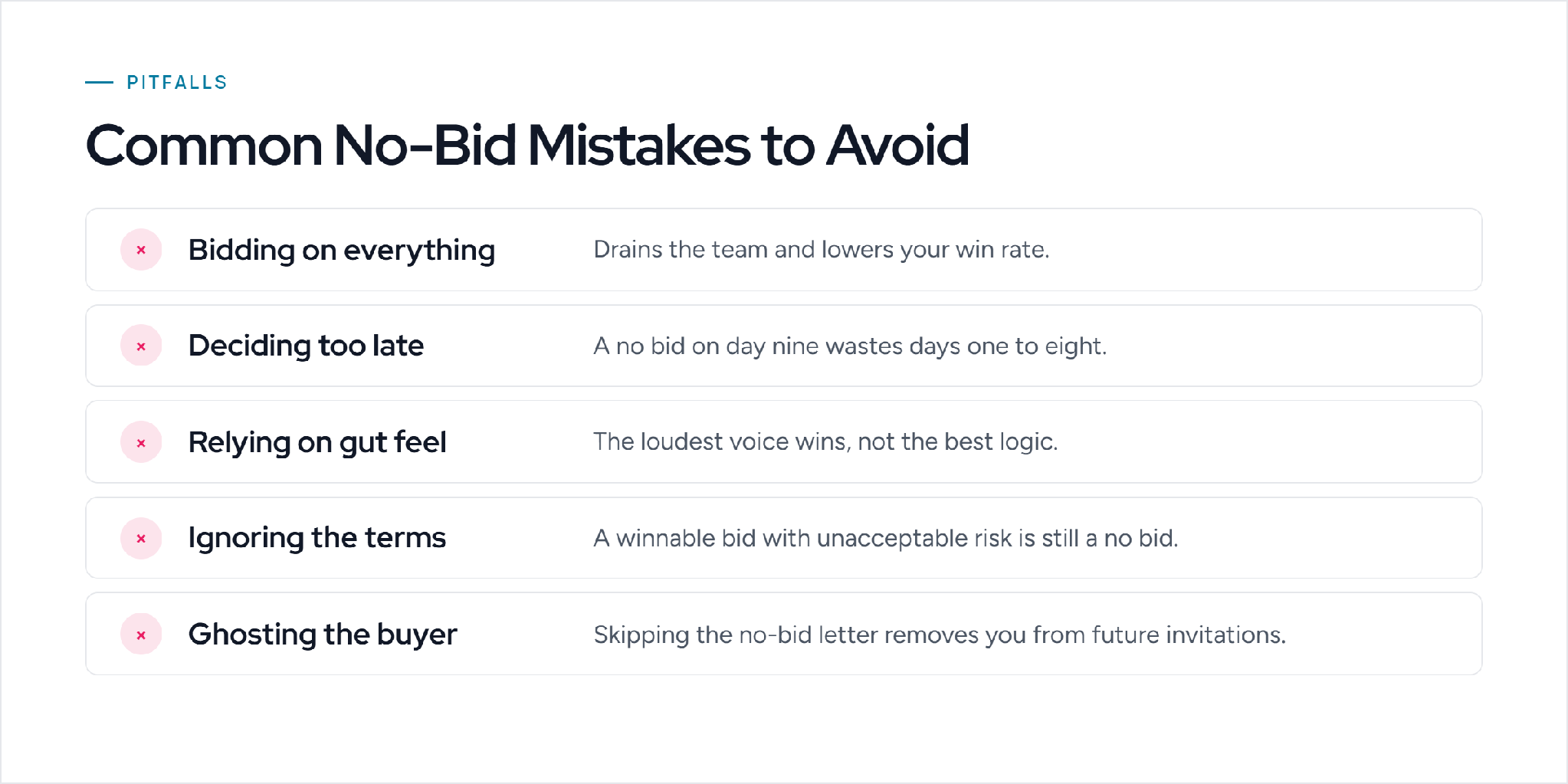
- Bidding on everything. Treating every RFP as a must-win drains the team and lowers your win rate.
- Deciding too late. A no bid on day nine wastes the work of days one through eight.
- Relying on gut feel. Without fixed criteria, the loudest voice wins, not the best logic.
- Ignoring the terms. A winnable bid with unacceptable risk or margin is still a no bid.
- Ghosting the buyer. Skipping a no-bid letter can quietly remove you from future invitations.
Also Read: RFP Response Process: A Step-by-Step Guide
How Inventive AI helps you make the right bid/no-bid call, faster
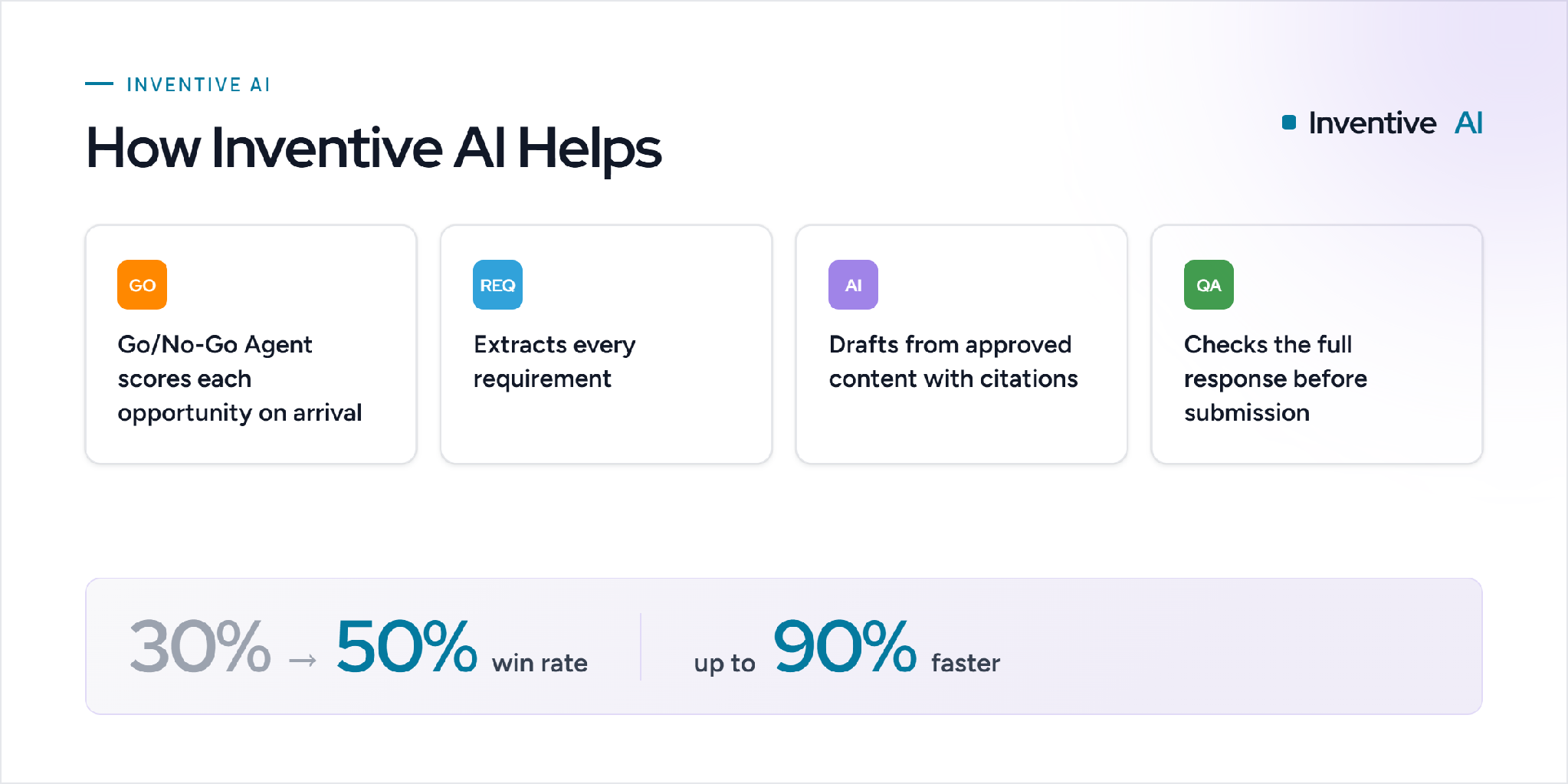
The hardest part of a no-bid decision is making it early, before the RFP has already eaten your week. Inventive AI includes a Go/No-Go Agent that evaluates each opportunity against fit and requirements the moment it arrives, so your team can decide to pursue or pass before wasting time on a weak deal.
For the opportunities worth pursuing, Inventive AI is an autonomous AI RFP platform that responds to RFPs, RFIs, DDQs, and security questionnaires, with humans in the loop for approvals. It extracts every requirement, drafts answers from your approved content with citations, and checks the full response before submission. The combination means you say no faster to the wrong bids and win more of the right ones.
Teams using Inventive AI have moved their win rate from 30% to 50% and cut RFP turnaround by up to 90%.
Must Reads
.avif)


%20(5).avif)