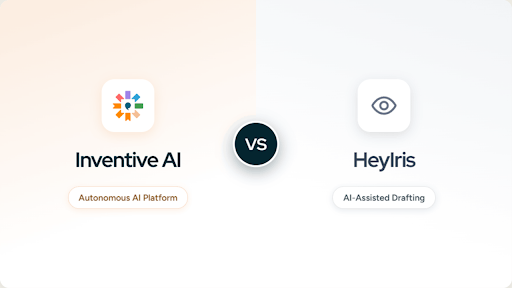
Responsive vs HeyIris: which RFP software is right for your team in 2026?
Responsive vs HeyIris compared on architecture, ease of use, content governance, security questionnaires, and support. See where each fits and the AI-native alternative.
Responsive and HeyIris both promise to take the manual work out of RFPs, security questionnaires, and DDQs, but they come from opposite ends of the market. Responsive, formerly RFPIO, is one of the established enterprise platforms in the category.
HeyIris is a newer, AI-first tool built for teams that want to move quickly without a long setup. The right choice depends less on feature counts and more on how your team actually works today and where it is headed.
The cost of getting this wrong is real. McKinsey found that the average knowledge worker spends nearly 20 percent of the workweek looking for internal information, and RFP response is one of the most information-heavy jobs in any revenue or security team.
This guide compares Responsive and HeyIris on what actually matters, then shows where an AI-native platform like Inventive AI fits.
The short version
- Responsive is the depth option. It offers the widest feature set, including a large content library, approval workflows, role-based permissions, and audit trails, with the trade-off of a steeper learning curve and a longer implementation.
- HeyIris is the speed option. It is easy to adopt and AI-forward, which suits lean teams, but it is younger and less proven on high-volume RFP and security questionnaire work at enterprise scale.
- Inventive AI is the AI-native alternative. The software drafts and checks full responses, automatic content governance flags outdated or conflicting answers before they ship, and built-in competitive intelligence sharpens your positioning, with onboarding within days, not weeks.
Responsive comparison with HeyIris: at a glance
Responsive and HeyIris line up on the factors you weigh most, from AI drafting quality and content upkeep to security, pricing model, and how long each takes to implement.
What Responsive is, and who it serves
Responsive, formerly RFPIO, is an enterprise platform built around a central content library for answering RFPs, RFIs, and security questionnaires at volume. It gives teams role-based permissions, approval workflows, moderation, and a wide set of integrations. Its AI layer, Responsive AI, suggests content and drafts first responses from the library you have built.
Responsive holds a 4.5 out of 5 rating on G2 from more than 1,300 reviews, and it suits large enterprises that need tight control over who edits and approves each response. That same control is why it takes training and a structured rollout to go live, not a same-day start, which matters when choosing RFP software for InfoSec teams working to questionnaire deadlines.
What reviewers say about Responsive (RFPIO)
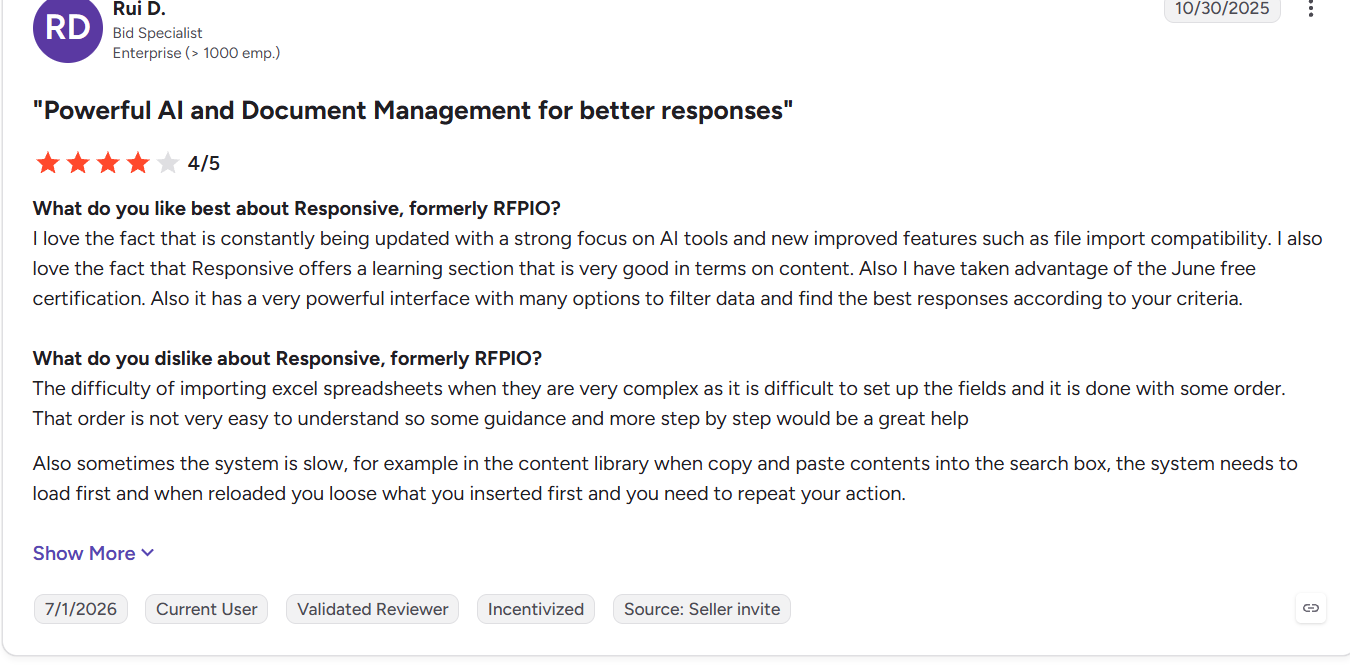
A Bid Specialist at a 1,000+ employee enterprise rates Responsive 4/5. The plus: frequent AI updates and strong content filtering. The problems: importing complex Excel files is hard because the field-mapping order is unclear, and the content library lags; pasting into search can trigger a reload that wipes your entry and forces a redo.
— Rui D., Bid Specialist, Enterprise (1,000+ employees), 4/5 on G2
Also Read: Responsive vs Inventive AI
What HeyIris is, and who it serves
HeyIris is an AI-first tool built to get a team drafting fast, with AI-suggested responses, task assignment, and a clean interface that needs little training. Reviewers consistently rate it easy to learn, and it holds a 4.9 out of 5 rating on G2, though from a much smaller base of 73 reviews that reflects how new it is.
It fits lean sales, pre-sales, and proposal teams that want to start this week without a rollout project. The trade-off is scale. HeyIris has fewer enterprise controls, such as granular permissions and approval workflows, and a shorter track record on the high-volume, audited questionnaire work Responsive was built for.
What reviewers say about HeyIris
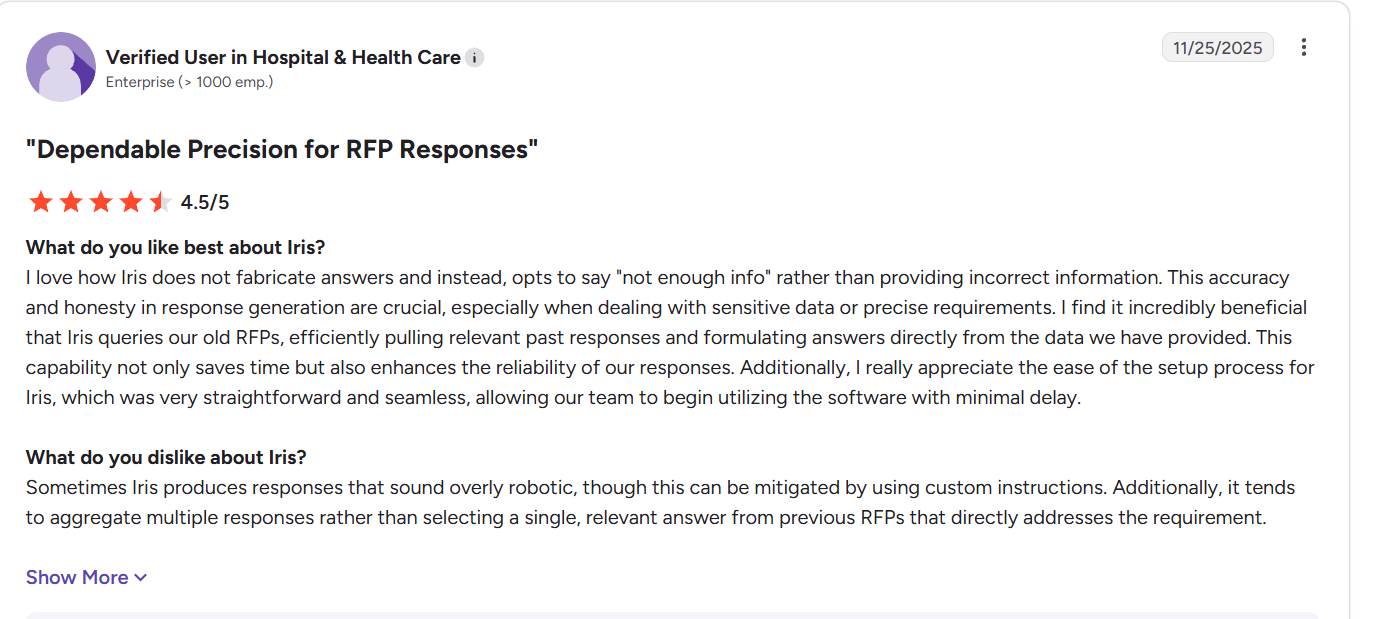
A reviewer in healthcare at a 1,000+ employee enterprise rates Iris 4.5/5. The plus: it avoids fabricating and flags "not enough info" instead of guessing. The problems: responses sound robotic without custom instructions, and Iris aggregates several past responses instead of picking the single most relevant one, leaving editing on every draft.
— Verified User in Hospital & Health Care, Enterprise (1,000+ employees), 4.5/5 on G2
Also Read: HeyIris vs Inventive AI
How Responsive and HeyIris differ on AI drafting, content governance, and security questionnaires
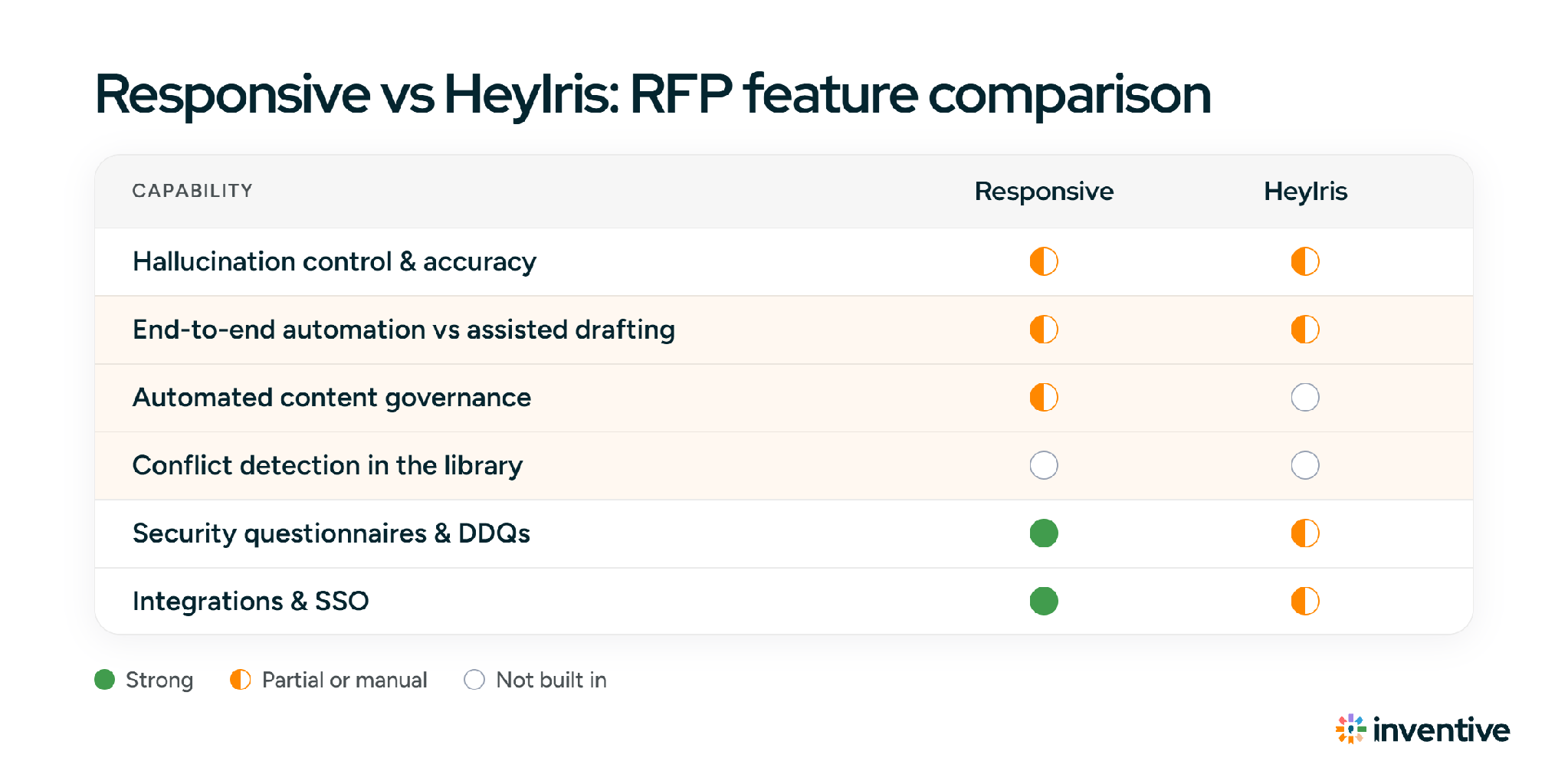
Both cover RFPs, security questionnaires, and DDQs. What separates them is how each handles AI accuracy, automation, content upkeep, and security workloads.
Hallucination control and accuracy
In an RFP or security questionnaire, a wrong response is a contractual statement, not a typo, so how the AI drafts matters more than how fast.
- Responsive: retrieves from content you have already approved, so invented responses are rare. But a draft is only as accurate as the library, and outdated entries get reused with full confidence.
- HeyIris: avoids fabricating and flags "not enough info" rather than guessing. Its weakness is aggregation: it merges several past responses instead of picking the single best, so each draft needs checking.
- What to look for: grounding, where the AI pulls from approved content, shows the source entry behind each response, and flags low-confidence drafts for review.
End-to-end automation versus assisted drafting
An RFP runs through stages: intake, go/no-go, shredding into questions, assigning owners, drafting, review and approval, formatting, and submission. Where a tool automates decides how much time it saves.
- Both tools: automate the drafting stage, generating a first-pass response per question.
- Still manual in both: intake, the go/no-go call, routing, approvals, and formatting. Neither runs a full pass unattended, so coordination load barely drops.
- What to look for: how much of the chain a tool automates, not just whether it writes a draft, since triage, routing, and formatting are where the hours go.
Automated content governance
Products change and certifications renew, so a response that was accurate last quarter goes stale while still sitting in the library.
- Responsive: real governance tooling (review cycles, ownership, moderation), but manual. Someone works through thousands of entries on a schedule, and that slips during busy periods.
- HeyIris: lighter, with enterprise controls reviewers call underdeveloped. It drafts fast but gives less structure for keeping a library accurate.
- Neither: flags stale content on its own; a person has to catch it before it ships.
- What to look for: automated governance that sets expiry and re-approval dates, reminds owners, and surfaces entries newer sources contradict.
Conflict detection in the content library
As experts contribute over time, a library accumulates contradictions: two retention periods, two uptime figures, two responses to the same control.
- Why it matters: submit conflicting responses and a buyer's security reviewer flags it, which stalls the deal or invites audit scrutiny.
- Both tools: catching conflicts is manual, so the risk grows with every contributor and entry.
- What to look for: automated conflict detection that surfaces contradictions and duplicates before submission. Ask each vendor to prove it, since it is rarely demoed.
Security questionnaire and DDQ handling
Security questionnaires and DDQs arrive as frameworks like SIG, SIG Lite, CAIQ, and VSA, often hundreds of questions tied to SOC 2 or ISO 27001 evidence, with InfoSec as the bottleneck and an annual refresh.
- Responsive: built for this volume, with audit trails, granular permissions, and throughput, which is why larger regulated teams choose it here.
- HeyIris: supports the same documents with lighter governance, a weaker fit where every response must be permissioned, logged, and tied to evidence.
- What to look for: framework awareness, control mapping, evidence attachment, and an audit trail of who answered and approved each item.
Integrations and SSO
An RFP tool is only as useful as its link to your CRM, storage, chat, and identity provider. Thin integrations become copy-paste and manual user management.
- Responsive: deeper native catalog, including Salesforce, Microsoft SharePoint, Microsoft Word, and Okta for SSO, valued for fitting an existing stack.
- HeyIris: covers identity well with SSO, SAML, and SCIM, but reviewers flag its application integrations as limited.
- What to look for: native connections to your must-have tools, weighed against maintaining a manual workaround for each gap.
Where Responsive shows its limitations
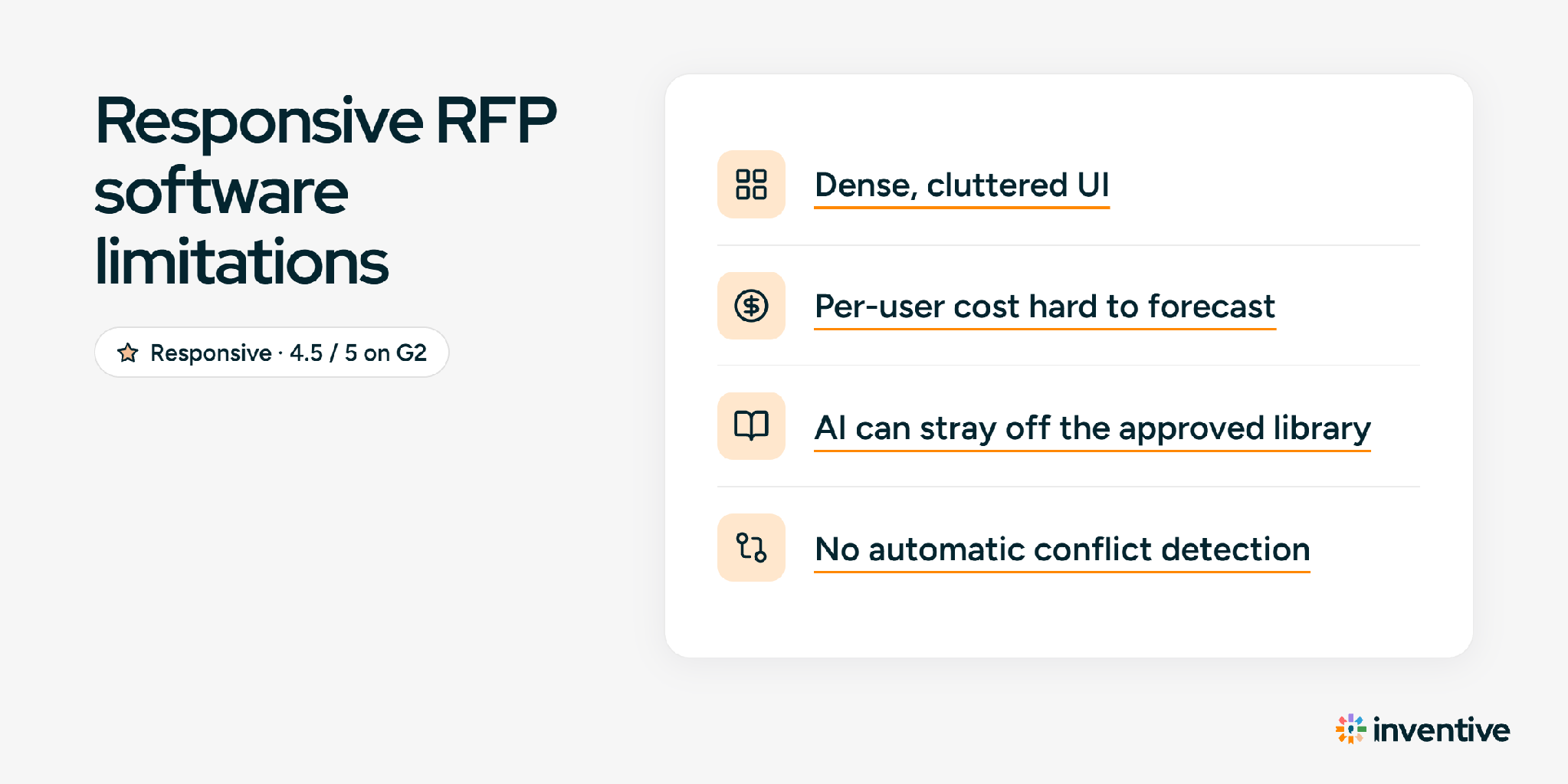
Responsive's reviews are strong overall, but the recurring criticism is consistent and worth weighing before you commit.
• The platform has a steep learning curve, and new users need meaningful training before they are productive.
• The interface is powerful but not intuitive, so everyday tasks can feel heavier than they should.
• Keeping the content library accurate is a continuous manual effort that falls on the proposal or InfoSec team.
• Rollout is a project in its own right, typically running close to two months before the platform is fully in use.
Where HeyIris falls short
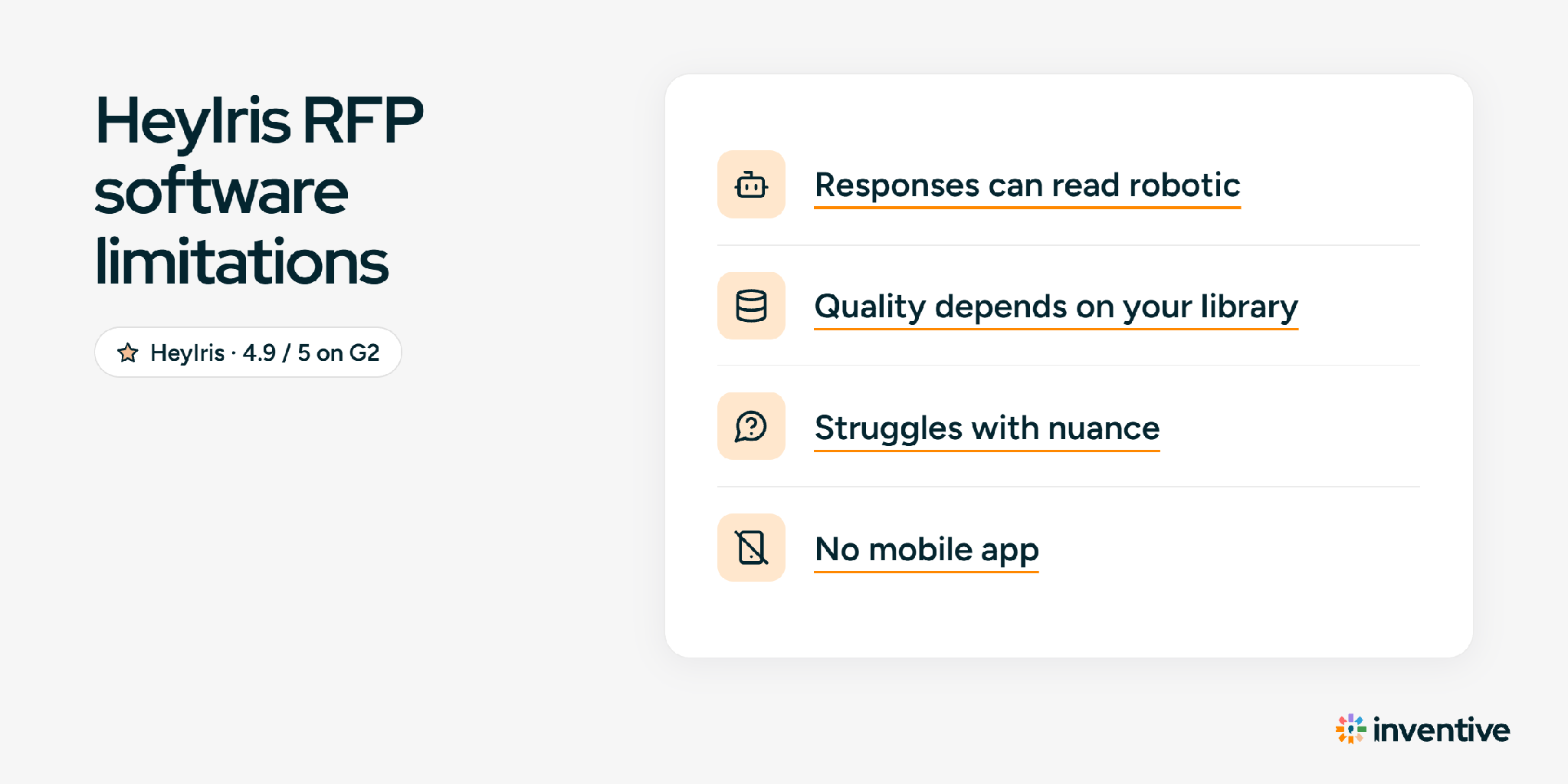
HeyIris earns high marks for ease of use, but its reviews point to the limits of a younger, AI-first product.
- The AI can pull details from different entries into a single response, so drafts need an accuracy check before they are sent.
- Drafts can read robotically and need editing to match your voice and a buyer-ready tone.
- Enterprise controls are lighter, including granular permissions, approval workflows, and content governance, which shows on high-volume, audited security questionnaire work.
- Application integrations are limited, so connecting to some CRM, storage, or collaboration tools takes manual work.
- With 73 G2 reviews, HeyIris has a shorter track record at enterprise scale than Responsive's 1,300-plus reviews.
HeyIris vs. Responsive: AI-native vs. bolted-on AI in drafting, review, and library upkeep
Most comparisons stop at features. The more useful question is how each tool was built, because that shapes how much work it actually removes. Responsive added AI to a platform designed years earlier around a managed content library, so its AI mainly retrieves and suggests from what you have already curated. HeyIris was built AI-first, which makes drafting fast, but it is still maturing the governance layer that keeps a growing library accurate.
This matters now more than it did two years ago. McKinsey reports that 65 percent of organizations regularly use generative AI, nearly double the prior year, so the question is no longer whether to use AI for responses but how deeply it is wired into the workflow. A tool where AI is the core can draft, check, and route a response end to end. A tool where AI sits on top still leans on people to manage content and catch errors.
Can you just use ChatGPT or Claude instead of RFP software like Responsive and HeyIris?
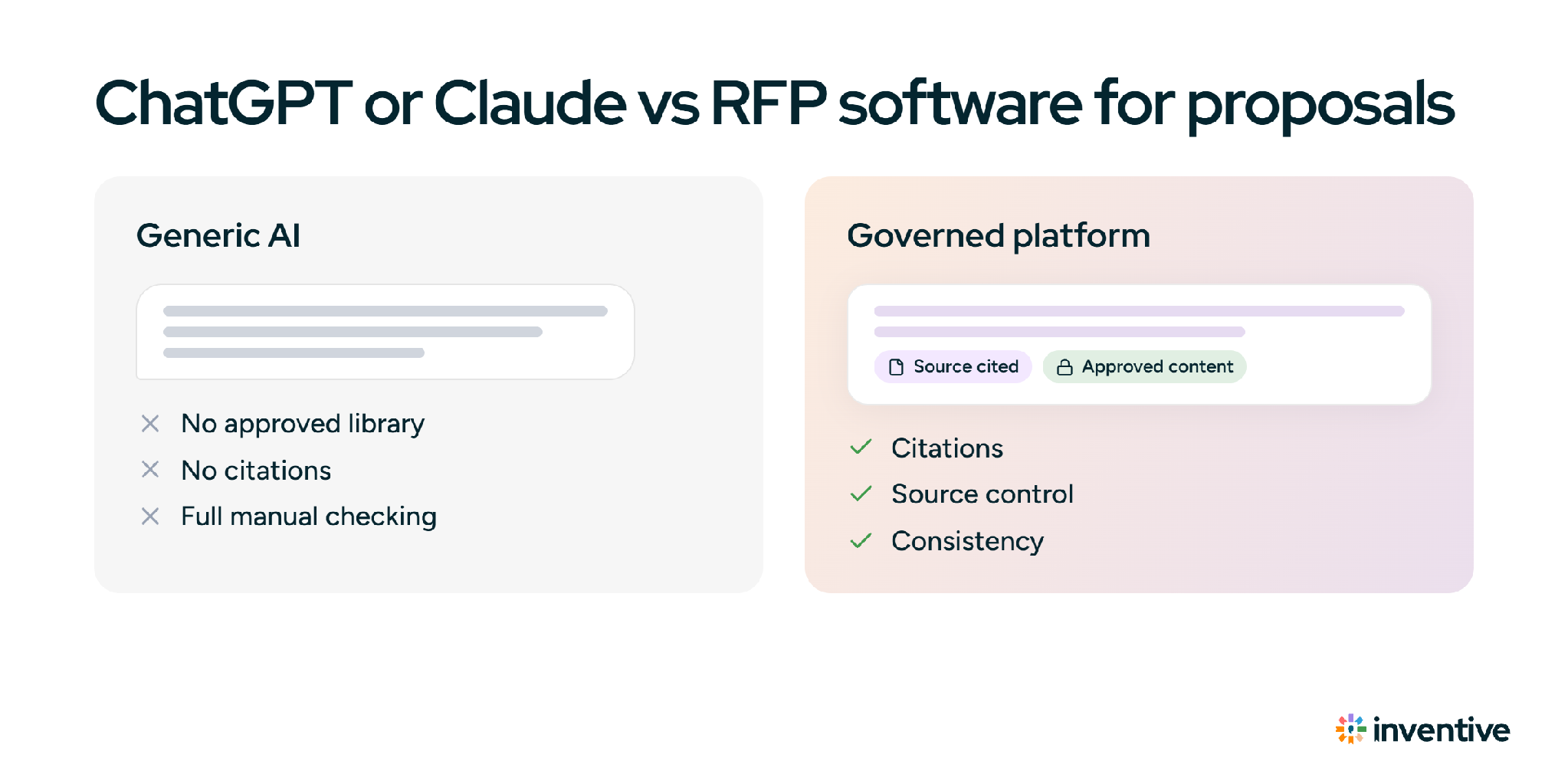
It is a fair question, and many teams try it first. General AI assistants write well, and for a single short RFP they can speed up a first draft. The gap shows the moment RFPs become a repeatable, high-stakes workflow, because a chatbot has no knowledge of your approved content, no record of who answered what, and no boundary around the confidential documents you paste in.
Where a chatbot genuinely helps: drafting a one-off response, rewriting a clunky paragraph, or summarizing a long RFP document. Here is how it compares to purpose-built RFP software across what actually matters.
See our breakdowns of using ChatGPT for RFP responses and how Claude compares to Inventive AI for RFPs.
Where Inventive AI is a better alternative: AI-native, not AI-bolted on
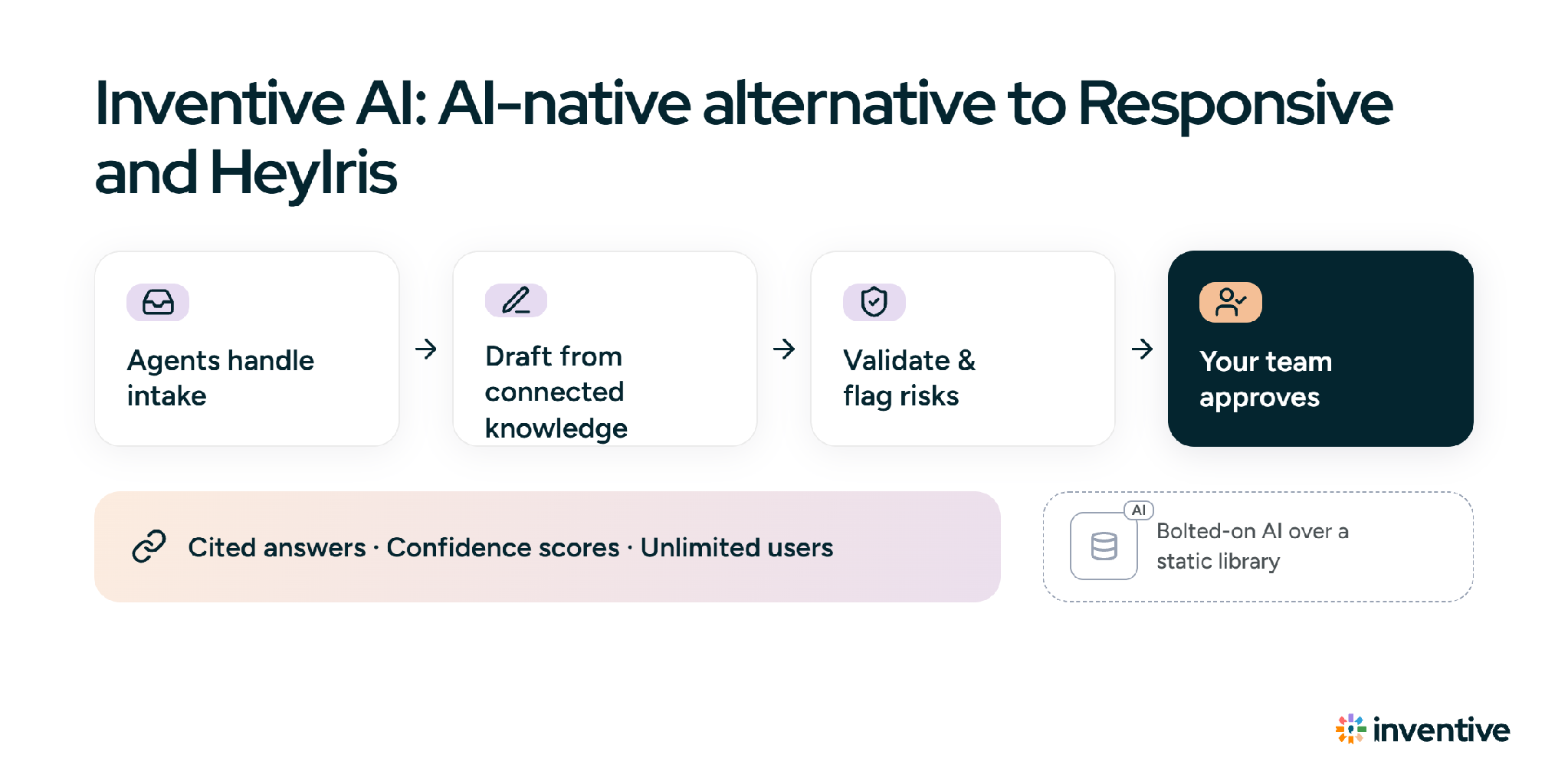
Responsive added AI to a platform built years earlier. HeyIris is AI-first but still building out governance and controls. Inventive AI is AI-native software, and governance is the core of the product, not features layered on top. That changes what the tool does on its own.
- Agents run the full cycle, not just drafting. Inventive AI takes an RFP from intake to submission-ready: it auto-identifies questions, scores the opportunity with a Go/No-Go Agent, drafts responses with citations and confidence scores, checks the full document for contradictions and gaps, and routes only what needs judgment to a human. Responsive and HeyIris stop at assisted drafting, leaving intake, qualification, routing, and validation manual.
- Automatic content governance. The library maintains itself by flagging stale and conflicting responses, instead of the manual review cycles Responsive depends on or the lighter controls reviewers report in HeyIris.
- Conflict detection built in. Contradictory responses are surfaced before submission, a check neither Responsive nor HeyIris automates.
- Grounded and source-cited. Responses are drawn from your approved content and cite their source, which keeps accuracy high and avoids the aggregation issue reviewers flag with HeyIris.
- Competitive Intelligence Agent. It positions your responses against named competitors and flags where you stand out, so the draft shows why you win, not just what you do. Responsive and HeyIris have no equivalent, so this stays manual.
- Live sync. Source content stays current across your systems, so a security response does not go stale between updates.
- Enterprise-ready, fast. Live in about a month, roughly half a typical Responsive rollout, with SOC 2 Type II, SSO, and zero data retention, and no customer data used to train models.