Thalamus AI Pricing, Features, and Reviews (2026 Guide)
Thalamus AI is gaining attention in the RFP space. We break down what it actually does, how it's priced, and whether it's the right fit for your team.
Thalamus AI is one of the newer AI-native platforms built to help proposal and pre-sales teams respond to RFPs, RFIs, security questionnaires, and other complex bids. If it is on your shortlist, the practical questions are what it actually does, what it costs, how early users rate it, and where it fits best. This guide walks through Thalamus AI’s features, pricing, reviews, strengths, and limitations, and points to a few alternatives worth comparing before you decide.
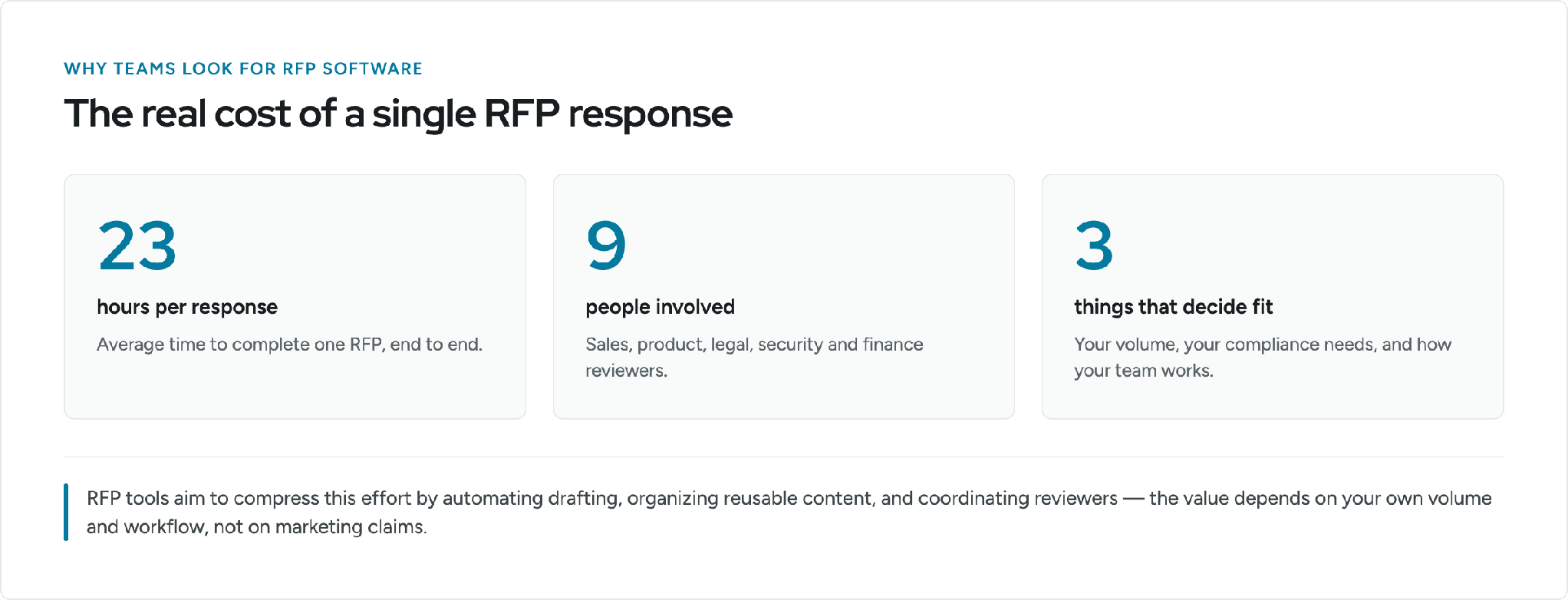
Responding to RFPs is genuinely time-consuming: industry benchmarks suggest a single RFP response can take roughly 23 hours and involve about nine people. Tools in this category aim to compress that effort by automating drafting, organizing reusable content, and coordinating reviewers. Whether any given tool is the right fit depends less on marketing claims and more on your volume, your compliance requirements, and how your team works.
Key takeaways
- Thalamus AI is an AI-native RFP and proposal platform that uses multiple AI agents to analyze bid documents, tag requirements, and draft responses across RFPs, RFIs, DDQs, and security questionnaires.
- Its feature set spans automated drafting, requirement mapping and compliance matrices, content management, SME collaboration, and enterprise security certifications (SOC 2, ISO 27001, GDPR).
- Thalamus AI does not publish pricing; plans are custom and quoted on request — common for this software category.
- Early reviews are positive but limited in number: it holds a 5-star average on G2 from a small set of reviewers, with praise for time savings and some notes about occasional bugs.
- Thalamus AI is one of several tools in this space; teams typically compare it against alternatives such as Responsive, Loopio, and Inventive AI before committing.
What is Thalamus AI?
Thalamus AI is an AI-native proposal and RFP response platform aimed at proposal, pre-sales, and revenue teams. Rather than acting only as a content library, it uses a set of specialized AI agents to read an incoming RFP, RFQ, or DDQ, identify and tag the requirements, and generate a first-draft response drawn from a company’s uploaded materials — past proposals, product documentation, and approved answers.
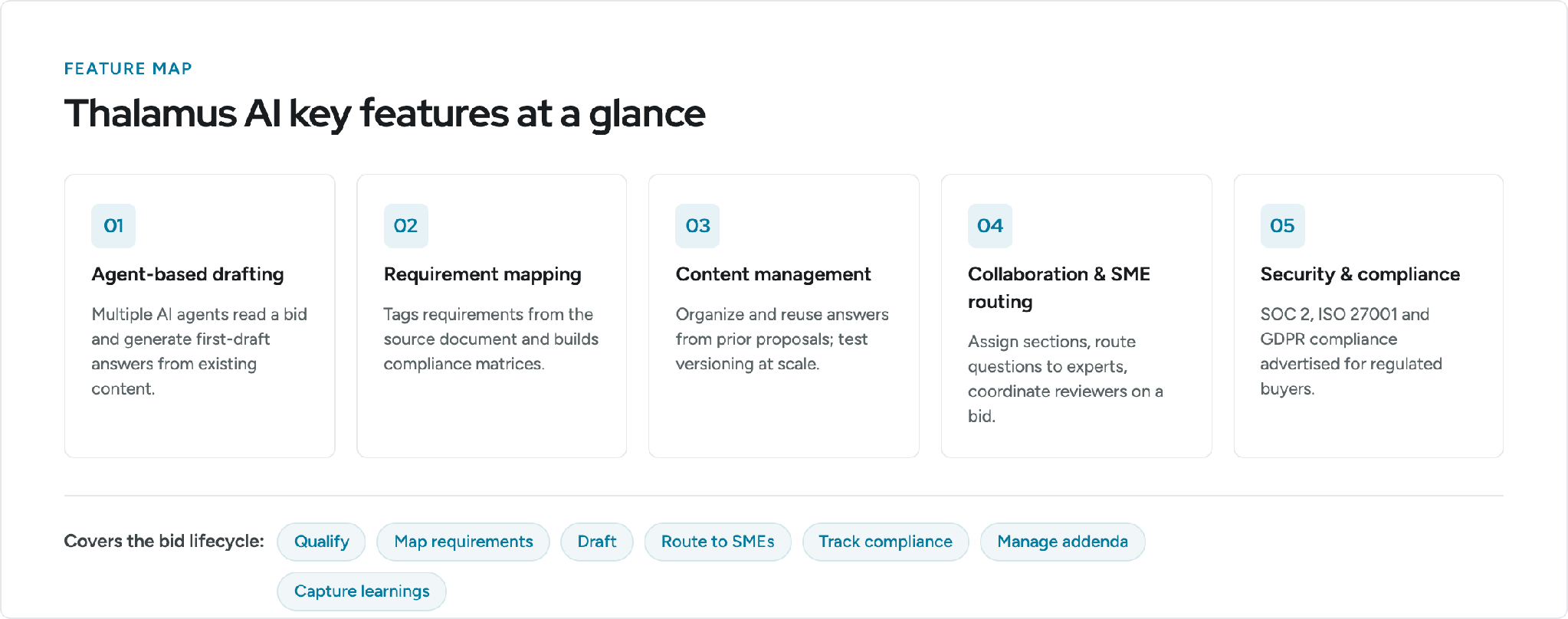
The platform positions itself around the full bid lifecycle rather than drafting alone: qualifying opportunities, mapping requirements, routing questions to subject-matter experts, tracking compliance, managing addenda, and capturing learnings after submission. It also advertises enterprise security credentials, including SOC 2, ISO 27001, and GDPR compliance. In short, Thalamus AI presents itself as an enterprise-oriented, agent-driven tool rather than a lightweight assistant — a point worth keeping in mind when comparing it with both legacy and newer platforms.
Thalamus AI key features
Thalamus AI groups its capabilities around reading a bid, drafting a response, and managing the surrounding workflow. The main features include:
- Agent-based automated drafting. Thalamus uses multiple AI agents to analyze an RFP and generate first-draft answers from your existing content. The company states that users can upload a document and get a draft quickly; as with any AI drafting tool, output quality depends on the completeness of the source material and still benefits from human review.
- Requirement mapping and compliance matrices. The platform tags requirements from the source document and can build compliance matrices — useful for structured, compliance-heavy bids where every requirement must be tracked and answered.
- Content management. Thalamus lets teams organize and reuse content from prior proposals. Buyers evaluating large libraries should test how it handles versioning and flags outdated or conflicting answers; robust content management matters most as a knowledge base grows.
- Collaboration and SME routing. Built-in workflows help assign sections, route questions to subject-matter experts, and coordinate reviewers across a bid.
- Security and compliance. SOC 2, ISO 27001, and GDPR compliance are advertised, which is relevant for regulated industries and security-sensitive procurement.
For a broader view of what to look for across this category, Inventive’s 15 best RFP software guide compares tools on features, fit, and pricing.
Thalamus AI pricing
Thalamus AI does not list pricing publicly. Plans are custom and based on factors such as team size and workflow configuration, so prospective buyers need to contact the company for a quote. This is common in the RFP-software category — most vendors, including several of Thalamus’s competitors, also quote enterprise pricing on request rather than publishing rate cards.
When comparing options, it helps to estimate seats, annual RFP and questionnaire volume, and the integrations and support level you’ll need, then request quotes on a like-for-like basis. Guides such as build vs. buy for RFP software can help frame the total-cost-of-ownership decision.
Thalamus AI reviews and ratings
At the time of writing, Thalamus AI holds a 5-star average on G2, though from a small number of reviewers, and it also appears on Capterra. Because the review base is small and the product is relatively new, treat the score as an early signal rather than a settled verdict.
Common themes in early user feedback include:
- Praised: time-saving AI agents that speed up first drafts, straightforward setup and maintenance, smooth data migration from existing systems, and responsive support.
- Raised as limitations: occasional bugs (for example, screen freezing or task-tracker loading issues) and a smaller track record than long-established platforms, simply because it is newer.
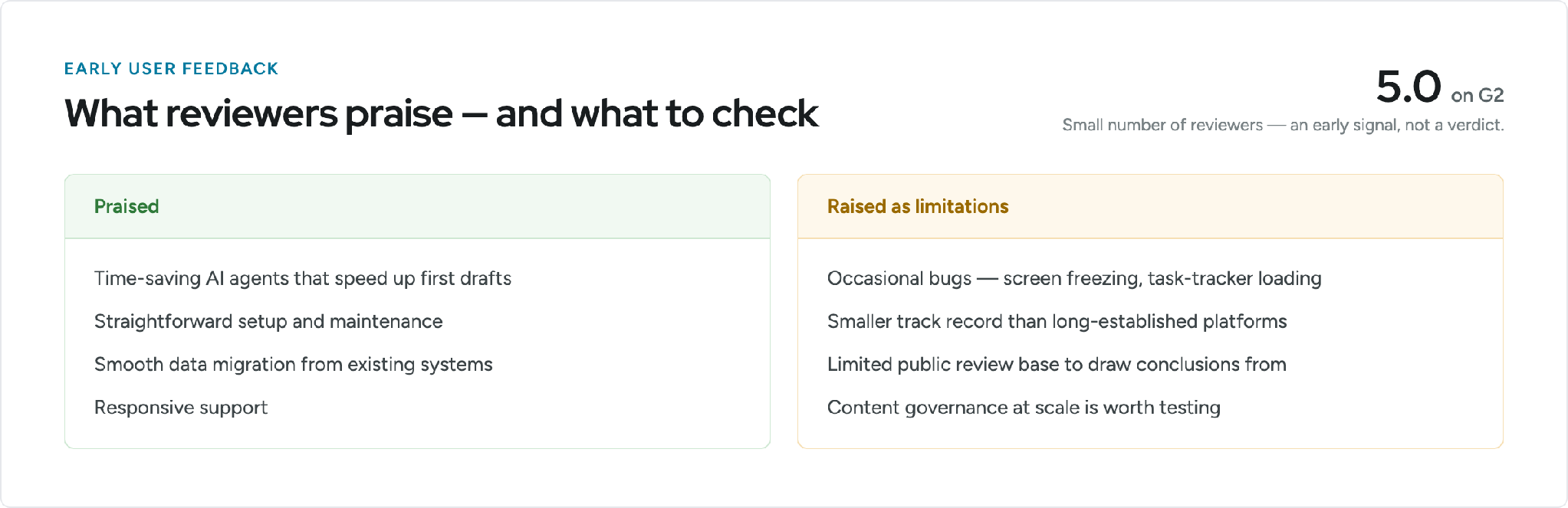
As with any peer-review score, it is worth reading recent reviews from teams whose size and use case resemble your own, and — given the small sample — asking Thalamus for reference customers in your industry.
Thalamus AI strengths and limitations
Like most tools in this category, Thalamus AI is stronger in some scenarios than others.
Where Thalamus AI tends to do well
- Fast first drafts. Its agent-based drafting is designed to turn a fresh RFP into a working draft quickly, which early reviewers cite as the main benefit.
- Structured, compliance-oriented bids. Requirement tagging, compliance matrices, and addenda tracking suit complex, multi-section proposals where nothing can be missed.
- Enterprise security posture. SOC 2, ISO 27001, and GDPR compliance make it easier to clear procurement and security review.
Where buyers should look closely
- Maturity and track record. As a newer platform with a small public review base, it has a shorter history than established tools; ask about uptime, roadmap, and references.
- Reported bugs. Some early reviewers mention occasional stability issues; a hands-on pilot is the best way to gauge current reliability.
- Content governance at scale. If you maintain a very large answer library, test how well it detects outdated or conflicting content, since that becomes harder as volume grows.
Who Thalamus AI is best for
Thalamus AI is a reasonable fit for proposal and pre-sales teams that handle structured, compliance-heavy bids and want an AI-native tool that automates requirement mapping and first-draft generation. Its lifecycle features and security certifications make it most relevant to enterprise and mid-market teams evaluating newer, agent-driven platforms.
Teams that need a long, proven track record, a large existing user community, or specific integrations should validate those points in a pilot and compare Thalamus against more established options. Inventive’s enterprise RFP software comparison is a useful reference for that segment.
Thalamus AI alternatives to consider
If Thalamus AI isn’t the right fit, several established and AI-native tools serve the same jobs. The options below are listed with comparable, one-line summaries; evaluate each against your own volume, integrations, and compliance needs.
- Inventive AI — an AI-native platform that runs the RFP, RFI, DDQ, and security-questionnaire workflow with agents and human approvals; customers report outcomes such as 90% faster responses at MaxVal and 422% ROI at AssetWorks.
- Responsive (formerly RFPIO) — a widely adopted, established response-management platform with a large content library and broad integrations; see its pricing, features, and reviews.
- Loopio — a popular RFP and questionnaire tool known for its content library and intake workflow; see its pricing, features, and reviews.
- Arphie — another newer AI-native entrant focused on autofill and generative drafting for proposal teams.
- Autogen AI — an AI writing platform aimed at bid and proposal teams, with an emphasis on generative drafting.
For a wider look at how newer AI-native tools compare with legacy platforms, see why AI-native RFP software is replacing legacy tools, and for content-library depth, the best RFP knowledge management platforms.
How to choose RFP and response software
Rather than starting from a vendor, start from your requirements. A few criteria that reliably separate the right tool from the wrong one:
- Volume and complexity. Match the tool to how many responses you produce and how much they vary; compliance-heavy, multi-section bids reward requirement mapping and matrices.
- Where your knowledge lives. Tools that connect to your existing systems reduce the burden of maintaining a separate library.
- Accuracy and traceability. Look for source citations and confidence signals so reviewers can verify answers — essential for security and compliance content.
- Collaboration and governance. Assignments, approvals, and content-freshness controls keep multi-team responses accurate over time.
- Maturity and support. For newer tools, weigh the roadmap, references, and support responsiveness alongside features.
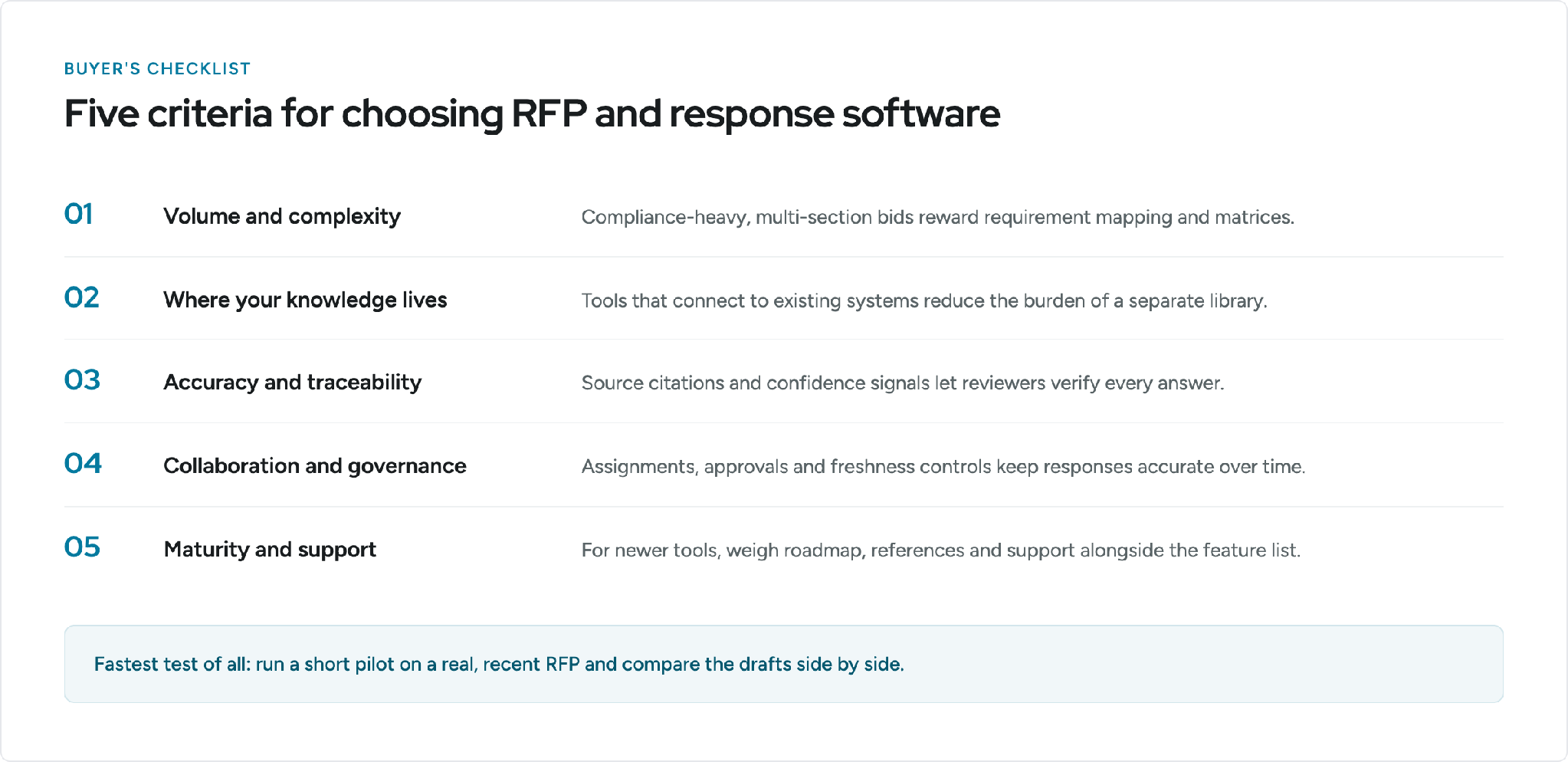
Running a short pilot on a real, recent RFP is usually the fastest way to see how any tool — Thalamus AI or an alternative — performs on your content. For a refresher on the fundamentals, see how to create an effective RFP response.
Frequently asked questions
What is Thalamus AI used for?
Thalamus AI is an AI-native platform used by proposal and pre-sales teams to respond to RFPs, RFIs, DDQs, and security questionnaires. It uses multiple AI agents to analyze bid documents, tag requirements, build compliance matrices, and generate first-draft responses from a company’s existing content, then supports review and collaboration through submission.
How much does Thalamus AI cost?
Thalamus AI does not publish pricing. Plans are custom and based on factors such as team size and workflow configuration, so you need to contact the company for a quote. This is typical in the RFP-software category, where most vendors provide enterprise pricing on request rather than a public rate card.
Is Thalamus AI good for enterprise RFP management?
Thalamus AI positions itself for enterprise and mid-market teams, with requirement mapping, compliance matrices, addenda tracking, and SOC 2, ISO 27001, and GDPR compliance. Because it is a newer platform with a small public review base, enterprise buyers should pilot it on a real bid and check references before standardizing on it.
How does Thalamus AI compare to other RFP tools like Responsive and Loopio?
Responsive (formerly RFPIO) and Loopio are established, library-centric platforms with large user communities and broad integrations, while Thalamus AI is a newer, agent-driven tool focused on automated requirement mapping and drafting. The best fit depends on your volume, existing content, and how much you value a mature ecosystem versus newer AI automation — comparing them on a real RFP is the most reliable test.
What are the best Thalamus AI alternatives?
Commonly evaluated alternatives include Inventive AI, Responsive, Loopio, Arphie, and Autogen AI. Each suits a different profile — from AI-native automation to large, established content libraries — so shortlist two or three and compare them on the criteria that matter most to your team, ideally in a short pilot.
Evaluating RFP and response tools? Inventive AI is an AI-native platform for RFPs, RFIs, DDQs, and security questionnaires — book a demo to see how it handles your content.

.avif)