Arphie vs Responsive (2026): AI-Native Agents or Enterprise Content Library?
Compare Arphie and Responsive on AI drafting, content governance, pricing and reviews plus where AI-native platforms like Inventive AI now fit.

Last reviewed: February 2026. This comparison draws on each vendor's published materials, verified customer reviews on G2 and Capterra (and TrustRadius where a current listing exists), and independent third-party analyses including Vendr, Proposify and SiftHub. Several figures below are reported rather than vendor-stated, and pricing and features change frequently — check the live listings and confirm current specifics with each vendor before you commit.
TL;DR: Which one fits your team?
Arphie suits teams that want AI agents to draft first-pass answers directly from the knowledge sources they already use, with source citations and confidence scoring baked in — and who can tolerate a newer product with a thin review base. Responsive fits larger, distributed teams that want a mature, centralized content library, deep workflow automation, and a broad integration ecosystem, and who accept a steeper learning curve and per-user pricing that scales in cost.
There is no universal winner. The right pick depends on what your team needs: speed and AI-native drafting, or an established library-and-workflow backbone. If you are early in evaluation, it is also worth scanning the newer AI-native category before you commit — one starting point is this RFP software comparison guide.
Arphie vs Responsive at a Glance
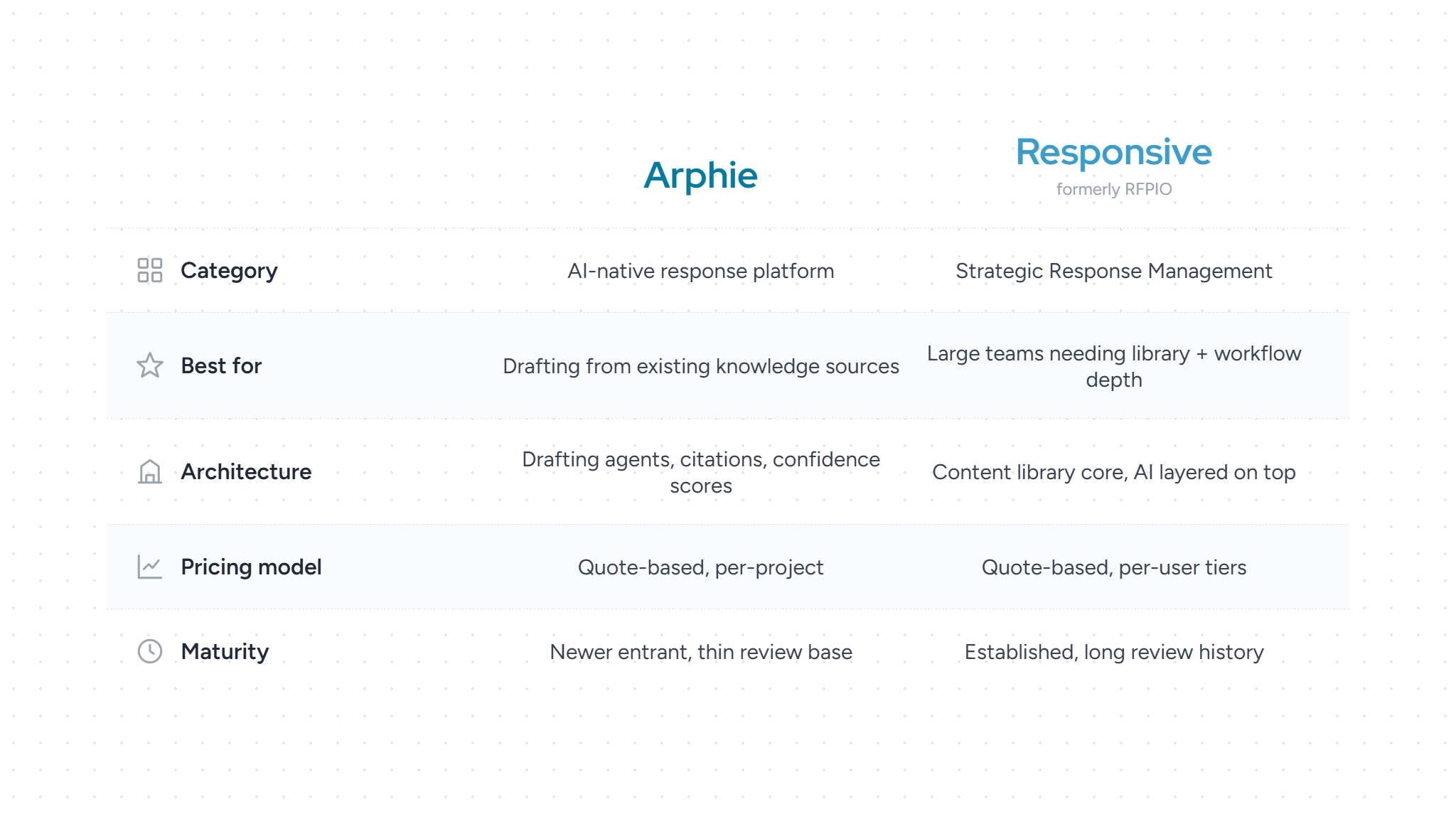
| Arphie | Responsive (formerly RFPIO) | |
|---|---|---|
| Category | AI-native RFP / RFI / DDQ / security-questionnaire response | Enterprise Strategic Response Management |
| Best for | Teams wanting AI agents to draft from existing knowledge sources | Large, distributed teams wanting a centralized library + workflow depth |
| Architecture | Built AI-native around drafting agents with citations + confidence scores | Content library at the core, with AI answering layered on |
| Maturity | Newer entrant, thin/recent review base | Established, long review history |
| Pricing | Quote-based; reported per-project (unlimited users per project) | Quote-based; reported per-user, tiered editions |
Figures are reported at the time of writing; confirm current details with each vendor.
What Should You Consider When Choosing Between Arphie and Responsive?
Answer-first: score both tools against the criteria below that matter most to your workflow, then verify each during a live demo with your own real questions.
- AI drafting approach: Does the AI draft complete first-pass answers, or mainly suggest reused content? Test both on a fresh RFP.
- Hallucination control: Does each answer ship with a citation and a confidence score, and will the tool say "I don't know" rather than guess?
- Content management: Do you want to maintain a curated library, or pull from where content already lives (SharePoint, Drive, Confluence)?
- Content governance: How does the tool flag outdated, conflicting or duplicate answers over time?
- Conflict detection: Can it catch contradictory answers across a long response before submission?
- Security questionnaires: How well does it handle VSQs, DDQs and Excel-heavy questionnaires specifically?
- Workflow automation: Assignments, reviewer stages, progress tracking — how much can you automate across teams?
- Collaboration: How do SMEs, sales and InfoSec review in parallel?
- Integrations: Does it connect to your CRM, storage and chat tools natively?
- Security and compliance: SOC 2, data-handling, and whether your data trains public models.
- Analytics: What reporting exists on throughput, win rates and content usage?
- Pricing and total cost: Per-seat vs per-project, plus onboarding, migration and support add-ons — weigh how those models play out across the category in this enterprise RFP software comparison before you sign.
- Ease of implementation: How long to first useful draft?
- Enterprise scalability: Does the licensing model punish you for adding users or volume?
Arphie vs Responsive: Feature-by-Feature Comparison
This is the core of the comparison. Values are drawn from vendor materials, verified reviews and third-party analyses at the time of writing.
| Dimension | Arphie | Responsive (formerly RFPIO) |
|---|---|---|
| Best for | AI-native drafting from existing knowledge sources | Enterprise library + workflow at scale |
| G2 rating | 4.9 / 5 (reported ~16–19 reviews; confirm on live listing) | 4.5 / 5 (reported ~1,228–1,309 reviews; confirm on live listing) |
| Capterra rating | 5.0 / 5 (1 review — very small sample) | 4.6 / 5 (reported ~185 reviews; confirm on live listing) |
| TrustRadius | No verified current listing found | Listing exists; current trScore/count not verified |
| Pricing model | Quote-based; reported per-project, unlimited users per project | Quote-based; reported per-user, tiered editions |
| Reported cost | Not publicly listed (custom quote) | ~$14,000/yr benchmark (Vendr via Proposify); ~$13,955/yr avg (SiftHub); ranges reported ~$5K–$29K+ |
| AI capabilities | AI agents draft first-pass answers with source citations + confidence scoring | AI answering layered over the content library; continual AI improvements noted |
| Hallucination control | Exact source citations, confidence scores, explicit "I don't know" signals | Content-library-backed answers; verification workflow-driven |
| Content management | Connects to Drive, SharePoint, Confluence, Highspot, Seismic — no migration required | Centralized content library as single source of truth |
| Integrations | Google Drive, SharePoint, Confluence, Seismic, Highspot, Slack, Salesforce, Front | Salesforce, Dynamics, Zoho, HubSpot, Pipedrive, Slack, Teams, Google Chat, Seismic, M365; MCP server with ChatGPT/Copilot/Claude |
| Mobile access | Lack of mobile access is the most cited limitation | Broader platform maturity |
| Export/import | Q&A pair imports restricted to Excel; export options reported limited | Complex Excel imports reported difficult to set up |
| Learning curve | Reported intuitive and fast to use | Steep learning curve, UI complexity reported |
| Customer support | Reported responsive (small sample) | Highly rated support noted by long-term reviewers |
Figures are reported at the time of writing; confirm with each vendor and on the live review listings.
Arphie: Deep Dive
Arphie is an AI-native platform for RFPs, RFIs, DDQs and security questionnaires. It is built around AI agents that generate first-pass answers from connected knowledge sources, attaching a source citation and a confidence score to each response. It is a newer entrant, so its review base is small and recent — our full Arphie pricing, features and review guide covers the product in more depth.
Best features
- AI agents draft first-pass answers directly from connected sources, so reviewers focus on the hard questions rather than starting from blank.
- Exact source citations on every AI-generated answer, plus confidence scoring and explicit "I don't know" signals to reduce hallucination risk.
- Connects to existing knowledge sources (Google Drive, SharePoint, Confluence, Highspot, Seismic) so teams pull from where content already lives instead of migrating first.
- Slack integration for ad-hoc questions, cited by reviewers as a time-saver.
- Reported intuitive, fast setup — reviewers describe saving large blocks of drafting time.
- Handles multiple file types on ingestion (PDF, Word, Excel, PowerPoint, Google Docs/Sheets/Slides).
Limitations
- Lack of mobile accessibility is the most consistently cited limitation in Arphie reviews.
- Limited export options, with Q&A pair imports restricted to Excel, per the G2 alternatives listing.
- Some file import/export and reporting features are reported as pending.
- A less mature Salesforce integration than some established rivals.
- Newer market position with a thin, recent review base — a small sample relative to established competitors, per SiftHub's breakdown. Teams wanting broader validation often line up other Arphie alternatives and competitors during evaluation.
- Quote-based pricing with no public list, which slows early budgeting.
Pricing. Arphie uses a "contact us" quote model with no public list price. Third-party analyses report a per-project structure (unlimited users per project) tied to team size, RFP/questionnaire volume and integration needs, per AutoRFP and SiftHub. Capterra lists the starting price as "Not provided by vendor," pricing model "Flat Rate" (Capterra). Confirm current pricing directly with the vendor.
Ratings and reviews. Arphie shows 4.9 / 5 on G2 (reported ~16–19 reviews depending on the page) and 5.0 / 5 on Capterra from a single review. No verified current TrustRadius listing was found. Treat these as directionally positive but statistically thin.
Positive: "I find Arphie intuitive and easy to use, which makes my tasks simpler. It's fast and accurate, allowing me to save time by focusing only on the difficult questions that matter." — G2
Mixed: "Arphie was great to use but is not something I would use long term in my particular work setting." — Software Advice
See it live: Insider reports its win rate rose from 30% to 50% and RFP responses got 90% faster after moving to an AI-agentic approach — read how in Insider's case study.
Responsive (formerly RFPIO): Deep Dive
Responsive is an established Strategic Response Management platform for RFPs, RFIs, security questionnaires (VSQs), DDQs and risk assessments. It is built around a large centralized content library, extensive workflow and collaboration automation, and AI answering. It has a long review history across G2, Capterra and TrustRadius, and our Responsive pricing and plans guide breaks down the tiers in more detail.
Best features
- Deep, centralized content library used as a single source of truth for approved Q&A, praised for streamlining content and bid management.
- Strong workflow automation across large, distributed teams — assignments, review stages and progress tracking.
- Broad integration ecosystem (Salesforce, HubSpot, Slack, Teams, SharePoint, Seismic and more), plus MCP server integration with ChatGPT, Microsoft Copilot and Claude.
- Handles the full range of response types — RFPs, RFIs, VSQs, DDQs and risk assessments.
- Highly rated, responsive customer support noted by long-term reviewers.
- Continual product and AI improvements over multiple release cycles.
Limitations
- Steep learning curve and UI complexity, with users reporting struggles with basic text editing and buried actions, per G2 pros-and-cons.
- Difficulty importing complex Excel spreadsheets — hard to set up field order, per G2.
- Usability inconsistencies between new and legacy UI, and slow bug resolution (fixes reported to take months), per Capterra.
- Salesforce integration friction reported as a recurring complaint, per Thalamus.
- Licensing model reported to make scaling expensive as teams grow. Teams facing that often review Responsive competitors and alternatives before renewal.
- Library-first approach means someone must keep the repository current for AI answers to stay accurate.
Pricing. Responsive does not publish list pricing. It uses per-user subscriptions with tiered editions (e.g., Lite and higher) and volume discounts, per Vendr and the vendor's own package overview. Third-party benchmarks report deals commonly around $14,000/year (Proposify, citing Vendr) and an average near $13,955/year with ranges roughly $7,000–$28,000, plus paid add-ons for onboarding, migration, premium support and dedicated hosting (SiftHub). These are reported, not vendor-stated — confirm directly.
Ratings and reviews. Responsive shows 4.5 / 5 on G2 (reported ~1,228–1,309 reviews) and 4.6 / 5 on Capterra (reported ~185 reviews). A TrustRadius listing exists, but a current trScore and count could not be verified from search.
Positive: "Responsive is a total lifesaver for RFPs and security questionnaires!" — G2
Mixed: "The current licensing model doesn't support scaling without breaking the bank." — Capterra
AI Capabilities: How Arphie and Responsive Approach Automation
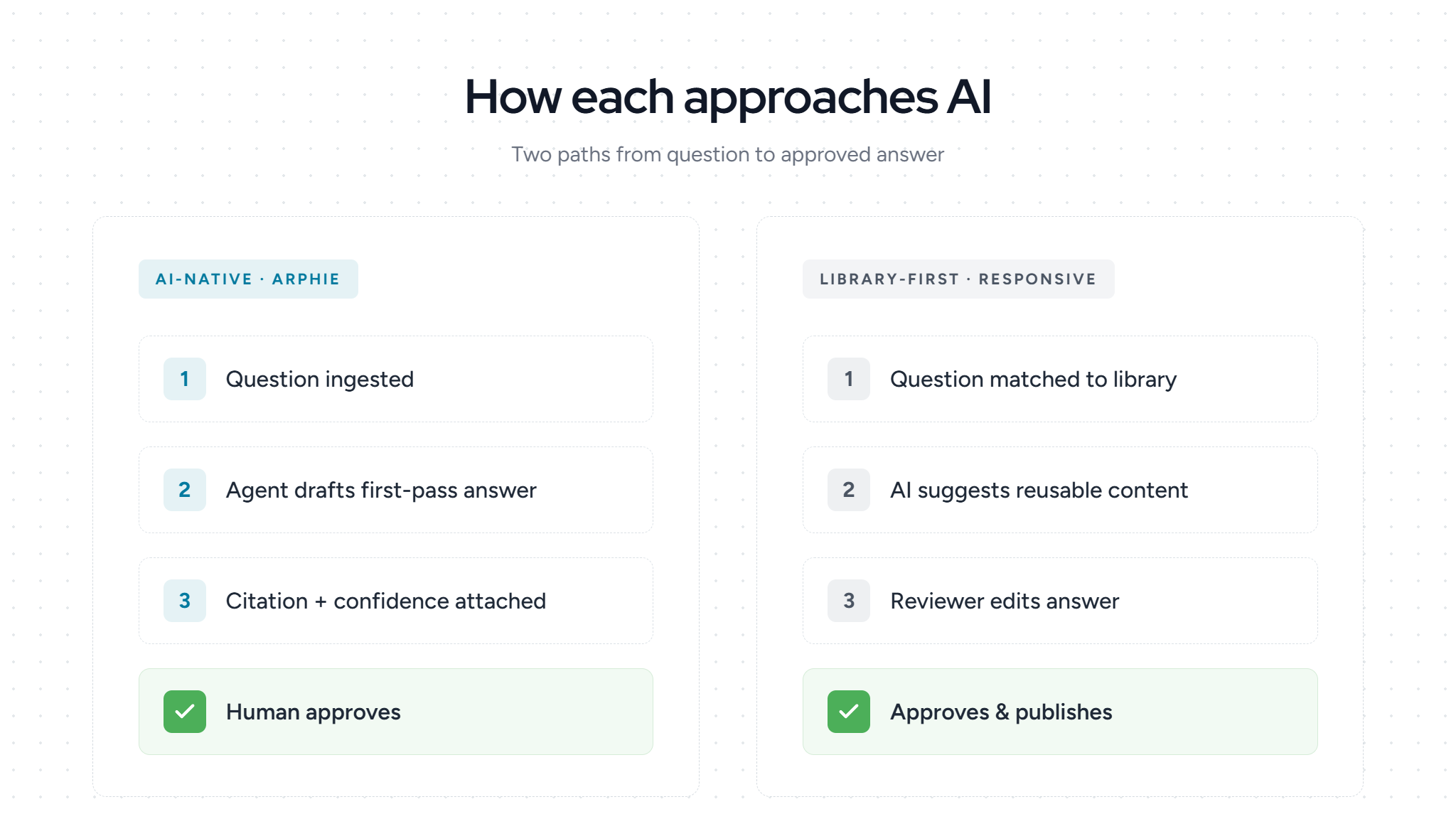
Answer-first: Arphie is built AI-native, generating first-pass answers with citations and confidence scores; Responsive layers AI answering onto an established content library. Both aim to cut drafting time, but the architecture differs.
Arphie
• Agents draft complete first-pass answers from connected sources, not just surface matches.
• Every answer carries a source citation and confidence score, with explicit "I don't know" flags.
Responsive
• AI answering draws on the curated library, so accuracy tracks how well the library is maintained.
• Long-term reviewers note steady AI improvements across releases.
Note (applies to both): AI accuracy depends heavily on the quality and freshness of your underlying content. Test each tool with real, edge-case questions during a trial and check how each handles a topic where your content is thin. RAD AI's team found AI answer quality varied sharply between tools — read the accuracy case study for how they benchmarked it.
Integrations: What Connects to What?
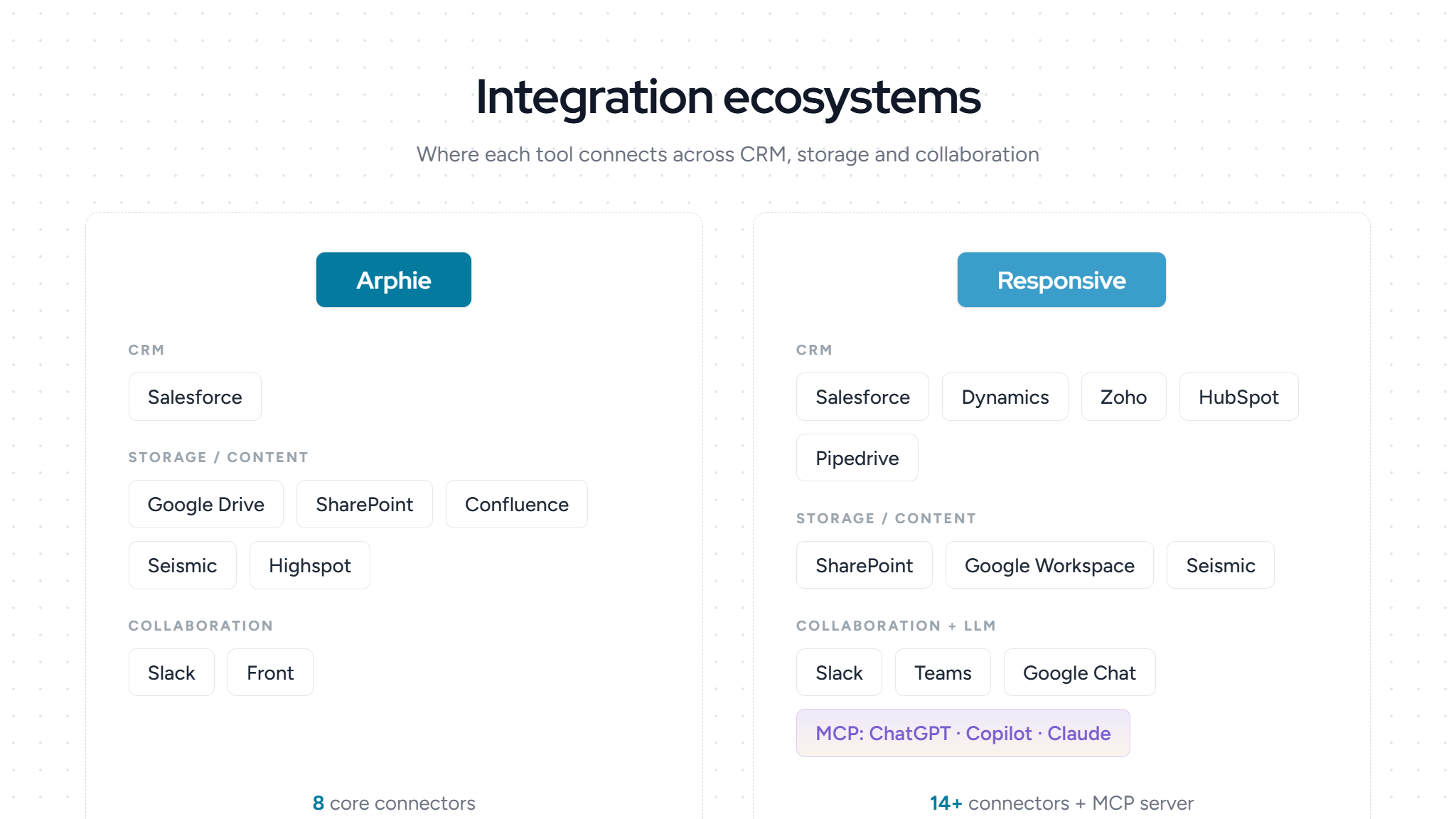
Answer-first: Responsive offers the broader integration ecosystem — more CRMs, chat tools and an MCP server for third-party LLMs — while Arphie covers the core content sources and collaboration tools most response teams rely on.
| Category | Arphie | Responsive |
|---|---|---|
| CRM | Salesforce | Salesforce, Dynamics, Zoho, HubSpot, Pipedrive, PipelineDeals |
| Storage/content | Google Drive, SharePoint, Confluence, Seismic, Highspot | SharePoint, Google Workspace, Seismic |
| Collaboration/chat | Slack, Front | Slack, Microsoft Teams, Google Chat |
| AI/LLM | Web-page ingestion, file uploads | MCP server with ChatGPT, Microsoft Copilot, Claude |
Arphie leans on connectors to the places content already lives — Google Drive, SharePoint, Confluence, Highspot and Seismic — which suits teams that do not want to migrate content into a new library first. Responsive covers a wider CRM footprint (Salesforce, Dynamics, Zoho, HubSpot, Pipedrive) and adds three chat surfaces plus an MCP server that exposes its content to ChatGPT, Copilot and Claude, which suits teams standardizing on Microsoft or multiple CRMs.
Confirm integration depth, not just presence, in a demo. Arphie's Salesforce integration is reported as less mature than some established rivals, and Responsive's Salesforce connection draws recurring friction complaints from reviewers — so test the specific CRM sync your team depends on with real records rather than trusting the feature checklist.
Pricing: How Much Do Arphie and Responsive Cost?
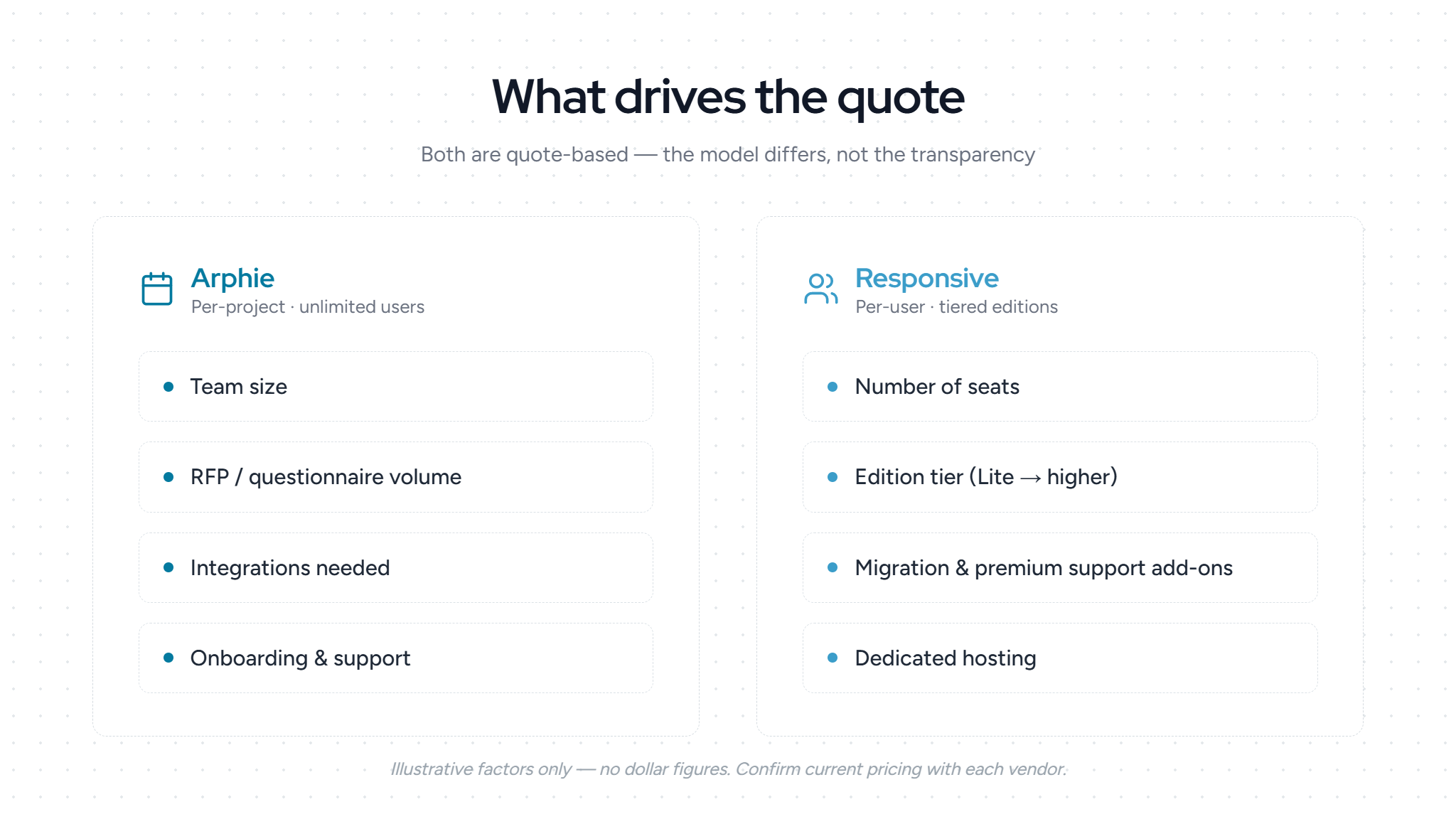
Answer-first: both are quote-based with no public list pricing. Arphie is reported to price per project (unlimited users per project); Responsive is reported to price per user with tiered editions.
How much does Arphie cost? Arphie does not publish pricing. Third-party sources report a custom quote tied to a per-project model, scaling with team size, questionnaire volume and integrations (AutoRFP; SiftHub).
How much does Responsive cost? Also quote-based. Third-party benchmarks report roughly $14,000/year typical, ranging ~$5,000–$29,000+ depending on team size and negotiation, with paid add-ons (Proposify/Vendr; SiftHub).
Note (applies to both): Because neither vendor lists prices, budget for onboarding, data migration and support add-ons, and get quotes at your real user and volume levels. A side-by-side of pricing approaches across the category is in this roundup of the best RFP software.
Weigh total cost: AssetWorks Facilities reported 422% ROI and roughly $105K in net savings after automating RFP responses — see the ROI breakdown when you build your own business case.
Reviews: What Do Users Say?
Answer-first: Responsive has depth of validation from a large, long-running review base; Arphie scores higher but on a very small, recent sample — so weight the ratings by sample size, not just the number.
- Arphie: 4.9 / 5 on G2 (reported ~16–19 reviews) and 5.0 / 5 on Capterra from a single review. Positive reviews consistently cite speed, ease of use and time saved on drafting, with the Slack integration singled out for ad-hoc questions. The most consistent criticism is the lack of mobile access, followed by limited export options and pending reporting features. Because the sample is small and recent, treat the near-perfect scores as early signal rather than settled reputation.
- Responsive: 4.5 / 5 on G2 (reported ~1,228–1,309 reviews) and 4.6 / 5 on Capterra (reported ~185 reviews). Positives cluster on the content library, workflow automation and responsive support; criticisms cluster on the learning curve, UI inconsistency between new and legacy interfaces, slow bug resolution and per-user scaling cost. A large sample makes those patterns more reliable than Arphie's thin base.
Community sentiment. Searches like "Arphie vs Responsive reddit" surface little for Arphie given how new it is, so first-hand user threads are sparse — most public signal sits on G2, Capterra and third-party review blogs. Responsive appears far more often in community discussion, usually praised for library depth and criticized for cost and complexity. Weigh community chatter accordingly, and prioritize a hands-on trial with your own content over anecdotes either way.
Is Arphie Better Than Responsive?
Answer-first: neither is universally better — it depends on what your team needs. Choose Arphie if you want AI-native drafting from existing sources, citations and confidence scoring, and fast onboarding, and you can accept a young product and thin review base. Choose Responsive if you want a mature, centralized content library, deep workflow automation across a large team, and a broad integration set, and you can absorb a steeper learning curve and per-user scaling costs.
Validate the trade-off that matters most to you in a live trial, using your own real RFP and questionnaire content.
Also Worth Considering: Inventive AI
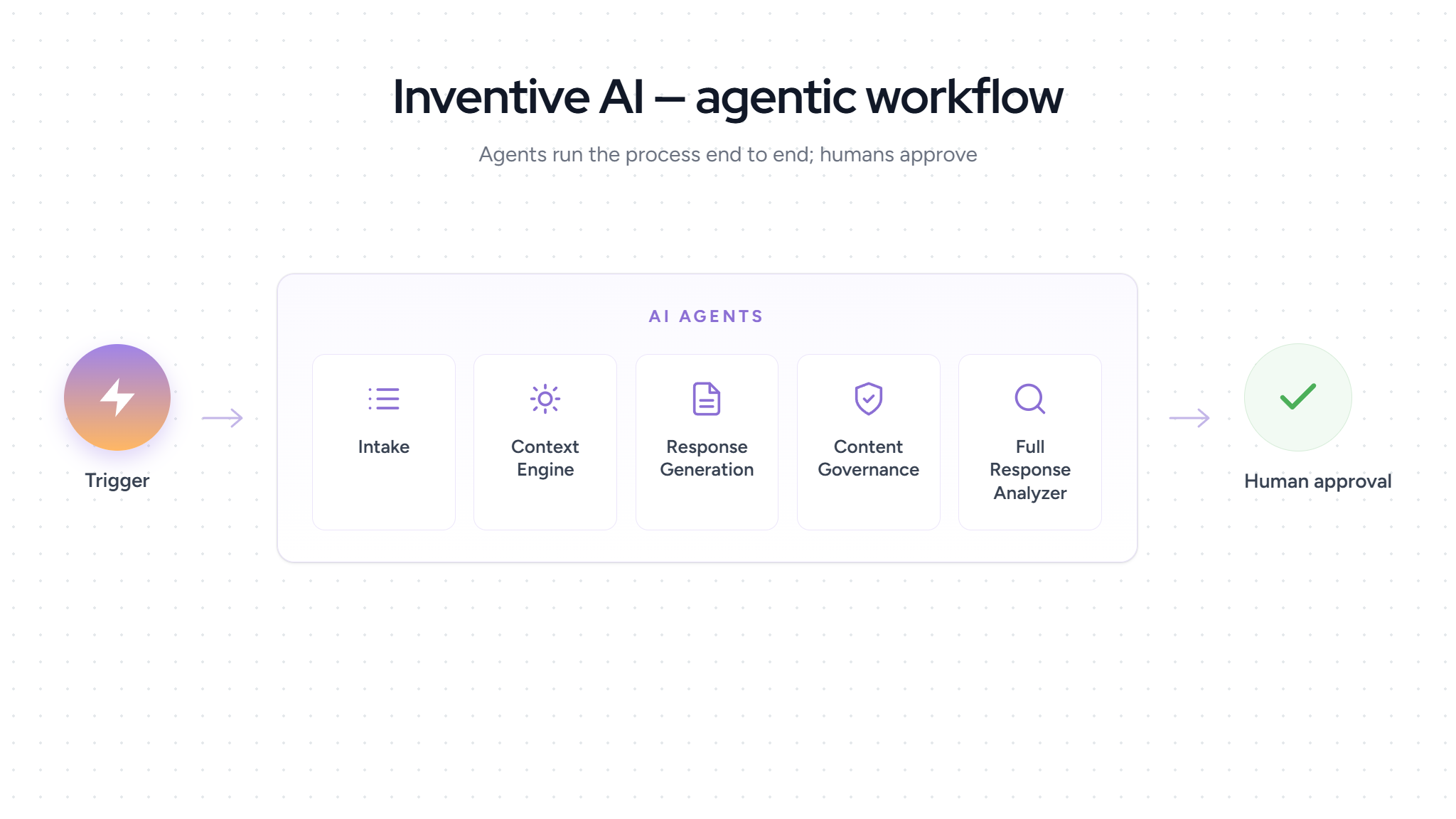
If you are weighing Arphie and Responsive, it helps to know a third architectural approach exists: a newer class of AI-native proposal platforms that are replacing legacy tools, running more of the response workflow with AI agents and keeping humans in the loop for approvals. Inventive AI is one example of that category. Rather than centering on a content library or a single drafting step, these platforms trigger agents to work the process end to end.
Inventive AI is positioned as an autonomous, AI-agentic platform for RFPs, RFIs, DDQs and security questionnaires, used by proposal teams, sales, presales, InfoSec and product marketing. Once triggered, agents understand the questions, draft responses, validate them and flag gaps, so teams approve output rather than write from scratch or maintain a separate repository.
Key capabilities of Inventive AI
- AI Response Generation drafts first-pass answers with source references, a confidence score and supporting context, flagging "Information unavailable" rather than guessing.
- A Knowledge Hub that connects to SharePoint, Google Drive, Salesforce, Confluence, Notion, Zendesk and websites, live-syncing when a source changes — no separate library to maintain.
- A Content Governance Agent that detects conflicting information, flags outdated content and surfaces duplicates automatically.
- A Context Engine that tailors responses to customer priorities, deal info and CRM data for deal-specific answers.
- A Competitive Intelligence Agent that compares positioning against named competitors inside the response.
- Format flexibility across Excel questionnaires and narrative proposals.
- Collaborative review and approval workflows, with approved answers feeding back into the Knowledge Hub.
- On response quality, RAD AI reported 2x more client-ready answers than the next-best tool tested; the platform is SOC 2 Type II compliant and does not use customer data to train public models.
Best for: mid-market and enterprise teams that want agents to run more of the RFP, DDQ and security-questionnaire process rather than manage a content library or draft answer-by-answer.
Why Buyers Comparing Arphie and Responsive Might Look at Inventive as an Alternative
The shared pain point across Arphie and Responsive is upkeep: Responsive's accuracy depends on keeping a large library current, and Arphie is newer with export, mobile and reporting gaps still filling in. Inventive AI is positioned to reduce that upkeep by having a Content Governance Agent maintain knowledge and a Context Engine tailor each response, with humans approving. Insider, which moved to this AI-agentic approach, reported 90% faster RFP responses and about 70% overall efficiency. If that trade-off is relevant, you can compare the AI-native approach in a demo.
Compare the agentic approach: For a direct head-to-head on architecture and accuracy, see Arphie vs Inventive AI and Responsive vs Inventive AI.
Frequently Asked Questions
Is Arphie better than Responsive?
Neither is better for every team. Arphie is stronger on AI-native drafting, citations and fast onboarding but is a young product with a thin review base. Responsive is stronger on library depth, workflow automation and integrations but has a steeper learning curve and per-user scaling costs. Match the strengths to your priorities and test both.
How much does Arphie cost?
Arphie does not publish pricing. Third-party sources report a custom, quote-based per-project model (unlimited users per project) that scales with team size, questionnaire volume and integration needs. Confirm current pricing with the vendor.
How much does Responsive cost?
Responsive is also quote-based. Third-party benchmarks report roughly $14,000/year typical, with ranges around $5,000–$29,000+ depending on team size and negotiation, plus paid add-ons for onboarding, migration and premium support. Treat these as reported, not vendor-stated.
Which handles security questionnaires better?
Both handle security questionnaires, VSQs and DDQs. Arphie emphasizes AI drafting with citations and confidence scores; Responsive emphasizes a governed content library and workflow. Test each on a real, Excel-heavy questionnaire — a category overview is in this guide to the best AI agents for security questionnaires.
Is there an AI-native alternative to Arphie and Responsive?
Yes. A newer category of AI-agentic platforms, including Inventive AI, runs more of the response process with agents while keeping humans in the loop for approvals. Whether that fits depends on how much manual upkeep and drafting your team wants to remove — evaluate it alongside Arphie and Responsive rather than in place of a trial.
Related Comparisons and Resources
For deeper evaluation as you shortlist, these resources cover adjacent comparisons, case studies and buyer guides:
• Arphie vs Responsive vs Inventive AI: side-by-side feature comparison
• Arphie alternatives and competitors
• Responsive (RFPIO) competitors and alternatives
• RFP software comparison guide
• Best enterprise RFP software compared
• 90% faster RFPs, zero weekend hours lost — case study


.png)
.png)