Loopio vs Arphie (2026): Content Library vs AI-Agent Drafting for RFPs
Compare Loopio and Arphie on AI drafting, content governance, pricing, integrations and reviews for RFPs plus the AI-native alternative buyers are watching.
Last reviewed: February 2026. The analysis below is built from each vendor's own published materials, verified G2 and Capterra reviews, TrustRadius where a listing exists, and independent third-party write-ups (Vendr, AutoRFP, SiftHub). Several figures come from small or aggregated samples, so read every number as a point-in-time snapshot — ratings, feature sets and quotes shift, and neither vendor lists public prices, so confirm the current specifics with Loopio and Arphie directly before you sign anything.
TL;DR: Loopio vs Arphie in three sentences
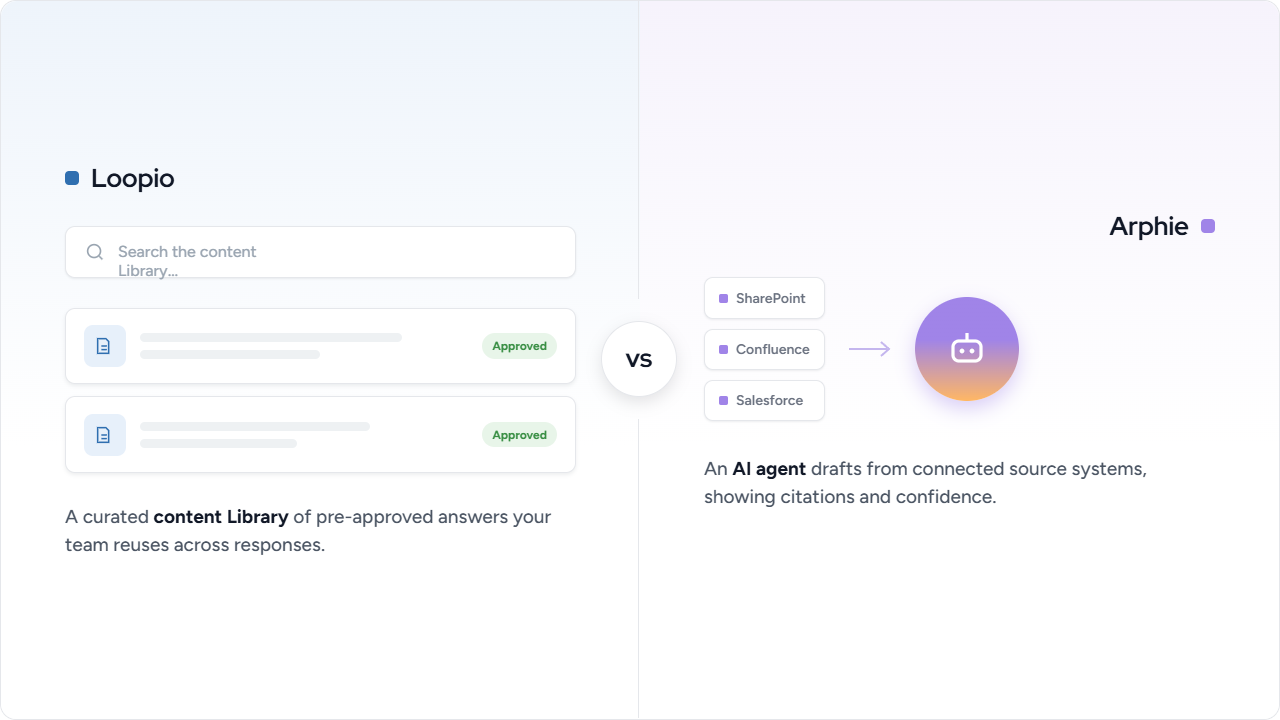
Loopio suits teams that want a mature, widely reviewed platform built around a curated content Library, with a long support and review history behind it. Arphie suits teams that want an AI-native tool where agents draft from connected sources and show citations plus confidence levels, accepting a thinner, newer review base in exchange. Which is "better" depends on what your team needs — a proven library-first workflow or an AI-agent-first one — and both are worth pressure-testing against the current field of RFP response tools before you commit.
What should you consider when choosing between Loopio and Arphie?
Start with the criteria that move the decision, then test each one in a live demo with your own documents.
• AI capabilities: Does the AI merely suggest reused answers, or does it draft from source systems? Ask each vendor to demo drafting on an unfamiliar question.
• Response quality and hallucination control: Do drafts ship with citations and a confidence signal, or do you verify manually? Arphie surfaces sources and confidence; probe how each handles an answer it can't support.
• Content management and governance: Who keeps answers current — a person maintaining a library, or an automated check? Loopio centers on a maintained Library.
• Conflict detection: Will the tool flag two answers that contradict each other before submission? Test it deliberately.
• Narrative vs Excel-style responses: Do you write prose proposals, fill spreadsheet security questionnaires, or both? Loopio reviewers flag graphics/formatting limits; Arphie reviewers report Excel-oriented import/export.
• Integrations: Do the connectors match your CRM, content and collaboration stack? Confirm depth, not just logos.
• Collaboration and review workflow: How do SME assignments, review cycles and approvals work at your volume?
• Security and compliance: What certifications exist, and is your data used to train models? Arphie states it does not train models on customer data.
• Analytics: Can you see cycle times, contributor load and win-relevant metrics?
• Pricing and total cost: Both are quote-based. Get written quotes and sanity-check them against an enterprise RFP software cost comparison before negotiating.
• Ease of implementation: How long to first productive proposal, and who does the setup?
• Enterprise scalability: Will it hold up across many concurrent RFPs, DDQs and questionnaires?
• Review depth: How much third-party evidence backs the claims? Loopio has a longer history; Arphie's base is newer and smaller.
Loopio vs Arphie at a glance
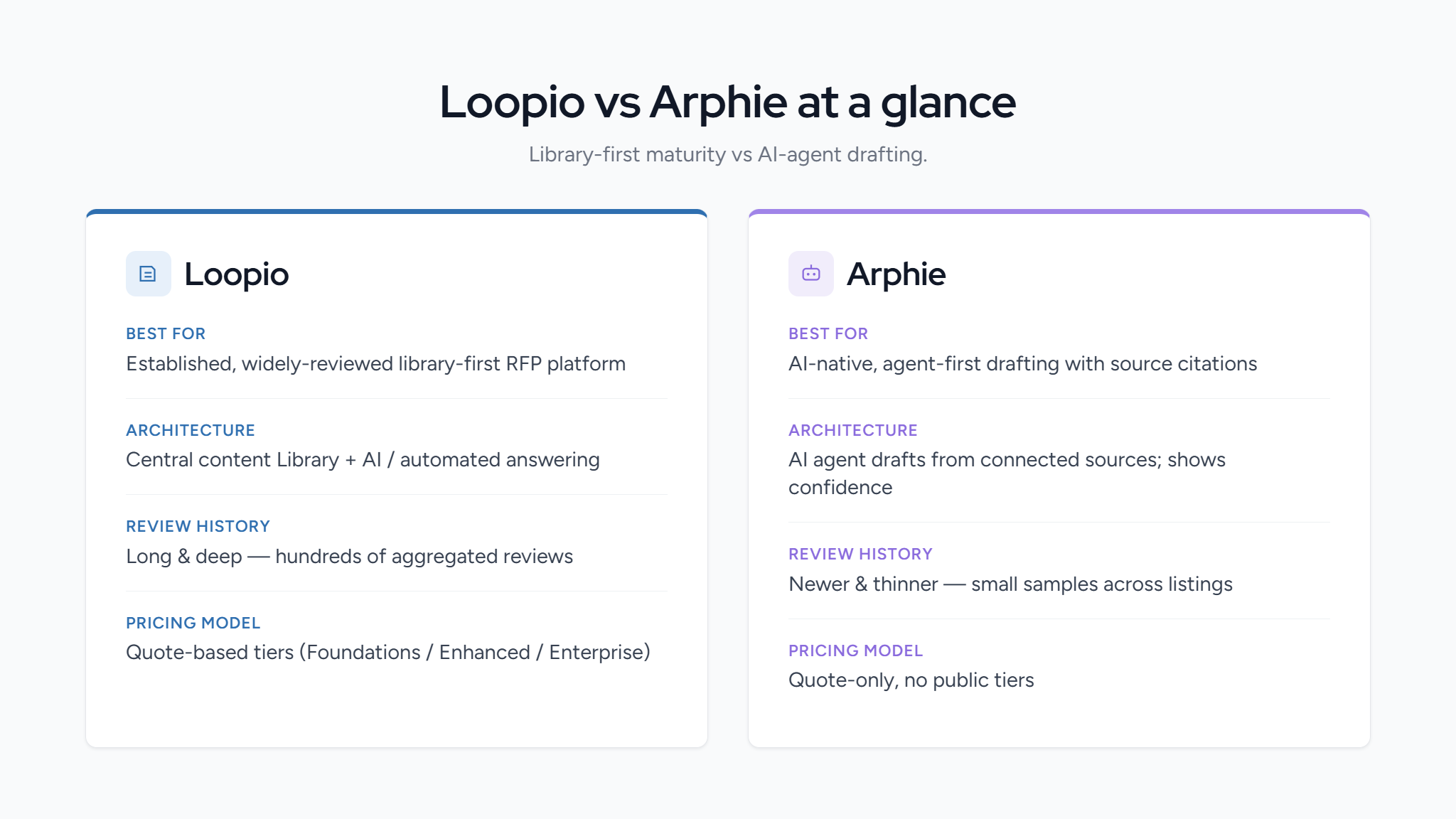
| Loopio | Arphie | |
|---|---|---|
| Best for | Teams wanting an established, widely reviewed library-first RFP platform | Teams wanting an AI-native, agent-first drafting tool with source citations |
| Architecture | Central content Library + AI/automated answering | AI agent drafts from connected sources; shows sources and confidence |
| Review history | Long, deep (G2 4.6, aggregate across Loopio Inc. products) | Newer, thinner (small samples across listings) |
| Pricing model | Quote-based tiers (Foundations / Enhanced / Enterprise) | Quote-only, no public tiers |
Loopio vs Arphie: feature-by-feature comparison
This is the detailed side-by-side. Figures are reported at time of writing — confirm each with the vendor.
| Dimension | Loopio | Arphie |
|---|---|---|
| Best for | Established library-first RFP/DDQ/security-questionnaire management | AI-native, agent-first drafting from source systems |
| G2 rating | 4.6 (812 reviews, aggregate across Loopio Inc. products) | ~4.9/5 reported (small sample, 16–19 reviews; confirm on live listing) |
| Capterra rating | 4.6 (74 reviews) | 5.0 reported (single review reported by a third party; confirm) |
| TrustRadius | 8 out of 10 | No verified listing found (a Gartner Peer Insights page exists) |
| Pricing | Quote-based tiers; Vendr reports ~$15K–$150K+ annual, mid-market commonly ~$30K–$60K | Quote-only; no public tiers (per AutoRFP, SiftHub) |
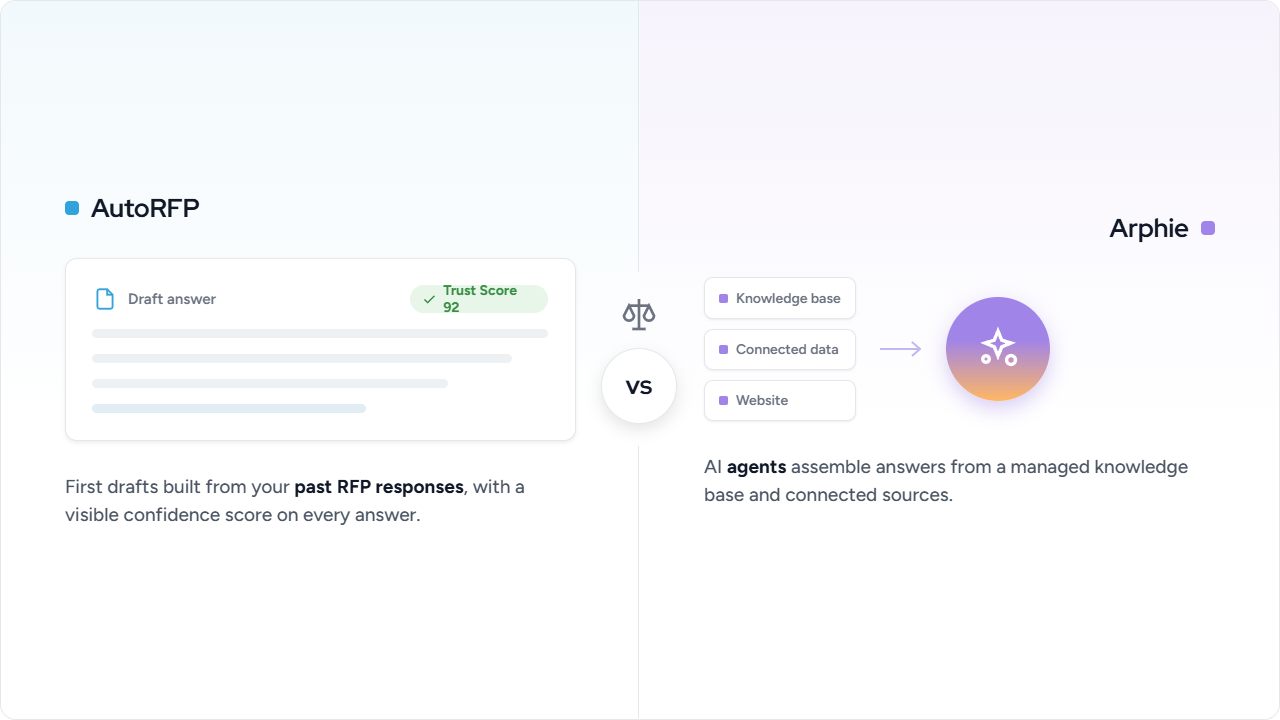
| AI approach | AI/automated answering over a maintained Library | Patent-backed AI agent drafts from connected sources |
| Response quality signals | Answers pulled from pre-approved Library content | Shows exact sources and AI confidence levels per draft |
| Content management | Central content Library, praised for pulling pre-approved answers | Connects to source systems rather than a manually maintained Q&A base |
| Collaboration | SME review cycles (some report slower UI when adding reviewers) | Intuitive interface; integrates into existing workflows |
| Integrations | Salesforce, Slack, Microsoft (Excel add-in, Teams), Seismic, Highspot, Google Sheets | Google Drive, SharePoint, Confluence, Seismic, Highspot, Salesforce, Slack |
| Export/formatting | Reviewers cite export/graphic formatting friction (25 pros/cons mentions on G2) | Reported Excel-only Q&A import; limited export/reporting features pending |
| Mobile | Not a commonly cited gap | Lack of mobile support most consistently cited limitation |
| Data/model policy | Confirm in vendor security review | States it does not use customer data to train models |
| Maturity | Long market and review history | Newer entrant, smaller review base |
Figures reported at time of writing from the cited public listings; ratings, counts and pricing change — confirm with each vendor.
Worth a look: RAD AI reported answering 2× more questions at high quality and cited "2x better response quality than AutoRFP, Loopio & Responsive" — read how that accuracy was measured.
Loopio: overview, features, limitations and pricing
Loopio is a Toronto-based RFP response platform for RFPs, DDQs and security questionnaires, built around a central content Library plus AI and automated answering, and covered in more depth in our Loopio pricing, features and reviews breakdown. It has one of the longer market and review histories in the category, which shows in the volume and depth of its third-party reviews. The workflow revolves around curating pre-approved answers once, then reusing and refreshing them across future responses — a model that rewards teams willing to maintain their content over time.
Best features
• Central content Library that reviewers say pulls pre-approved answers with little effort, reducing repeat follow-ups with SMEs.
• Ease of use and an intuitive interface that reviewers cite consistently.
• Efficient search across stored content.
• Responsive customer support, frequently highlighted in reviews.
• Integrations across a common sales and content stack (Salesforce, Slack, Microsoft, Seismic, Highspot).
• Software that "learns" from your input over time, per user reports.
Limitations (sourced from G2)
• Export and formatting friction: users report manually adjusting exports and wanting better graphic handling.
• Bullet-point and graphics formatting can be lost on export; graphics must be uploaded as images.
• One Capterra reviewer put it bluntly: "If you have graphics in your proposals, this is not the product for you."
• Some users note a slower interface when adding people to review cycles.
• Library-first workflow means answer freshness depends on ongoing manual maintenance — teams weighing this often scan Loopio alternatives for RFP management to compare governance approaches.
• Pricing is not public, so budgeting requires a direct quote.
• As with any reused-content model, drafts are only as current as the last Library update.
Pricing
Loopio's pricing page describes quote-based tiers — Foundations (includes 10 seats, aimed at smaller sales-led teams), Enhanced and Enterprise — with no public dollar figures. Third-party benchmark data from Vendr reports typical annual contract values of roughly $15,000 to $150,000+, with mid-market teams (10–25 users) commonly around $30,000–$60,000 (reported — confirm on the live listing).
Ratings and reviews
• G2: 4.6 (812 reviews, aggregate across Loopio Inc. products) — G2
• Capterra: 4.6 (74 reviews) — Capterra
• TrustRadius: 8 out of 10 — TrustRadius
Loopio's rating volume is its strongest reviews signal: the score sits at 4.6 across hundreds of aggregated data points, so recurring themes — Library ease and support quality on the positive side, export/graphics handling on the negative — are backed by a large enough sample to trust the pattern. Read recent entries rather than all-time, since the product and its AI features have evolved across that long history.
User quotes
Positive: "Loopio is a very easy to use, 'intelligent' piece of software that 'learns' from your input." — Capterra
Mixed: "If you have graphics in your proposals, this is not the product for you." — Capterra
Arphie: overview, features, limitations and pricing
Arphie is positioned as an AI-native platform for RFP, DDQ and security-questionnaire automation, and our Arphie pricing, features and review guide covers it in more depth. Its marketing centers on a "patent-backed" RFP AI agent that connects directly to source systems rather than requiring a manually maintained Q&A knowledge base, and that shows sources and AI confidence levels on generated drafts. The vendor also states it does not use customer data to train its models. Because the product is newer, its reviews are recent but sparse — a trade many teams accept to get agent-first drafting rather than reuse-first suggestions.
Best features
• AI agent that drafts answers by connecting to source systems instead of relying only on a hand-built Q&A base.
• Drafts ship with exact source references and a confidence level, reducing the risk of shipping an unsupported answer.
• Large reported time savings on RFPs and security questionnaires, per reviewers.
• Intuitive interface that reviewers repeatedly cite.
• Integration into existing workflows to generate responses quickly.
• Stated data policy that customer data is not used to train models.
Limitations (sourced from G2)
• Lack of mobile support is the most consistently cited limitation on G2.
• Limited export options, with reported Excel-only imports for Q&A pairs, plus pending file import/export and reporting features, per G2's alternatives page.
• A less mature Salesforce integration than some competitors, per the same source.
• A thinner, more recent review base overall, with small sample sizes across listings, per SiftHub — buyers who want more data points often review Arphie alternatives and competitors alongside it.
• No public pricing, so total cost requires a direct quote.
• One reviewer flagged fit over time: it worked well but wasn't something they would use long term in their setting.
Pricing
Arphie's site directs buyers to request a demo or quote and lists no public price tiers. Independent guides from AutoRFP and SiftHub both confirm a custom-quote model that varies with team size, RFP/questionnaire volume and integrations (reported — confirm directly with the vendor).
Ratings and reviews
• G2: ~4.9/5 reported (product page showed 16 reviews; a competitors page cited 4.9/5 across 19 — figures vary, confirm) — G2
• Capterra: 5.0 reported (from a very small sample, a single review reported by a third-party comparison; confirm) — Capterra
• TrustRadius: no verified listing found; a Gartner Peer Insights page exists but a reliable star rating could not be verified.
Arphie's scores are high but rest on a small base, so treat them as directional rather than settled. The consistent themes across those few reviews — fast completion of lengthy documents, source-cited drafts, and the mobile gap — are useful early signals, but a 4.9 across ~19 reviews carries less statistical weight than a 4.6 across hundreds. Ask the vendor for reference customers at your size to offset the thin public sample.
User quotes
Positive: "The best thing about Arphie is that it drastically reduces the time to complete lengthy RFP documentation." — G2
Mixed: "Arphie was great to use but is not something I would use long term in my particular work setting." — Software Advice
Weighing library-first vs AI-agent drafting? Insider reported a win rate that climbed from 30% to 50% and 90% faster responses after moving to an agentic workflow — see how it works in a demo.
AI capabilities: how Loopio and Arphie differ
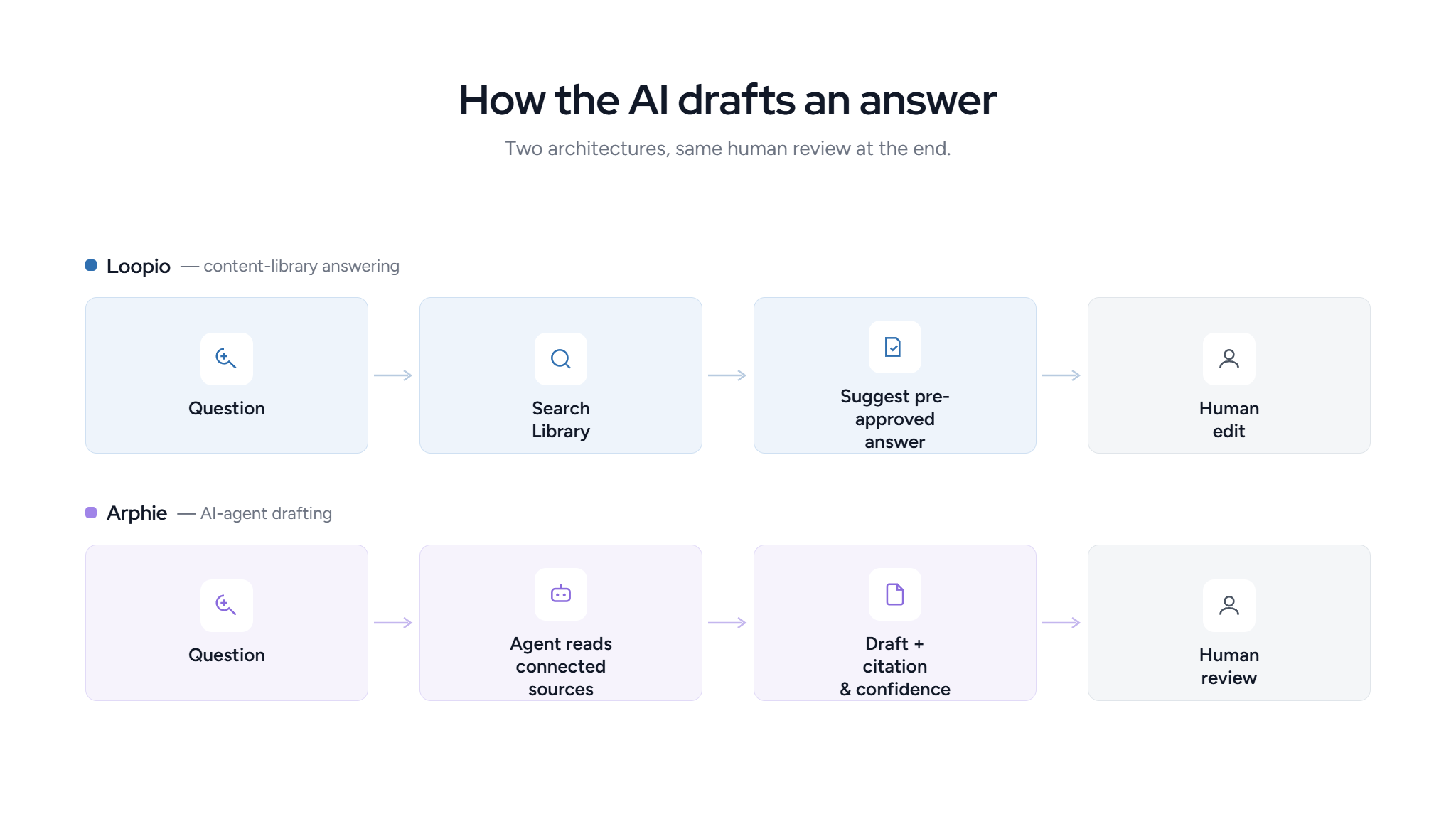
Loopio applies AI and automation over a maintained content Library, suggesting pre-approved answers your team has curated. Arphie is built AI-native, with an agent that drafts from connected sources and attaches a source reference and confidence level to each answer.
Loopio
• AI/automated answering surfaces the best-matching Library content.
• Answer quality tracks how well the Library is maintained.
• Reviewers value the "learns from your input" behavior over time.
Arphie
• Agent drafts from source systems rather than only reused Q&A pairs.
• Each draft shows its exact sources and a confidence signal.
• Vendor states models are not trained on customer data.
Note (applies to both): Neither AI removes the need for human review. Whether answers come from a curated Library or an AI agent, verify accuracy on your own edge-case questions during a trial — a head-to-head accuracy read like the one where Inventive AI was cited at 2× the response quality of the next-best tool tested is more telling than any feature list.
Integrations compared
Confirm connector depth, not just presence, during evaluation.
| Integration | Loopio | Arphie |
|---|---|---|
| Salesforce | Yes (incl. Loopio for Salesforce for Slack) | Yes (reported less mature than some competitors) |
| Slack | Yes | Yes |
| Microsoft (Excel add-in, Teams) | Yes | SharePoint reported |
| Seismic | Yes | Yes |
| Highspot | Yes | Yes |
| Google Sheets | Google Drive | |
| Confluence | Confirm with vendor | Yes |
Integration lists compiled from third-party summaries; confirm current connectors and depth with each vendor.
Security, compliance and data handling
For RFPs and security questionnaires, how each tool treats your data matters as much as its features. On the public record, Arphie is explicit that it does not use customer data to train its models — a point worth confirming in writing during procurement. Loopio's specific certifications and data-handling terms are not detailed in the sources gathered here, so request its current security documentation (SOC 2, ISO 27001, data-residency and subprocessor lists) directly from the vendor rather than assuming parity.
• Loopio: confirm certifications, data residency and retention in a vendor security review; the platform's long enterprise history suggests standard controls, but verify the current attestations.
• Arphie: states customer data is not used to train models; ask how source-system access is scoped and how confidence signals are logged.
Note (applies to both): Do not take a stated data policy as a substitute for an attestation report. Ask each vendor for its latest audit letter and a data-processing addendum, and have InfoSec review both before purchase. For a security-questionnaire-specific lens on AI response tools, compare against a dedicated review of AI agents for security questionnaires.
Analytics and reporting
Neither vendor's public materials in the research reviewed here spell out analytics depth in detail, so treat reporting as a demo checklist item rather than a decided strength for either tool. Ask both to show live dashboards — not slides — for the metrics your team is measured on.
• Loopio: confirm whether you can track cycle times, Library freshness, contributor load and content-usage reporting out of the box.
• Arphie: the alternatives coverage on G2 notes reporting features still maturing, so verify what dashboards exist today versus what is on the roadmap.
Loopio pricing vs Arphie pricing
Neither vendor publishes list prices, so both require a quote. Loopio's tiers (Foundations / Enhanced / Enterprise) are quote-based, with Vendr reporting roughly $15K–$150K+ annually and mid-market deals commonly $30K–$60K. Our breakdown of Loopio's true cost and the "library tax" unpacks where those add-on fees tend to come from. Arphie is quote-only with no published tiers, per AutoRFP and SiftHub. Because both hide pricing, get written quotes scoped to your seat count and volume, and benchmark them against an independent RFP software comparison guide before you negotiate.
Ease of implementation and adoption
Both tools are described by reviewers as easy to use, but implementation effort differs by architecture. Loopio's model front-loads work into building and curating the content Library, then pays off as answers accumulate; expect setup time to import and organize existing content. Arphie's agent connects to source systems, which can shorten initial content prep but shifts the effort toward configuring and validating those connections and reviewing early drafts.
• Loopio: reviewers cite an intuitive interface and efficient search; budget time for Library seeding and ongoing maintenance.
• Arphie: reviewers report quick generation once connected; confirm how long source-system setup takes and who owns it.
Worth a look: MaxVal reported completing 80 RFP questions in 3 hours — work that used to take nearly a week — after adopting an agentic approach and dropping the need to babysit a Q&A library. Read that fast-turnaround case study.
Reviews: what users say about Loopio and Arphie
Loopio's evidence base is deep: G2 4.6 (812 aggregate reviews) and Capterra 4.6 (74), with reviewers praising Library ease and support while flagging export and graphics formatting. Arphie's base is newer and thinner — a reported ~4.9/5 on G2 across a small sample and a reported 5.0 Capterra from a single review — with praise for time savings and citations, and the most consistent complaint being no mobile support. When one tool has hundreds of reviews and the other has dozens, weight them accordingly and read recent reviews for both. If your team relies on Reddit-style peer chatter, note that Arphie's shorter track record means fewer independent threads to draw on.
Is Loopio better than Arphie?
Neither is universally better — it depends on what your team needs. Choose Loopio if you want a mature, heavily reviewed platform with a curated content Library, strong support reputation and a broad integration set, and you can accept manual export/formatting cleanup. Choose Arphie if you want AI-native drafting where an agent pulls from connected sources and shows citations and confidence, and you can accept a newer, thinner review base plus no mobile support today. Match the architecture — library-first vs agent-first — to how your team actually works, and verify both on your own documents.
Also Worth Considering: Inventive AI
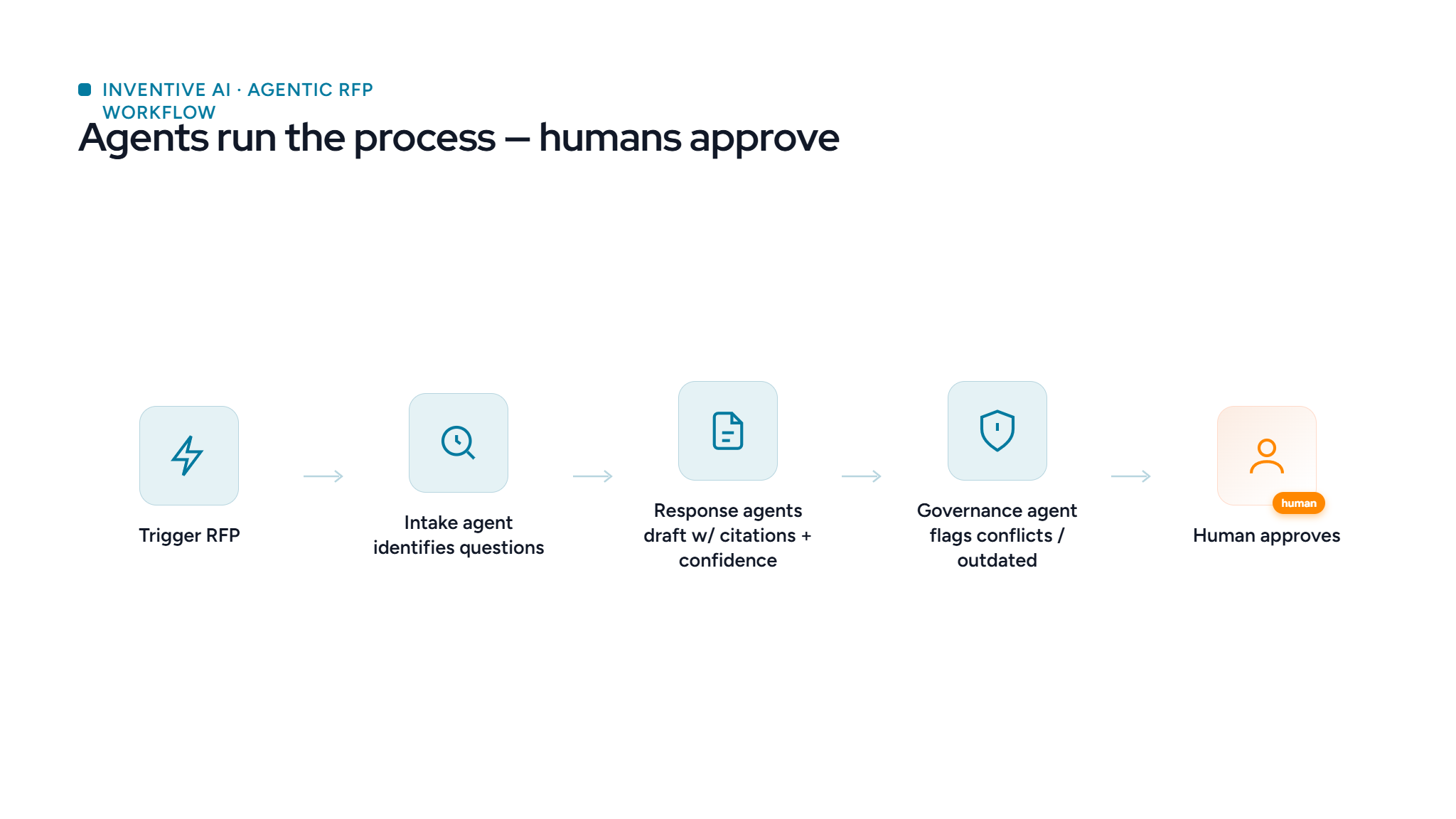
If you are weighing Loopio's library-first model against Arphie's single-agent drafting, it helps to know a third architectural approach exists: a newer category of AI-native, agentic proposal platforms — part of a broader shift in why AI-native RFP software is replacing legacy tools — of which Inventive AI is one example worth putting on the evaluation list. Rather than centering on a maintained content library or one drafting agent, Inventive AI is positioned as an autonomous, AI-agentic platform for RFPs, RFIs, DDQs and security questionnaires, with humans kept in the loop for approvals.
Key capabilities of Inventive AI
• Agents run the full process — understanding the RFP, finding information, drafting, flagging gaps and validating — not just suggesting answers.
• AI-generated first drafts the vendor describes as substantially faster than writing from scratch, with citations attached (confirm the specifics against your own documents in a trial).
• A unified Knowledge Hub that connects SharePoint, Google Drive, Salesforce, Confluence, Notion, Zendesk and Okta and live-syncs when a source doc changes — no separate repository to maintain.
• A Content Governance Agent that detects conflicting information, flags outdated content and surfaces duplicates.
• A Context Engine that tailors responses to customer priorities and deal context, rather than reusing generic answers.
• Competitive Intelligence agents that compare positioning against named competitors within the response.
• Format flexibility across Excel and narrative responses, plus collaborative review and approval workflows.
• Response quality that a customer case study reports as 2x more client-ready answers than the next-best tool tested.
Best for: mid-market and enterprise proposal, presales, sales-ops and InfoSec teams that want agents to run the RFP process end to end with human approval, rather than maintaining a library or reviewing answer-by-answer.
Why buyers comparing Loopio and Arphie might look at Inventive as an alternative
The shared pain point across a library-first tool and a single-agent tool is the same: someone still maintains content or verifies drafts one answer at a time. Inventive AI is positioned to address that with a Content Governance Agent and a Full Response Analyzer that check the whole document for conflicts and gaps. AssetWorks Facilities reported a 422% ROI and roughly $105K in net savings after choosing it over legacy RFP software. If that model fits your workflow, see the agentic approach in a demo.
Frequently asked questions
Is Loopio better than Arphie?
Neither wins outright. Loopio offers a mature, widely reviewed library-first platform with strong support; Arphie offers AI-native agent drafting with source citations and confidence signals but a newer, thinner review base and no mobile support. The better fit depends on whether your team prefers a curated library workflow or agent-first drafting.
How much does Loopio cost?
Loopio does not publish list prices. Its pricing page describes quote-based Foundations, Enhanced and Enterprise tiers, and Vendr reports typical annual contracts of roughly $15,000 to $150,000+, with mid-market deals commonly $30,000–$60,000 (reported — confirm on the live listing). Get a scoped quote for your seat count and volume.
How much does Arphie cost?
Arphie is quote-only with no public tiers. Independent guides from AutoRFP and SiftHub confirm a custom-quote model that depends on team size, RFP/questionnaire volume and integrations. Request pricing directly from the vendor.
Which handles security questionnaires and formatting better?
Both cover security questionnaires. Loopio reviewers cite export and graphics formatting friction, and Arphie reviewers report Excel-oriented import/export with some pending file-handling features. Test your actual questionnaire formats — spreadsheet and narrative — during a trial of each.
Is there an AI-native alternative to Loopio and Arphie?
Yes. A newer category of AI-native, agentic platforms — Inventive AI among them — runs the RFP process with agents that draft from connected systems, cite sources, flag conflicts and keep humans in the loop for approvals. Evaluate it the same way you would the incumbents: on your own documents, against your own quality bar. For a like-for-like starting point, see Loopio vs Inventive AI.
Related comparisons and resources
For deeper research beyond this head-to-head, these guides and case studies cover adjacent questions:
• Insider: 50% higher win rate, 90% faster responses
• Loopio competitors for RFP management
• Arphie alternatives and competitors

.avif)


.png)


.png)