Conveyor vs Arphie (2026): A Buyer's Comparison for Security-Questionnaire and RFP Teams
Conveyor vs Arphie compared on AI accuracy, pricing, integrations and G2 reviews, and where an AI-agentic alternative fits for security-questionnaire teams.
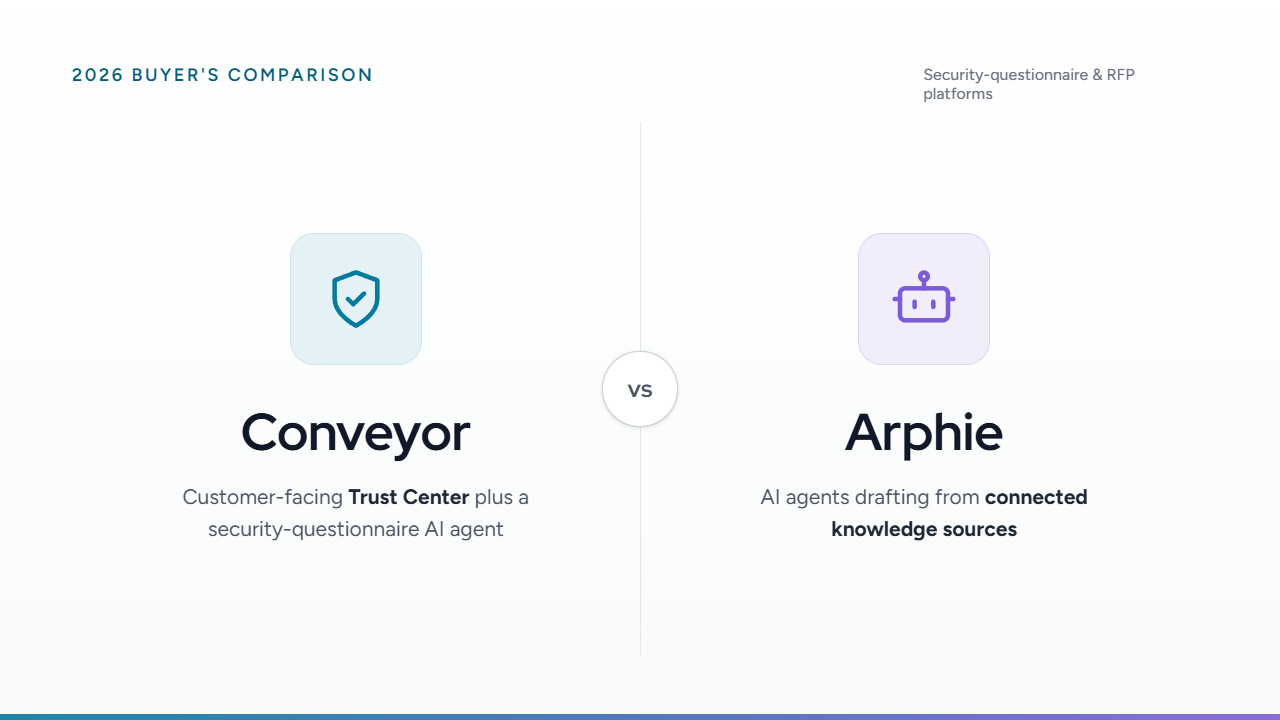
Both Conveyor and Arphie are recent, AI-native entrants aimed at cutting the hours teams spend on security questionnaires, DDQs and RFPs. They take different routes to the same problem. This guide compares them on architecture, features, pricing, integrations and verified reviews so you can decide which fits your workflow — not which one a vendor wants you to buy.
Last reviewed: January 2026. This comparison draws on each vendor's published materials, verified G2 and Capterra reviews, and independent third-party write-ups (SiftHub, Responsive, Software Advice). Both products price on a quote or usage basis and ship changes often, so read every figure below as a point-in-time snapshot. Confirm current pricing, plan caps and integration coverage with each vendor before you sign anything.
TL;DR: Conveyor vs Arphie in Three Sentences
Conveyor fits teams whose center of gravity is security review — a public Trust Center for customer self-service plus an AI agent that answers inbound security questionnaires with cited sources. Arphie fits teams that want AI agents drafting RFP, DDQ and security-questionnaire answers from knowledge that already lives in Google Drive, SharePoint, Confluence, Seismic or Highspot, without maintaining a separate library.
Which is better depends on what your team needs — lead with Conveyor if trust-portal self-service is the priority, lead with Arphie if broad RFP/DDQ coverage across connected sources matters more; buyers comparing the two are also increasingly benchmarking a newer class of AI-agentic response platforms as a third reference point.
Conveyor vs Arphie at a Glance
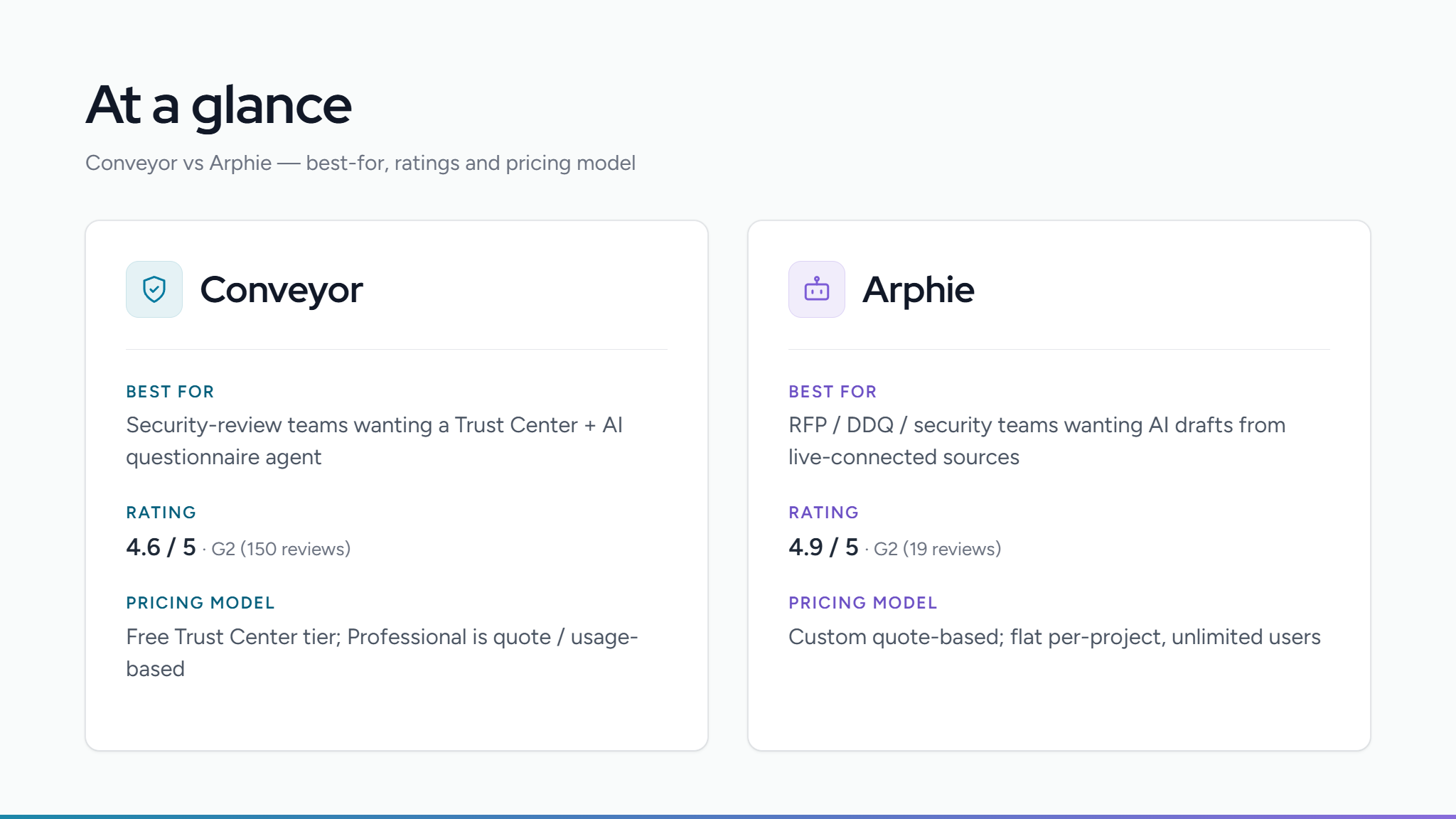
| Conveyor | Arphie | |
|---|---|---|
| Best for | Security-review teams wanting a customer-facing Trust Center + AI questionnaire agent | RFP/DDQ/security teams wanting AI drafts from live-connected knowledge sources |
| G2 rating | 4.6 / 5 (150 reviews) | 4.9 / 5 (19 reviews) |
| Capterra rating | Listing exists; no verified rating/count found | 5.0 / 5 (1 review — very thin sample) |
| Pricing model | Free Trust Center tier; Professional is quote/usage-based | Custom quote-based; flat per-project, unlimited users |
| Signature capability | Public Trust Center for document self-service | Live knowledge connections to existing content systems |
Figures are reported at time of writing. Conveyor's larger review base reflects a longer time in market; Arphie's higher score sits on a much smaller, newer sample. Weigh the score alongside the sample size.
What Should You Consider When Choosing Between Conveyor and Arphie?
Short answer: match the tool to your dominant use case (security review vs. broad RFP/DDQ), then pressure-test AI accuracy, source coverage and pricing during a demo. Use these criteria as your checklist:
• Primary use case: Is your volume mostly inbound security questionnaires, or a mix of RFPs, DDQs and security reviews?
• AI drafting quality: How accurate are first drafts on your real content, and how much editing do they need?
• Hallucination control: Does each answer ship with a citation and a confidence signal you can verify?
• Knowledge management: Do you want a managed library, or AI that pulls from where content already lives?
• Customer self-service: Do you need a public trust portal so prospects answer their own security questions?
• Content governance: How does the tool flag stale or conflicting answers before they ship?
• Integrations: Does it connect to your CRM, ticketing, docs and content stores? (See the integrations table below.)
• Workflow and collaboration: Can you assign questions, track ownership and route approvals?
• Export and format flexibility: Can it handle Excel questionnaires and narrative proposals both?
• Security and compliance: What certifications and data-handling policies apply?
• Analytics and reporting: Can you see cycle times, throughput and content gaps?
• Pricing and total cost: Per-seat vs. per-project vs. usage-based — model your real volume. The RFP software comparison guide walks through how to compare quote-based vendors on a like-for-like basis.
• Ease of implementation: How long until the first useful draft, and how heavy is admin setup?
• Maturity and reviews: How deep is the verified review base for the size of your rollout?
Feature-by-Feature Comparison: Conveyor vs Arphie
This is the core of the comparison. Values reflect vendor materials and verified reviews at time of writing — confirm specifics with each vendor.
| Dimension | Conveyor | Arphie |
|---|---|---|
| Best for | Security-review teams needing a Trust Center + questionnaire AI agent | Teams drafting RFPs, DDQs and security questionnaires from connected sources |
| G2 rating | 4.6 / 5 (150 reviews) | 4.9 / 5 (19 reviews) |
| Capterra rating | Listing present; no verified rating found | 5.0 / 5 (1 review) |
| AI capabilities | AI agent answers security questionnaires; answers cited to source docs with confidence scoring | AI agents draft answers from a managed, live-connected knowledge base with source citations and confidence signals |
| Response quality (per reviews) | "AI functionality is great to automate the more standard questions" (G2) | "Fast and accurate… focus only on the difficult questions that matter" (G2) |
| Customer self-service | Trust Center for public document sharing and prospect self-service | Not a core focus; centered on response drafting |
| Knowledge source model | CRM/ticketing intake feeds the AI agent | Live connections to Google Drive, SharePoint, Confluence, Seismic, Highspot; URL ingestion |
| Integrations | Slack, Salesforce, HubSpot, Jira, Claude | Salesforce, Slack, Google Drive, SharePoint, Confluence, Seismic, Highspot, Website/URL |
| Export / format | Questionnaire and RFP output; browser-extension gaps noted by reviewers | Excel Q&A import; limited export options, some import/export features pending |
| Mobile access | Not highlighted in sources | Lack of mobile access is the most cited limitation |
| Reporting/analytics | Not detailed in sources | Reporting reported as inadequate/pending |
| Pricing model | Free Trust Center tier; Professional quote/usage-based | Custom quote-based; flat per-project, unlimited users |
| Ease of implementation | Fast for end users; admin configuration can be intricate | Fast setup/onboarding cited by reviewers |
| Market maturity | Longer in market; ~150 G2 reviews | Newer; thin/recent review base |
Figures are reported at time of writing; confirm with each vendor before purchasing.
AI Capabilities: How Each Tool Drafts Answers
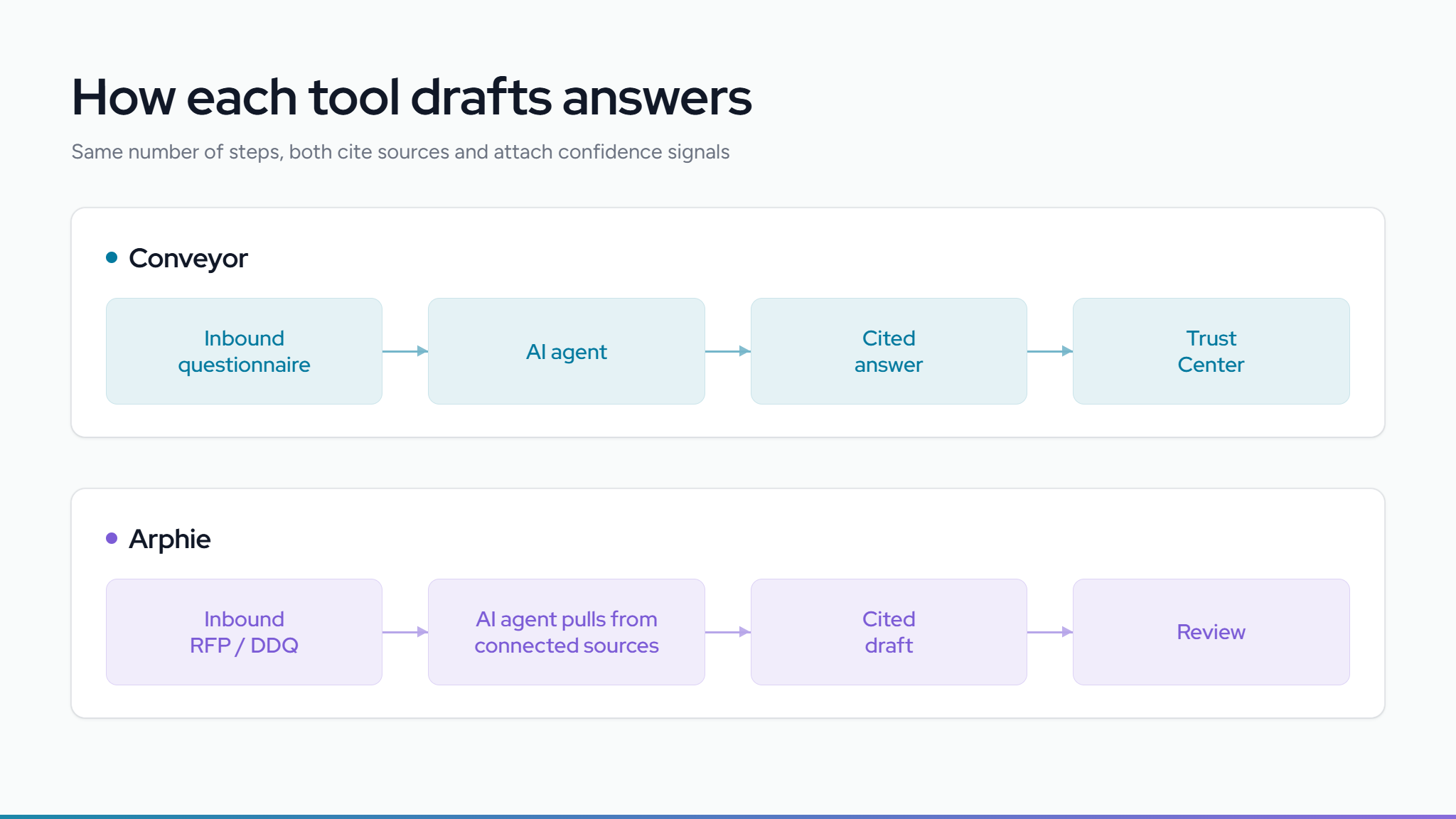
Both platforms are built AI-first and both attach source citations and confidence signals to answers so reviewers can validate quickly rather than trust blindly.
Conveyor
• AI agent focuses on security questionnaires, drawing on CRM and ticketing intake.
• Answers are cited back to source documents with confidence scoring, which reviewers say reduces manual review.
• Reviewers describe strong automation on "the more standard questions."
Arphie
• AI agents draft across RFPs, DDQs and security questionnaires from a managed knowledge base.
• Live connections pull from Google Drive, SharePoint, Confluence, Seismic and Highspot, so drafts reflect current content.
• Each answer shows exact source citations and confidence signals; reviewers report it is "fast and accurate."
Note (applies to both): Neither product's review base is as deep as legacy RFP platforms, and AI draft quality varies with the quality of your underlying content. Test both on your own edge-case questions before deciding. If cross-document consistency and automatic conflict detection are priorities, benchmark them against an AI-agentic approach in the best AI agent for security questionnaires roundup.
Integrations: What Connects to What

| Category | Conveyor | Arphie |
|---|---|---|
| CRM | Salesforce, HubSpot | Salesforce (reported as less mature than some competitors) |
| Collaboration | Slack | Slack |
| Ticketing / project | Jira | — |
| Content stores | CRM/ticketing intake | Google Drive, SharePoint, Confluence, Seismic, Highspot |
| AI / other | Claude | Website/URL ingestion |
The architectures pull integrations in opposite directions. Conveyor's connectors — Salesforce, HubSpot, Jira and Claude — mostly feed its agent from CRM and ticketing systems, which suits a security-review team routing inbound questionnaire requests. Arphie's connectors lean toward content stores (Google Drive, SharePoint, Confluence, Seismic, Highspot) plus website ingestion, so drafts pull from where source knowledge already sits.
Two caveats to verify in a demo: Arphie reviewers report its Salesforce integration is less mature than some rivals, and Conveyor reviewers flag gaps around the browser extension and API. Confirm the exact connectors, direction of sync, and whether each is one-way or bidirectional before you commit, connector names on a marketing page rarely tell you how deep the integration actually goes.
Conveyor: Overview, Features and Reviews
Conveyor pairs an AI agent for security questionnaires with a customer-facing Trust Center, so prospects can self-serve security documents while your team automates repetitive questionnaire responses. It has been in market longer than Arphie, reflected in a larger G2 review base.
Best features
• AI agent automates standard security-questionnaire responses.
• Answers cited back to source documents with confidence scoring, reducing manual review.
• Trust Center centralizes security document sharing and enables customer self-service.
• Reviewers report an intuitive, easy-to-use interface that speeds response cycles.
• Time-saving on RFP and questionnaire completion is a recurring theme in reviews.
• CRM and ticketing intake (Salesforce, HubSpot, Jira) feeds the agent.
Limitations (sourced as per G2)
• Reviewers note missing features, particularly around the browser extension and API capabilities.
• Occasional slow loading times reported during urgent tasks.
• Initial setup and configuration can be intricate for admins; onboarding support was flagged in a review.
• Security-questionnaire automation is gated to the paid Professional plan, per the vendor's own blog.
• Public pricing is inconsistent across sources (see below), making budgeting harder without a quote.
• Buyers weighing the Trust Center against broader RFP coverage sometimes shortlist other options, the Conveyor alternatives and competitors overview lays out where each fits.
Ratings and reviews
• G2: 4.6 / 5 across 150 reviews (G2).
• Capterra: listing exists, but no verifiable rating/count was found.
• TrustRadius: no verified rating located.
Positive: "It's super easy to use and the AI functionality is great to automate the more standard questions." — G2 review
Mixed: "The initial configuration, especially for admins, can be intricate." — G2 review
Comparing security-questionnaire automation approaches? One team reports 90% faster RFPs with zero weekend hours lost after moving to an agentic platform — see the 90%-faster case study.
Arphie: Overview, Features and Reviews
Arphie is an AI-native platform for RFPs, DDQs and security questionnaires, built around AI agents that draft from a managed, live-connected knowledge base. Rather than maintaining a separate content library, it connects to where content already lives Google Drive, SharePoint, Confluence, Seismic, Highspot. and drafts from there.
Best features
• AI agents draft answers across RFPs, DDQs and security questionnaires.
• Live connections to Google Drive, SharePoint, Confluence, Seismic and Highspot pull from existing content.
• Each answer shows exact source citations and confidence signals for fast validation.
• Reviewers describe it as highly intuitive with fast setup and onboarding.
• Strong reported time-savings on RFP responses.
• Website/URL ingestion adds public content as a source.
Limitations (as per G2)
• Lack of mobile accessibility is the most consistently cited limitation
• Limited export options (only Excel imports for Q&A pairs), with file import/export and reporting features pending (
• Salesforce integration reported as less mature than some competitors
• Reporting functionality reported as inadequate or pending
• Newer market position with a thin, recent review base
• Teams that want deeper reporting or mobile access often widen the shortlist — the Arphie alternatives and competitors overview compares the main options.
Ratings and reviews
• G2: 4.9 / 5 across 19 reviews (G2) — note the alternatives page reports 19 while the reviews listing shows ~16; the sample is small either way.
• Capterra: 5.0 / 5 based on 1 review (Capterra) — very thin.
• TrustRadius: no verified rating located. Arphie also has a Gartner Peer Insights profile, but no verified star rating/count could be isolated.
Positive: "It's fast and accurate, allowing me to save time by focusing only on the difficult questions that matter." — G2 review
Mixed: "Arphie was great to use but is not something I would use long term in my particular work setting." — Software Advice review
Evaluating AI-native RFP tools head to head? RAD AI reports 2× more accurate responses from an agentic platform than from other RFP AI tools it tested, read the RAD AI accuracy case study.
How Much Does Conveyor Cost?
Conveyor has a free Trust Center tier and a quote/usage-based paid plan. The free tier caps at roughly 120 companies/year with limited documents, Q&As and Conveyor branding. Paid Professional pricing is quote/usage-based, priced on trust-center download volume and/or the number of questionnaires and RFPs processed by AI, with volume discounts.
Reported starting prices disagree: G2 lists a starting price of $9,600/yr (G2 pricing), while Conveyor's own comparison blog cites a Professional plan starting at $4,800 (Conveyor blog), reported (confirm on the live listing). Note that security-questionnaire automation sits on the paid Professional plan, not the free tier. For a fuller feature-and-pricing breakdown, see the Conveyor AI pricing and features review.
How Much Does Arphie Cost?
Arphie does not publish pricing. It uses custom, quote-based pricing built on team size, annual RFP/questionnaire volume and integration needs, with a flat per-project model and unlimited users rather than per-seat fees; there is no standard free trial (trial on request).
This is reported (confirm with vendor) via SiftHub and corroborated by Responsive's comparison glossary; the Arphie pricing, features and review breakdown covers what to ask for in a quote. The unlimited-user model can favor larger teams, but without published tiers you'll need a written quote to compare it against Conveyor's usage-based figures.
Note (applies to both): Quote-based pricing means the sticker figures floating online may not reflect your deal. Ask each vendor for a written quote tied to your seat count, volume and integrations, and compare on total cost — not headline numbers.
Building your budget case? AssetWorks reports a 422% ROI and roughly $105K in net savings from RFP automation. See how AssetWorks measured the return.
Is Conveyor Better Than Arphie?
Neither is universally better, it depends on your dominant workflow. Conveyor is the stronger fit when customer-facing security self-service (the Trust Center) is central and you want a longer-tenured product with a deeper review base. Arphie is the stronger fit when you need AI agents drafting across RFPs, DDQs and security questionnaires from content that already lives in your document and enablement systems, and you value fast onboarding.
Weigh the trade-offs honestly: Conveyor reviewers flag intricate admin setup and browser-extension/API gaps; Arphie reviewers flag missing mobile access, limited exports and pending reporting. Both have thinner review histories than legacy platforms. Run a side-by-side pilot on your real questionnaires before deciding. For a structured scoring approach across categories, the enterprise RFP software comparison is a useful framework.
Security, Content Governance and Reviews
Both tools cite answers to sources and attach confidence signals, the baseline for hallucination control. Where they differ: Conveyor's Trust Center adds a governed, customer-facing document layer, so prospects pull approved security artifacts directly, while Arphie's live connections keep drafts tied to whatever the current source content says.
Neither approach removes the governance work of keeping that underlying content accurate — Conveyor still relies on the documents you publish to the portal, and Arphie's drafts are only as current as the connected repositories. Ask each vendor how stale or conflicting answers get surfaced, who owns approving them, and whether the system flags contradictions across a full response or only answer-by-answer. Confirm each vendor's certifications (e.g., SOC 2) and data-handling policies directly, since these change and were not fully verifiable in public sources at time of writing.
On reviews, remember the asymmetry: Conveyor's 4.6/5 sits on 150 G2 reviews; Arphie's 4.9/5 sits on ~19, and its Capterra 5.0 rests on a single review. A higher average on a small, recent sample carries less weight than a slightly lower average on a larger one. Read the individual reviews, not just the star average — and check whether reviewers match your company size and use case.
Also Worth Considering: Inventive AI
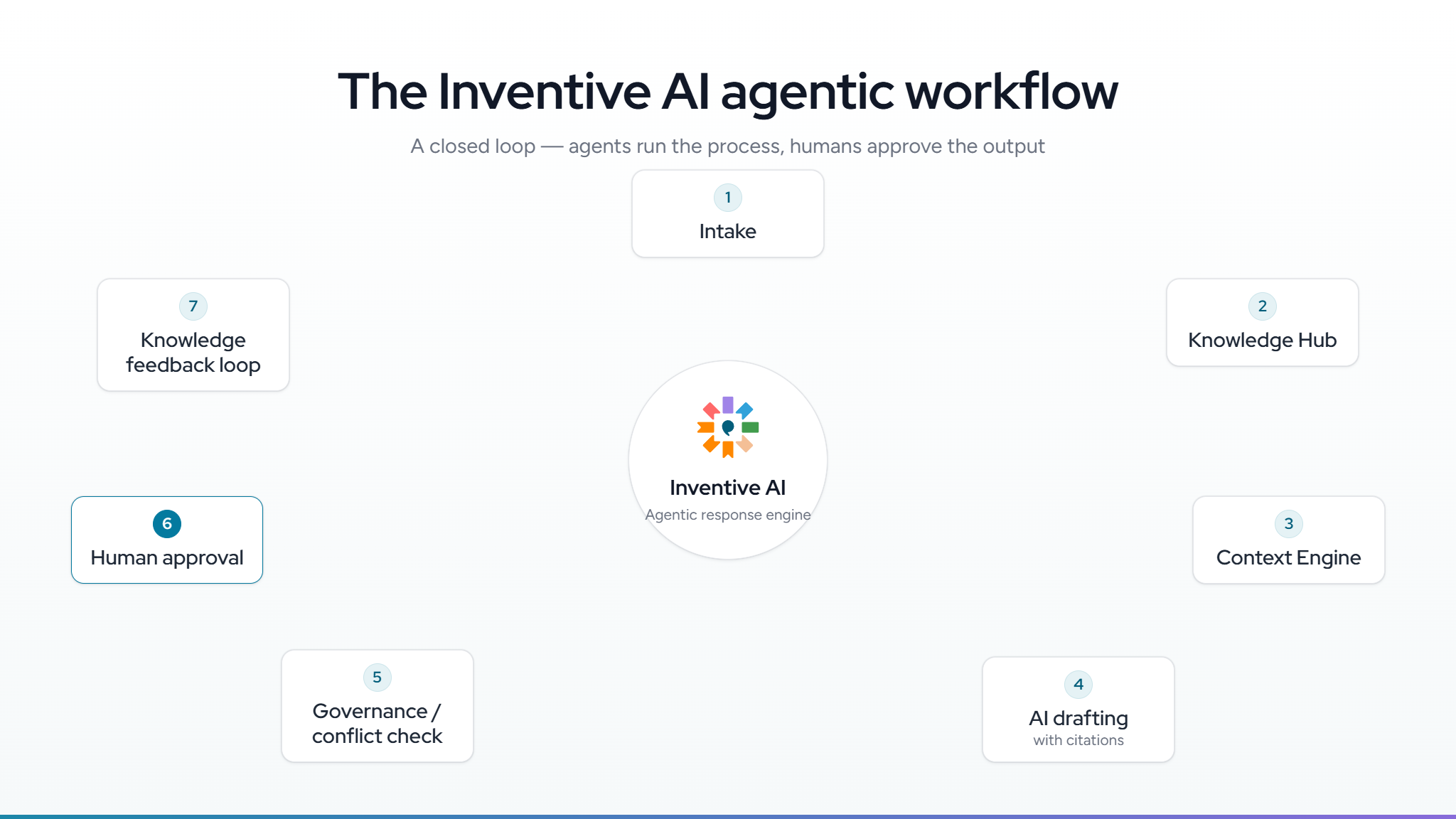
If you're weighing Conveyor and Arphie, it's worth knowing there's a broader category of AI-agentic response platforms taking a different architectural approach — and Inventive AI is one example. Instead of centering on a trust portal or a managed library, this category runs the response workflow with autonomous agents and brings humans in mainly for approvals.
Inventive AI is an autonomous, AI-agentic platform for RFPs, RFIs, DDQs and security questionnaires. It connects to existing systems instead of asking teams to maintain a new repository, then triggers agents that understand the document, find information, draft, validate and flag gaps for human judgment.
Key capabilities of Inventive AI
• AI first drafts generated from connected sources, each cited with a confidence score, flagging "information unavailable" rather than guessing.
• Unified Knowledge Hub connecting SharePoint, Google Drive, Salesforce, Confluence, Notion, Zendesk, Okta and websites, with live sync when a source doc changes.
• Content Governance Agent that detects conflicting info, flags outdated content and surfaces duplicates automatically.
• Context Engine that tailors responses per deal using customer priorities, CRM data and sales notes.
• Competitive Intelligence Agent that compares positioning against named competitors inside the response.
• Format flexibility for Excel questionnaires and narrative proposals alike.
• Collaborative review and approval workflows with assignments, ownership and progress tracking.
• Response quality: RAD AI reports 2× more client-ready answers than the next-best tool it tested.
Best for: mid-market and enterprise teams handling a mix of RFPs, DDQs, security and compliance questionnaires who want agents to run the process end-to-end, not just assist with drafting.
Why Buyers Comparing Conveyor and Arphie Might Look at Inventive as an Alternative
The shared pain point across Conveyor and Arphie reviews is the ceiling on automation — standard questions get handled, but consistency across a full document, conflict detection and per-deal tailoring still lean on people.
Inventive AI is positioned to address that with a Full Response Analyzer that checks the whole document for contradictions and missing requirements, and a Content Governance Agent that keeps knowledge current automatically. Insider reports its win rate rose from 30% to 50% with 90% faster responses after moving to the agentic model. If that architecture interests you, you can book a walkthrough.
Frequently Asked Questions
Is Conveyor better than Arphie?
Neither wins outright. Conveyor is better for teams centered on security review with a customer-facing Trust Center and a deeper review base (4.6/5, 150 G2 reviews). Arphie is better for teams drafting RFPs, DDQs and security questionnaires from live-connected content sources, with fast onboarding (4.9/5 on a smaller 19-review sample). Match the tool to your dominant use case and pilot both.
How much does Conveyor cost?
Conveyor offers a free Trust Center tier (capped at ~120 companies/year with limits and branding). Its paid Professional plan is quote/usage-based; reported starting prices range from $4,800 (Conveyor's blog) to $9,600/yr (G2). Because pricing is usage-based, request a written quote for your volume, reported figures should be confirmed on the live listing.
How much does Arphie cost?
Arphie does not publish pricing. It uses custom, quote-based pricing built on team size, annual volume and integrations, with a flat per-project model and unlimited users rather than per-seat fees. There's no standard free trial (trial on request). Confirm current terms directly with Arphie.
Do Conveyor and Arphie both handle RFPs, or just security questionnaires?
Both handle more than security questionnaires, but with different emphasis. Conveyor centers on security review — an AI agent for security questionnaires plus a customer-facing Trust Center — while also processing RFPs on its Professional plan. Arphie is built for a broader mix of RFPs, DDQs and security questionnaires from the start, drafting from live-connected content sources. If RFP breadth is your priority, weigh Arphie's model; if inbound security self-service dominates your workload, weigh Conveyor's Trust Center.
What do reviewers say are the biggest limitations of each tool?
For Conveyor, G2 reviewers cite missing browser-extension and API features, occasional slow loading during urgent tasks, and intricate admin setup. For Arphie, reviewers most often cite the lack of mobile access, limited export options, and reporting that is inadequate or still pending, alongside a thin, recent review base per SiftHub. Test these specific areas against your workflow during a trial rather than relying on the headline star rating.
What is an alternative to Conveyor and Arphie?
Beyond these two, buyers commonly evaluate legacy RFP platforms (Loopio, Responsive, Qvidian) and a newer class of AI-agentic response platforms. Inventive AI is one example of the AI-agentic category: rather than a trust portal or a managed content library, agents run intake, drafting, governance and validation, with humans approving the output. RAD AI reports 2× more accurate responses than other RFP AI tools it tested. For a wider view of the field, the best RFP software roundup compares the main options side by side.
Related Comparisons and Resources
If you're still narrowing your shortlist, these guides go deeper on the tools and categories referenced above:
• Conveyor vs Inventive AI comparison — a direct look at Conveyor's Trust Center model against the AI-agentic approach.
• Arphie vs Inventive AI comparison — how Arphie's managed knowledge base compares with autonomous agents.
• RFP software comparison guide — how to evaluate quote-based vendors on a like-for-like basis.
• Best RFP software roundup — a broad field comparison for buyers early in research.
• MaxVal's zero-weekend-hours case study — a team that cut RFP turnaround dramatically after switching approaches.

.avif)