Conveyor vs Loopio (2026): Which Response Platform Fits Your Team?
Conveyor vs Loopio compared on AI, pricing, reviews and integrations plus where an AI-native alternative fits for RFPs and security questionnaires.
Conveyor and Loopio both automate response work, but they were built for different jobs. Conveyor is an AI-native platform aimed at security questionnaires and a customer-facing Trust Center. Loopio is an established RFP response manager built around a shared content library. This guide compares them on features, pricing, AI, integrations and reviews — using verified sources — so you can match the tool to your workflow.
Last reviewed: February 2026. This comparison pulls from vendor-published pages, verified G2 and Capterra reviews (plus TrustRadius where a listing exists), and independent third-party analyses such as Vendr. Pricing and features shift often, and quote-based vendors rarely publish list prices, confirm current specifics with Conveyor and Loopio directly before you buy.
Conveyor vs Loopio: The Short Answer
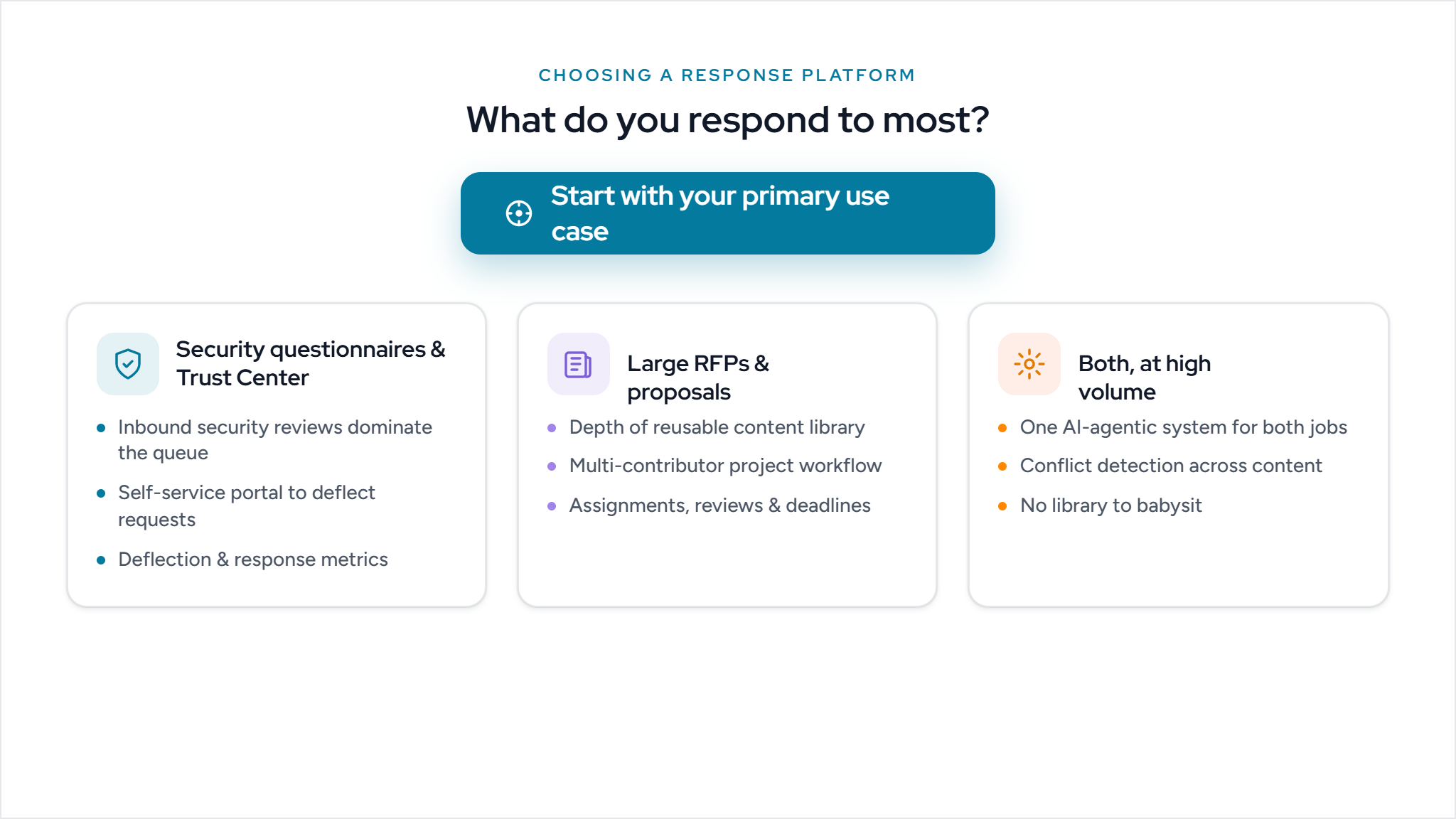
Conveyor fits teams whose main pain is inbound security reviews — SOC 2 questionnaires, vendor risk assessments, and buyers who want self-service access to security documentation. Its AI agent and Trust Center are built around that job. Loopio fits teams running full RFPs, DDQs and proposals at volume, where a curated, reusable content library and structured project workflow matter most.
Neither is universally "better." The right pick depends on what your team responds to most: if security questionnaires dominate your queue, Conveyor's focus is an advantage; if you manage large, narrative RFPs across many contributors, Loopio's library and project tooling do more. Teams that need both jobs handled by one AI-agentic system sometimes evaluate a newer category of AI-native response platforms alongside these two.
What Should You Consider When Choosing Between Conveyor and Loopio?
Answer-first: weigh the tools against the work you actually do most. Use these criteria as demo questions.
• Primary use case: Are you mostly answering security questionnaires (Conveyor's strength) or full RFPs and proposals (Loopio's strength)?
• AI capabilities: Does the AI draft cited answers, and how much manual correction do reviewers report after generation?
• Response quality: Test edge-case questions during a trial. How client-ready is the first draft before editing?
• Content management: Does the platform maintain a knowledge base for you, or does answer quality depend on your team keeping a library current?
• Conflict detection: Can it flag contradictory or outdated answers across your content, not just fill blanks?
• Trust Center / self-service: Do you need a customer-facing portal to deflect inbound security reviews? (Conveyor's differentiator.)
• Workflow automation: How well does it handle multi-contributor assignments, reviews and deadlines on large projects?
• Collaboration: Can SMEs, sales and InfoSec work in one project without leaving their tools?
• Integrations: Does it connect to your CRM, chat, docs and SSO? (See the integrations table below.)
• Security and compliance: SOC 2 status, data handling, and whether your content trains external models.
• Analytics: Do the reports tell you win rates, response times and content gaps, or just basic activity?
• Pricing model: Is it per-user, credit-based, or custom, and how does it scale? Model the cost against your volume before signing; a breakdown of RFP software pricing factors helps frame the questions.
• Ease of implementation: How long to first value, and how much setup does the content base require?
• Enterprise scalability: Will it hold up across many concurrent projects and business units?
Conveyor vs Loopio at a Glance
| — | Conveyor | Loopio |
|---|---|---|
| Best for | Security questionnaires + customer Trust Center | RFPs, DDQs and proposals at volume |
| Founded | 2021 (AI-native entrant) | 2014 (established platform) |
| G2 rating | 4.6 (~150 reviews; vendor page cites 91) | 4.6 (~810+ reviews) |
| Core strength | AI security-questionnaire agent, self-service portal | Centralized content library, project workflow |
| Pricing model | Free tier + custom/credit-based paid tiers | Custom quote, structured by users/size |
Note: ratings and review counts on live listings change over time; figures above are reported at the time of writing.
Feature-by-Feature Comparison
The centerpiece comparison. Cells use verified figures from the sources linked later; confirm current values with each vendor.
| Dimension | Conveyor | Loopio |
|---|---|---|
| Best for | Inbound security reviews, vendor risk questionnaires | Full RFPs, DDQs, security questionnaires at scale |
| Founded / maturity | 2021, newer AI-native entrant | 2014, 1,500+ organizations served |
| G2 rating | 4.6 (~150 reviews; Conveyor's page cites 91) | 4.6 (~810+ verified reviews) |
| Capterra | Listing shows no aggregate rating at time of research | 4.6 (74 reviews) |
| TrustRadius | No verifiable listing found at time of research | 8.0 / 10 (reported; confirm on live listing) |
| AI capabilities | AI questionnaire agent generates cited answers, reduces manual review | SmartFill / GenAI "Magic" suggests and drafts answers from the library |
| Response quality | Reviewers cite strong time savings; accuracy can vary and need edits | Depends on library freshness; GenAI gets mixed feedback, may need heavy editing |
| Content management | Self-updating knowledge library | Centralized library with categories and tags; needs active upkeep |
| Trust Center / self-service | Customer-facing Trust Center to deflect inbound reviews | Not a core feature |
| Workflow / collaboration | Assignments and review; users want more CRM/workflow integrations | Strong project workflow; best-in-class Project Import |
| Integrations | Salesforce, Slack, Teams, DocuSign, Jira, Zendesk, HubSpot, Confluence, Google Drive, public API | Salesforce, MS Dynamics, HubSpot, Slack, Seismic, Highspot, MS Word/Office |
| Analytics | Deflection and response metrics via Trust Center | Reporting reported as relatively basic |
| Pricing | Free $0 tier; Professional reported from ~$9,600/yr (G2); Vendr avg ~$21K/yr | Custom quote; Vendr estimates ~$1,000–1,500/user/yr, enterprise ~$75K–200K+ |
| Customer support | Reviewers cite responsive support | Reviewers cite strong support and onboarding |
Note: figures are reported at the time of writing and vary by contract; confirm with each vendor.
See how an AI-native agent handles both security questionnaires and RFPs without a library to babysit — book an demo.
Conveyor: Overview, Features, Pricing and Reviews
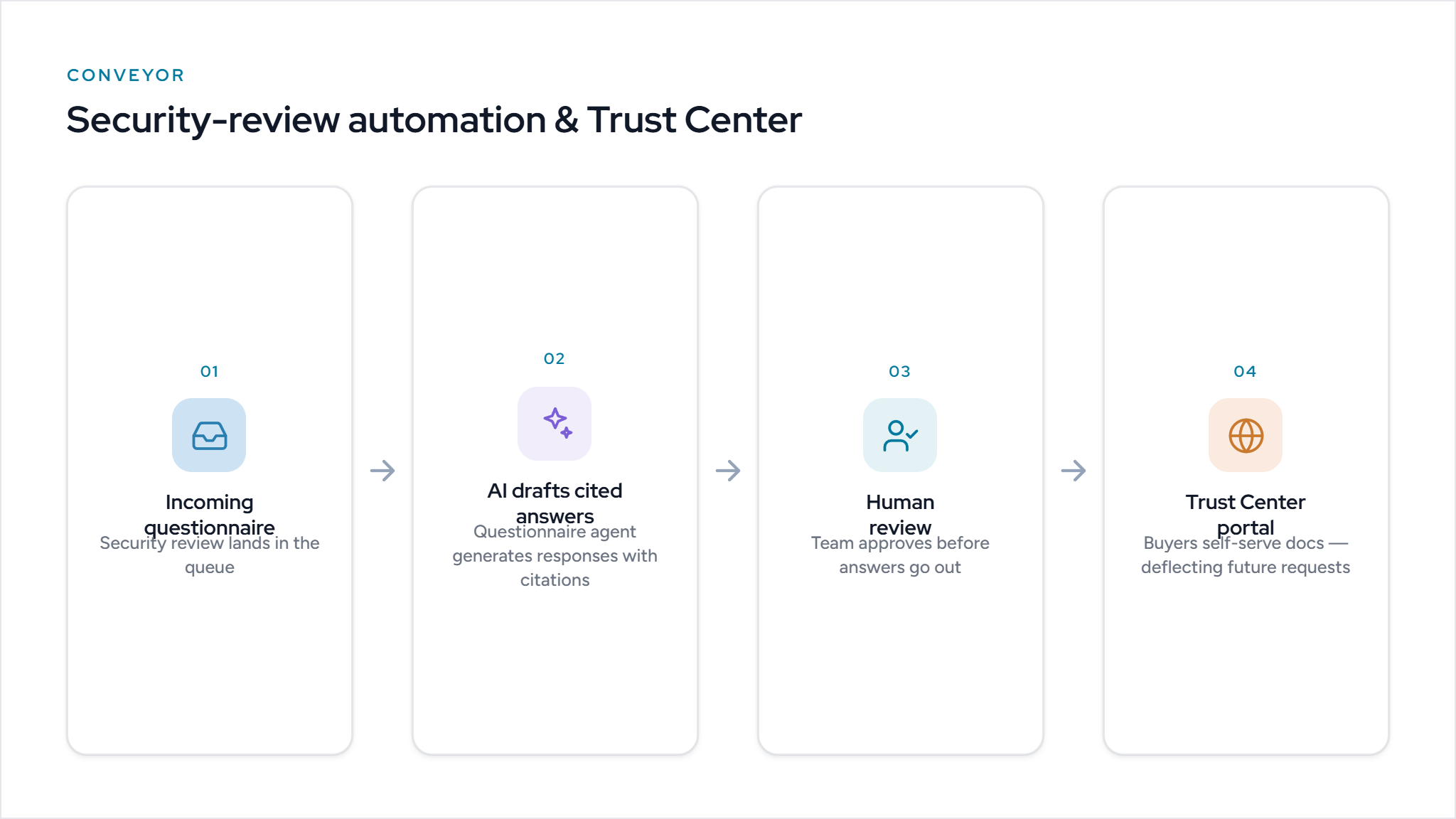
Conveyor, founded in 2021 by Chas Ballew (ex-Aptible), is an AI-native customer security review platform. It combines AI security-questionnaire automation, a self-updating knowledge library, and a customer-facing Trust Center that lets buyers self-serve security documentation. The design centers on one job: getting security reviews off your team's plate.
Conveyor best features:
• AI questionnaire agent that generates cited answers and reduces manual review time.
• Self-updating knowledge library that keeps source answers current.
• Customer-facing Trust Center for self-service access to security docs, deflecting inbound reviews.
• Reviewers commonly report 75–90% reductions in questionnaire completion time.
• Broad integration set including Salesforce, Slack, Teams, DocuSign, Jira, Zendesk and a public API.
• Responsive customer support cited across reviews.
Conveyor limitations (sourced from G2):
- AI response accuracy can vary and sometimes requires manual adjustment.
- Trust Center customization (branding and layout) is somewhat limited.
- Users want more CRM and workflow integrations than currently available.
- Credit-based pricing (Trust Center access / RFP projects) can get costly at scale, per G2 pricing data.
- Questionnaire-centric rather than RFP-centric; may fall short for complex, enterprise-scale RFPs or technical proposals.
- Google Doc URLs are not currently supported.
- Teams outgrowing its security-review focus often review Conveyor alternatives for broader response automation.
Conveyor pricing (sourced): A Free $0/year tier covers the Trust Center only — up to 120 companies/year for gated content, limited docs/Q&As, Conveyor branding, and no questionnaire automation or integrations, per Conveyor's pricing page. A Professional tier is reported to start around $9,600/year per G2 pricing data (the vendor page lists it as custom/quote), adding AI questionnaire automation, integrations and a custom Trust Center domain; for a fuller cost picture, see this breakdown of Conveyor AI's pricing, features and reviews. Third-party transaction data from Vendr estimates an average of ~$21,000/year and a maximum near ~$66,000/year. Confirm current pricing directly.
Conveyor ratings and reviews: G2 shows 4.6 across roughly 150 reviews (Conveyor's own page cites 91), per G2. Its Capterra listing displayed no aggregate rating at time of research, and no verifiable TrustRadius score was found.
Positive: "Conveyor has almost completely taken the hassle out of responding to security questionnaires." — G2 review
Mixed: "The only downside is that google doc URL's are not currently supported." — G2 review
Loopio: Overview, Features, Pricing and Reviews
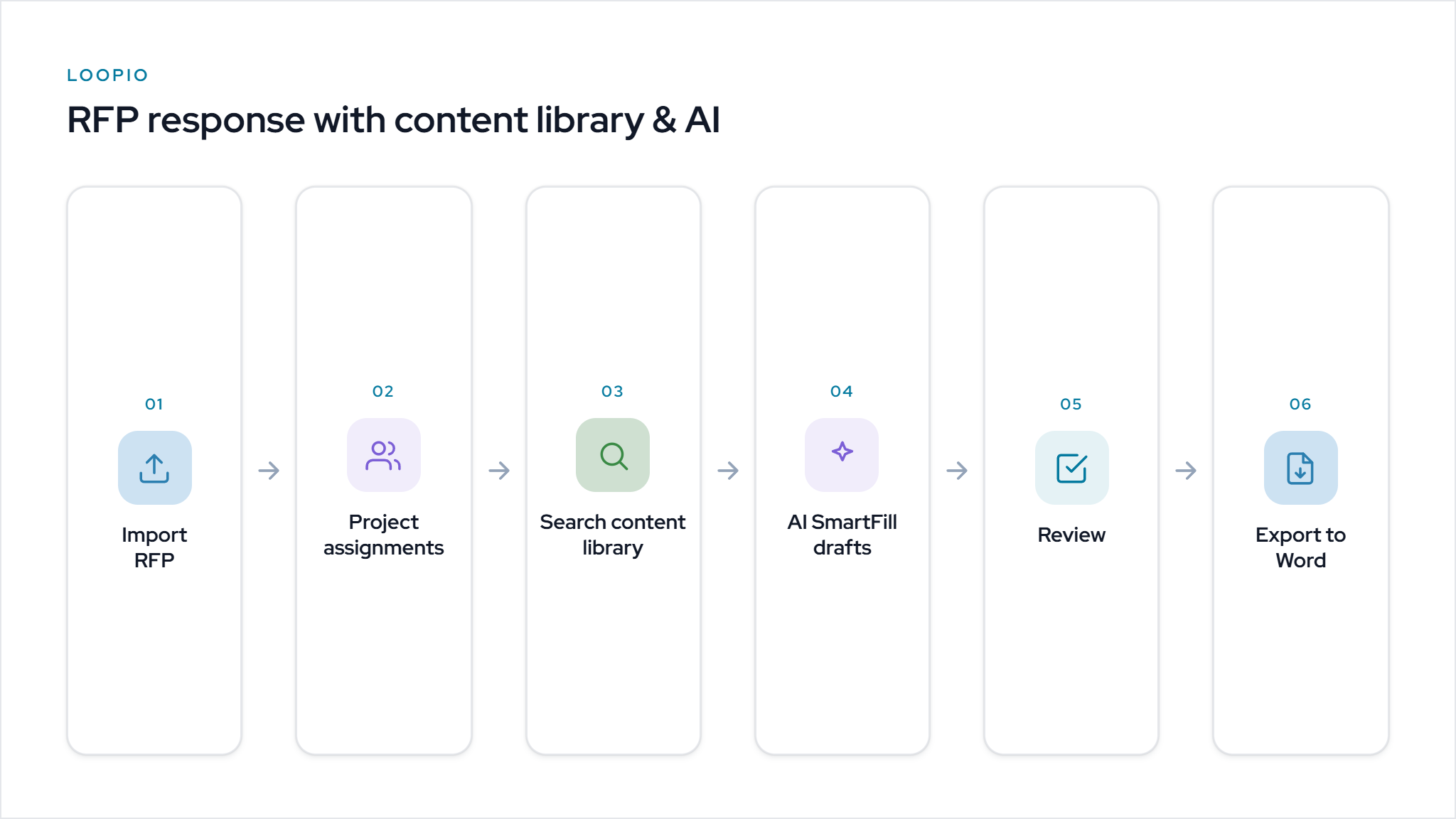
Loopio, founded in Toronto in 2014, is an established RFP and response management platform. It centers on a well-organized content library plus AI answering (SmartFill and GenAI), serving RFPs, DDQs and security questionnaires for more than 1,500 organizations. Its longer history shows in a much deeper review base and mature project workflow.
Loopio best features
• Centralized, well-organized content library (categories, tags) for reusing pre-approved answers.
• Intuitive interface and easy onboarding, cited repeatedly across reviews.
• Strong customer support and a best-in-class Project Import for getting projects to teams quickly.
• AI features reported to cut time-to-first-draft by ~70–80%.
• Microsoft Word integration to search and populate responses in-document.
• Broad reach across RFPs, DDQs and security questionnaires in one platform.
Loopio limitations (sourced from G2):
• Response quality relies heavily on a well-maintained library and declines if content isn't kept current, per SoftwareReviews.
• Learning curve and setup effort; can feel complex for new users.
• Reporting and analytics are relatively basic, per G2 reviews.
• Template and workflow customization is somewhat limited, per G2 reviews.
• The GenAI "Magic" feature gets mixed feedback and can require heavy editing, per G2 reviews.
• Custom pricing with no public list price makes budgeting harder without a quote, per Gartner.
• Teams weighing the upkeep burden often compare Loopio competitors for RFP management.
Loopio pricing (sourced): Loopio uses custom, quote-based subscriptions with no public list price, structured by users, features and org size, per Gartner. Third-party estimates from Vendr put Essentials commonly around $1,000–$1,500 per user/year, with enterprise ACV roughly $75,000–$200,000+; Forrester-cited third-party figures land near ~$54,000–$142,000/year. For a fuller view of what drives the total, see this breakdown of Loopio pricing and the "library tax". Treat all as estimates, not vendor-confirmed.
Loopio ratings and reviews: G2 shows 4.6 across roughly 810+ verified reviews, per G2. Capterra shows 4.6 (74 reviews), per Capterra, and TrustRadius reports 8.0/10 (reported; confirm on the live listing).
Positive: "Still the best User Interface out of all the tools that I've used." — G2 review
Mixed: "The GenAI feature is useful for quick, one-off questions or when I need a fast starting point, but it's less helpful when I want to further refine the language it suggests without needing to start the prompt from scratch." — G2 review
RAD AI reports 2× more accurate responses than other RFP AI tools it tested — read the benchmark case study.
AI Capabilities: How Conveyor and Loopio Compare
Answer-first: Conveyor's AI is purpose-built for security questionnaires and ships cited answers; Loopio's AI drafts from your library but its quality tracks how current that library is.
Conveyor:
• AI questionnaire agent auto-drafts answers with citations, reducing manual review.
• Reviewers cite large time savings, though accuracy can vary on edge cases.
Loopio:
• SmartFill and GenAI ("Magic") suggest and populate answers from stored content.
• Reviewers report ~70–80% faster first drafts, but GenAI gets mixed feedback on refinement.
Note (applies to both): In both tools, AI output quality depends on the underlying content, Conveyor's knowledge library and Loopio's answer library. Test whether the AI flags gaps or contradictions rather than confidently filling them, and see how a conflict-detecting, AI-agentic approach differs in a trial.
Integrations Compared
Answer-first: both cover the common CRM and collaboration stack; Conveyor adds a public API and more security-review tools, while Loopio leans into sales enablement and MS Word.
| Integration | Conveyor | Loopio |
|---|---|---|
| Salesforce | Yes | Yes |
| HubSpot | Yes | Yes |
| Microsoft Dynamics | — | Yes |
| Slack | Yes | Yes |
| Microsoft Teams | Yes | — |
| MS Word / Office | — | Yes |
| Seismic / Highspot | — | Yes |
| DocuSign, Jira, Zendesk, Front | Yes | — |
| Confluence, Google Drive | Yes | — |
| Public API | Yes | Confirm with vendor |
Note: integration lists change; confirm current connectors with each vendor.
Reviews and Reputation: Conveyor vs Loopio
Answer-first: both hold a 4.6 on G2, but the sample sizes differ sharply, Loopio's ~810+ reviews reflect a decade in market, while Conveyor's thinner, more recent base reflects a 2021 AI-native entrant. On "Conveyor vs Loopio Reddit" threads and review sites, the recurring theme is fit: Conveyor for security-review deflection, Loopio for structured RFP volume. Read recent reviews for both, since AI features change quickly.
AssetWorks Facilities reports a 422% ROI and $105K in net savings after moving off legacy RFP software — see how in the case study.
Is Conveyor Better Than Loopio?
Neither is better in the abstract — it depends on what your team responds to most. Conveyor is stronger if your bottleneck is inbound security questionnaires and you want a Trust Center to deflect them. Loopio is stronger if you run high volumes of full RFPs and proposals and need a mature content library plus multi-contributor project workflow. If you need both jobs at once, or you're tired of maintaining a library to keep AI answers accurate, that's usually when teams broaden the shortlist. See Loopio vs an AI-native platform for one such comparison.
Also Worth Considering: Inventive AI
If you're weighing Conveyor and Loopio, it's worth knowing a newer category has emerged: AI-native platforms built around autonomous agents rather than a content library that people maintain. Inventive AI is one example of this architectural shift, and it's reasonable to evaluate it alongside the two established options.
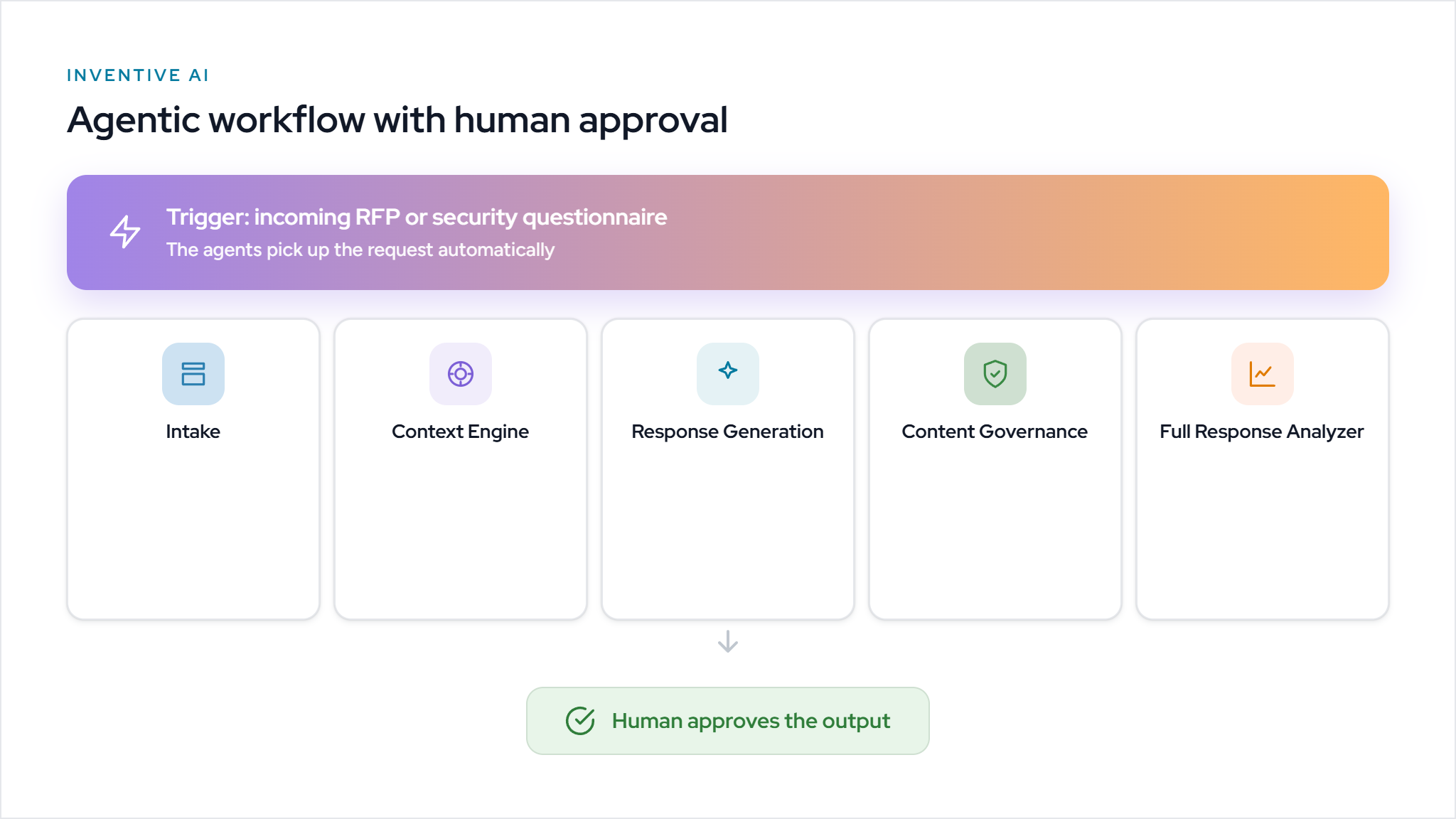
Inventive AI is an autonomous, AI-agentic platform for RFPs, RFIs, DDQs and security questionnaires, with humans in the loop for approvals. Rather than bolting AI onto a library, its agents run the workflow — understanding the request, drafting, validating and flagging gaps — and connect to systems teams already use instead of asking them to maintain a new repository. It serves sales, presales, solution engineering, InfoSec and proposal teams.
Key capabilities of Inventive AI:
• AI-generated first drafts with source references and confidence scores; MaxVal reported completing 80 questions in 3 hours — work that previously took nearly a week — in its RFP automation case study.
• Knowledge Hub that live-syncs SharePoint, Google Drive, Salesforce, Confluence, Notion, Zendesk and websites — no manual re-import.
• Content Governance Agent that detects conflicting info, flags outdated content and surfaces duplicates automatically.
• Context Engine for deal-specific personalization, pulling in customer priorities, sales notes and CRM data.
• Competitive Intelligence Agent that positions responses against named competitors.
• Format flexibility across Excel and narrative documents (PDF, Word, PPT).
• Collaborative review and approval workflows, with approved answers feeding back into the Knowledge Hub.
• Hallucination control: every response ships with citations and a confidence score, flagging "Information unavailable" instead of guessing; SOC 2 Type II compliant. On response quality, RAD AI reported 2× more client-ready answers than the next-best RFP AI tool it tested.
Best for: mid-market and enterprise teams handling a mix of RFPs, DDQs and security questionnaires who want agents to run the process end to end, with humans approving the output.
Why buyers comparing Conveyor and Loopio might look at Inventive as an alternative
The shared pain point across both tools is content upkeep: Conveyor's AI accuracy can vary and Loopio's quality tracks how current its library is. Inventive AI is positioned to address that with a Content Governance Agent that flags issues automatically and a Context Engine that tailors answers per deal — reducing the "babysit the library" burden both tools carry. Insider reports its win rate improved from 30% to 50% with 90% faster responses after adopting it; you can read the Insider case study for the specifics.
Compare the AI-native approach against your Conveyor and Loopio shortlist — book a demo.
Frequently Asked Questions
Is Conveyor better than Loopio?
It depends on your primary use case. Conveyor is built for security questionnaires and a customer-facing Trust Center; Loopio is built for full RFPs and proposals with a reusable content library. Both hold a 4.6 on G2, though Loopio has a far larger, older review base. Match the tool to the work you do most.
How much does Conveyor cost?
Conveyor offers a Free $0/year Trust Center tier, per its pricing page. A Professional tier is reported to start around $9,600/year on G2 (the vendor lists it as custom), and Vendr estimates an average near $21,000/year. Confirm current pricing with Conveyor.
How much does Loopio cost?
Loopio uses custom, quote-based pricing with no public list price, per Gartner. Third-party estimates from Vendr suggest ~$1,000–$1,500 per user/year for Essentials and enterprise deals of ~$75,000–$200,000+. Treat these as estimates and request a quote.
Which tool is better for security questionnaires versus RFPs?
Conveyor is questionnaire- and Trust-Center-centric, so it's a natural fit for inbound security reviews. Loopio spans RFPs, DDQs and security questionnaires but is strongest on structured RFP projects. If security questionnaires are your core need, also see this roundup of AI agents for security questionnaires.
Is there an AI-native alternative to Conveyor and Loopio?
Yes. A newer category of AI-agentic platforms — Inventive AI among them — runs the response process with autonomous agents instead of requiring teams to maintain a content library. These are worth evaluating alongside Conveyor and Loopio, especially if content upkeep or AI accuracy is your main concern.
Related Comparisons and Resources
For deeper research as you finalize your shortlist:
• Conveyor vs Inventive AI: a detailed comparison
• RFP software comparison guide
• Best enterprise RFP software compared
.avif)